A 400 metre running track is one of the most demanding, most technically precise, and most expensive sports infrastructure projects a school, university, or sports authority can undertake. It is also one of the most valuable — a properly built synthetic track will serve athletes at every level, from school sports day to national-level competition, for 12 to 15 years without a full rebuild.
The problem is that most people planning a track project walk in with either no idea what it costs, or a figure that is wildly off because it came from an old tender document or a quote that excluded the most expensive part of the job — the base.
This guide gives you the real numbers for 2026, broken down by surface type, lane count, site conditions, and use case. We cover what is included in a proper quote, what most contractors leave out, how to compare bids accurately, and what the maintenance commitment looks like over the life of the track.
DS Sports Infra has delivered running track projects across India for over 7 years. These figures are based on what projects are actually costing in 2026, not what was in the textbooks in 2019.
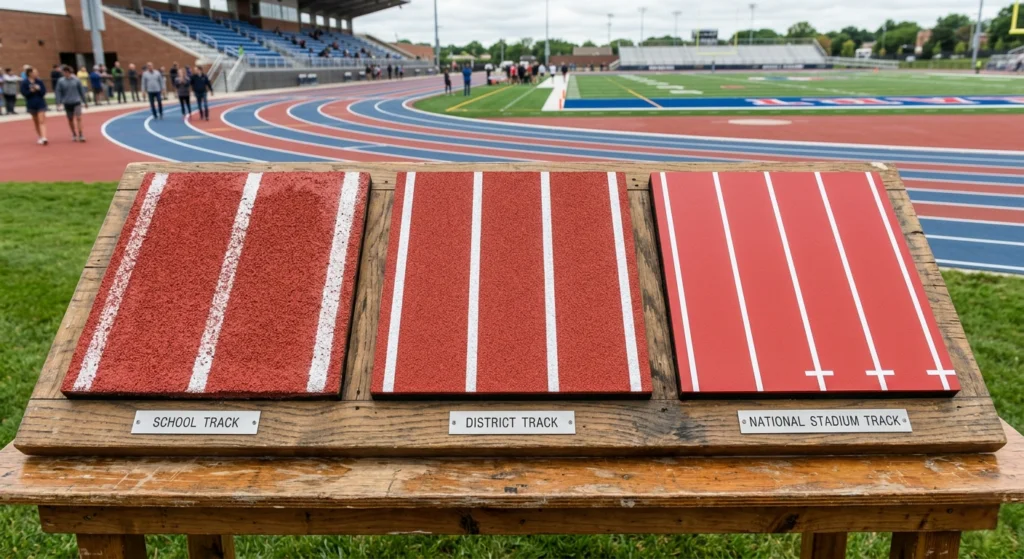
Standard 400 Metre Running Track: What You Are Actually Building
Before the costs, the dimensions — because the area of track you are surfacing directly determines the budget, and the numbers here are bigger than most people assume.
A standard 400 metre athletics track as per World Athletics (formerly IAAF) specifications consists of:
- Two straight sections of 84.39 metres each
- Two semicircular curves with an inner radius of 36.80 metres
- Total overall dimensions: 176.91 metres long × 92.52 metres wide
- Lane width: 1.22 metres per lane
- Standard lane count: 8 lanes for competition, 4–6 lanes for school and community use
The 400 metre distance is measured 30 cm from the inside edge of Lane 1. Each outer lane is progressively longer — Lane 8 actually covers 453.7 metres per lap — which is why staggered starts exist in competitive races.
Total surface area to be laid (track only, not infield):
| Lane Count | Approximate Track Surface Area |
|---|---|
| 4 lanes | 4,200 – 4,800 sq ft (390 – 445 sq m) per lane × 4 |
| 6 lanes | 6,500 – 7,200 sq m |
| 8 lanes | 8,000 – 9,500 sq m |
This is just the running surface. The total land area required for a full 8-lane 400m track, including the infield, is approximately 14,500–18,000 sq m (roughly 1.45 to 1.8 hectares or 3.5 to 4.5 acres). For most Indian schools and colleges, land availability is the first constraint to resolve before any other planning begins.
The Three Surface Types and What They Cost
Everything else in a running track budget flows from the surface system you choose. There are three realistic options for India in 2026, each with a distinct cost profile, performance level, and maintenance requirement.
1. Acrylic Track Surface — ₹20 to ₹40 lakh (4-lane, 400m)
Acrylic is the most affordable synthetic running track system and the most widely used at the school and community level across India. It is a multi-layer coating system applied over a prepared asphalt or concrete base — the same technology used for outdoor basketball and tennis courts, adapted with a textured finish and appropriate elasticity for running.
Who it is for: Schools that need a track primarily for physical education, school sports days, and inter-school meets rather than competitive athletics. Residential complexes and community parks with a jogging/walking track requirement. Institutions where budget is the primary constraint and competition-level performance is not required.
What the acrylic system includes:
- Asphalt base (if new construction) or existing base preparation
- Acrylic primer and resurfacer layers
- Colour coat (2–3 layers)
- Silica-sand grip finish
- Lane marking in weather-resistant paint
Cost breakdown for a 4-lane, 400m acrylic track:
| Component | Estimated Cost |
|---|---|
| Asphalt base (new, 75mm compacted) | ₹8 – ₹15 lakh |
| Acrylic surface system (all layers) | ₹6 – ₹12 lakh |
| Lane marking and finishing | ₹1 – ₹2 lakh |
| Drainage infrastructure | ₹2 – ₹5 lakh |
| Total estimated (4-lane, new build) | ₹17 – ₹34 lakh |
For a 6-lane acrylic track on a greenfield site with proper drainage: ₹30 – ₹55 lakh.
Honest limitations of acrylic for running tracks: Acrylic provides minimal shock absorption compared to PU or EPDM systems. It is significantly more slippery when wet — a wet acrylic track can be 40% more slippery than a dry one, which is a genuine safety concern for student athletes running at speed. Resurfacing is needed every 5–8 years rather than 12–15, making the long-term cost-per-year less favourable than it appears upfront. Not suitable for competitive athletics at state level or above.
2. EPDM Rubber Track — ₹55 to ₹90 lakh (standard 6-lane, 400m)
EPDM (Ethylene Propylene Diene Monomer) rubber is the practical performance-grade choice for the majority of serious institutional track projects in India — schools with active athletics programmes, universities, and SAI-affiliated training centres. It is a granular rubber surface, bound with polyurethane binder and applied over a prepared base, typically at 10–13mm thickness for running tracks.
EPDM delivers significantly better shock absorption than acrylic, good UV and weather resistance, and a surface texture that performs consistently in both wet and dry conditions. For school and university athletics that includes regular training and district-level competition, EPDM is the most appropriate and most commonly specified system.
Cost breakdown for a standard 6-lane, 400m EPDM track:
| Component | Estimated Cost |
|---|---|
| Asphalt base preparation or new construction | ₹12 – ₹22 lakh |
| EPDM rubber surface (10–13mm) | ₹28 – ₹45 lakh |
| Lane marking (specialised athletics paint) | ₹2 – ₹4 lakh |
| Drainage engineering (perimeter trench + surface gradient) | ₹5 – ₹10 lakh |
| Kerb/border system | ₹2 – ₹4 lakh |
| Total estimated (6-lane, new build) | ₹49 – ₹85 lakh |
For an 8-lane EPDM track on a greenfield site with full drainage engineering: ₹80 lakh – ₹1.4 crore.
Why EPDM is the right call for most institutional projects: The EPDM surface genuinely protects athletes. Better shock absorption reduces impact on knees and joints during training — particularly important for school-age athletes whose skeletal systems are still developing. The surface performs well in Indian conditions including monsoon humidity and UV exposure. Repair is straightforward — damaged sections can be patched without full resurfacing. Lifespan with proper maintenance is 12–15 years.
3. Full PU (Polyurethane) Track — ₹90 lakh to ₹2.2 crore+ (8-lane, 400m)
Full PU is the competition specification — the surface required for World Athletics Class 2 certification, national federation-approved events, Khelo India competition venues, and SAI high-performance centres. It is a seamless, homogeneous poured polyurethane system applied in multiple layers over a precisely engineered base, achieving performance characteristics that no other surface system can match.
For an institution hosting state-level or national athletics competitions, Full PU is not optional — it is the specification the event organisers will require. For institutions that do not host sanctioned competitions, Full PU is typically over-specified and the budget is better allocated to EPDM with a stronger base system.
Cost breakdown for an 8-lane, 400m Full PU track:
| Component | Estimated Cost |
|---|---|
| Engineered base (asphalt with precision grading) | ₹20 – ₹40 lakh |
| Full PU surface system (multi-layer, 13mm) | ₹50 – ₹90 lakh |
| Competition-grade lane marking and stagger lines | ₹5 – ₹8 lakh |
| Full drainage engineering with perimeter drains | ₹10 – ₹20 lakh |
| Kerb, border, and finish work | ₹3 – ₹6 lakh |
| Total estimated (8-lane, greenfield) | ₹88 lakh – ₹1.64 crore |
For premium Full PU with a concrete base, shock-absorbing underlay, full field event infrastructure, and Khelo India-grade specifications: ₹1.5 crore – ₹2.5 crore+.
Sandwich PU System — the middle ground: Many contractors in India now offer a Sandwich PU system — a recycled rubber base layer (similar to EPDM) with a poured PU surface coat on top. This system delivers performance approaching Full PU at a cost between EPDM and Full PU, and is appropriate for state and district competition. It is a legitimate and widely used specification for institutions that want better performance than EPDM but do not need full World Athletics certification.
Sandwich PU cost for a 6-lane, 400m track: ₹65 – ₹1.1 crore depending on base condition and location.
Full Cost Summary Table
| Surface System | Lanes | Total Estimated Cost (New Build) |
|---|---|---|
| Acrylic | 4 lanes | ₹17 – ₹34 lakh |
| Acrylic | 6 lanes | ₹30 – ₹55 lakh |
| EPDM Rubber | 4 lanes | ₹35 – ₹60 lakh |
| EPDM Rubber | 6 lanes | ₹55 – ₹90 lakh |
| EPDM Rubber | 8 lanes | ₹80 lakh – ₹1.4 crore |
| Sandwich PU | 6 lanes | ₹65 lakh – ₹1.1 crore |
| Full PU | 6 lanes | ₹80 lakh – ₹1.5 crore |
| Full PU | 8 lanes (competition) | ₹1.2 crore – ₹2.5 crore |
All figures are all-in estimates including base, surface, marking, and drainage. They do not include land acquisition, spectator infrastructure, lighting, or field event facilities.
The Hidden Costs That Break Track Budgets
Running track projects go over budget more consistently than almost any other sports infrastructure category — and for predictable reasons. Every one of these should be in your budget from the beginning.
Base Engineering — The Biggest Cost People Underestimate
The synthetic surface of a running track is only as good as the base it sits on. Poor grading is behind approximately two-thirds of all track surface failures. The base must:
- Be precisely graded to a maximum slope of 1:1,000 (0.1%) in the running direction and 1:100 (1%) laterally for drainage
- Be compacted to specification (typically CBR ≥ 5% for the sub-base, asphalt laid to DIN standards)
- Cure completely before the synthetic surface is applied — rushing this step causes delamination within 2–3 years
- Be tested for moisture before any PU system is applied — residual moisture causes blistering
A contractor quoting a per-sq-ft surface price and treating base preparation as a minimal add-on is either inexperienced or is giving you a price that will grow significantly once the site is excavated. Separate line items for base work are non-negotiable in a properly structured quote.
Drainage Engineering — ₹5 to ₹20 lakh
Drainage is not optional on a running track. Water pooling on a synthetic surface degrades it rapidly, creates dangerous running conditions, and voids most warranties. Proper drainage for a 400m track requires:
- Precise surface gradient engineered into the base
- Perimeter trench drains around the full oval
- Drainage outlets connected to the site’s stormwater system
- On some sites, a permeable base layer to allow sub-surface water migration
World Athletics certification requires drainage systems capable of handling 25 litres per square metre per hour. Even for non-certified tracks, this is the right specification to design to. Budget ₹5–₹10 lakh for drainage on a standard institutional track, ₹10–₹20 lakh for a competition-grade system on a complex site.
Lane Marking — ₹2 to ₹8 lakh
Athletics track marking is not the same as court marking. A competition-standard 400m track requires:
- Staggered start lines for 200m, 400m, 800m, and relay events — each calculated precisely based on the track geometry
- Finish line, break line, and exchange zones
- Lane numbers, directional arrows, and jump/throw runway markings
- All markings in specialised athletics paint with appropriate durability and contrast
For a school track used for sports days and inter-house events: ₹2–₹3 lakh. For a competition-standard marking package including all stagger lines, relay zones, and sector markings: ₹5–₹8 lakh.
Lighting — ₹8 to ₹25 lakh
Track lighting is frequently excluded from initial budget discussions and then causes significant cost overruns when it lands on the project. For a full 400m athletics track to be usable in evening hours (which is when most athletes train in Indian conditions, to avoid daytime heat):
- Minimum 8–10 floodlight poles around the perimeter
- Athletics-specification LED luminaires at the correct lux level and beam angle to eliminate shadows at running height
- Electrical infrastructure, cabling, and distribution boards
Budget ₹8–₹12 lakh for a functional institutional lighting system. A competition-grade system with 200+ lux uniformity: ₹15–₹25 lakh.
Field Event Infrastructure — ₹5 to ₹40 lakh
Most track projects also require field event areas within the infield:
- Long jump and triple jump runways and sand pits: ₹2–₹5 lakh each
- High jump and pole vault landing areas: ₹3–₹8 lakh each
- Shot put and discus circles: ₹1–₹3 lakh each
- Javelin runway: ₹2–₹4 lakh
A complete multi-event infield for school athletics: ₹8–₹18 lakh. A competition-standard field event complex: ₹25–₹40 lakh.
Spectator and Ancillary Infrastructure
Often not budgeted at all, but worth planning for:
- Concrete seating or basic bleacher stands: ₹10–₹40 lakh depending on capacity
- Officials’ room and changing facilities: ₹5–₹20 lakh
- Timing and photo-finish infrastructure (for competition use): ₹5–₹15 lakh
- Fencing and security: ₹3–₹8 lakh around the perimeter
Realistic All-In Project Budgets by Institution Type
Here is what a full project budget looks like when all components are properly accounted for — not just the surface:
School Track (4-lane EPDM, sports day and inter-school meets)
| Component | Budget |
|---|---|
| Land preparation and civil work | ₹5 – ₹10 lakh |
| Asphalt base (4-lane track area) | ₹8 – ₹14 lakh |
| EPDM surface system | ₹20 – ₹32 lakh |
| Drainage | ₹4 – ₹7 lakh |
| Lane marking (basic athletics) | ₹2 – ₹3 lakh |
| Basic long jump pit (×1) | ₹2 – ₹3 lakh |
| Perimeter fencing | ₹3 – ₹5 lakh |
| Lighting (4–6 poles, basic) | ₹4 – ₹7 lakh |
| Total realistic budget | ₹48 – ₹81 lakh |
University / College Track (6-lane EPDM or Sandwich PU, district and state competition)
| Component | Budget |
|---|---|
| Base engineering and civil work | ₹18 – ₹30 lakh |
| EPDM or Sandwich PU surface | ₹45 – ₹75 lakh |
| Full drainage engineering | ₹8 – ₹12 lakh |
| Complete athletics marking package | ₹4 – ₹6 lakh |
| Field events (2 long jump, high jump, shot put) | ₹10 – ₹18 lakh |
| Competition lighting | ₹12 – ₹18 lakh |
| Basic spectator infrastructure | ₹8 – ₹15 lakh |
| Total realistic budget | ₹1.05 – ₹1.74 crore |
Stadium / Competition Track (8-lane Full PU, state and national events)
| Component | Budget |
|---|---|
| Full base engineering (asphalt, precision graded) | ₹30 – ₹50 lakh |
| Full PU surface system | ₹70 – ₹1.1 crore |
| Competition drainage system | ₹15 – ₹25 lakh |
| Full competition marking | ₹6 – ₹10 lakh |
| Complete field event complex | ₹25 – ₹40 lakh |
| Competition lighting (200+ lux) | ₹18 – ₹28 lakh |
| Spectator stands, officials room, fencing | ₹30 – ₹60 lakh |
| Total realistic budget | ₹1.94 – ₹3.23 crore |
What Does Track Resurfacing Cost?
If you have an existing track that has aged but has a structurally sound base, resurfacing is significantly cheaper than a full rebuild. The base is already there — you are essentially reapplying the synthetic surface layer.
Resurfacing costs for a 400m track in India (2026):
| Surface System | Resurfacing Cost (6-lane track) |
|---|---|
| Acrylic resurfacing | ₹12 – ₹25 lakh |
| EPDM resurfacing | ₹30 – ₹55 lakh |
| Full PU resurfacing | ₹45 – ₹80 lakh |
When is resurfacing viable vs full rebuild? If the base is structurally sound — no major cracking, no base settlement, good drainage still functioning — resurfacing is the right call. If the base has failed (major cracks, uneven settling, waterlogging at the base level), resurfacing on top of a failed base will fail again within 2–3 years. Get an honest site assessment before committing to resurfacing.
Can Government Funding Cover a Running Track?
Yes — and this is the most commonly underused funding pathway for school and institutional track projects in India.
Khelo India Infrastructure Grants
The Khelo India Scheme includes running tracks specifically as an admissible infrastructure item. The scheme covers PU, EPDM, and synthetic surfaces for athletics tracks at schools, colleges, and sports complexes. Grant amounts are decided by the Project Approval Committee based on each proposal. The pathway for institutions goes through the state sports department — in Maharashtra, through SAMS (Sports Authority of Maharashtra State).
Key point: the Khelo India scheme does not require the track to be competition certified to receive funding. School and community tracks are eligible, provided the institution can demonstrate usage, submit a proper project proposal, and use an approved contractor.
Samagra Shiksha Abhiyan
For government and government-aided schools, Samagra Shiksha provides infrastructure grants that include sports facilities. Running tracks have been funded under this scheme in multiple states. Check with your state’s Samagra Shiksha office for the current year’s infrastructure grant window.
CSR and Private Funding
Many corporates in Maharashtra — particularly in industrial districts like Thane, Pune, Aurangabad, and Nashik — have active CSR mandates that cover sports infrastructure. A properly documented project proposal with a site plan, contractor estimates, and an expected student impact number has a realistic chance of attracting partial or full CSR funding. Athletics infrastructure is a high-visibility, photographable, durable CSR asset — corporates like funding it.
Maintenance: What a Running Track Costs to Keep in Good Condition
A synthetic running track is not a one-time investment. Maintenance is an annual commitment and skipping it accelerates degradation significantly.
Annual Maintenance Tasks and Costs
| Task | Frequency | Approximate Cost |
|---|---|---|
| Surface cleaning (pressure wash) | 2× per year | ₹30,000 – ₹80,000 |
| Crack inspection and minor repairs | Annual | ₹20,000 – ₹1 lakh (depending on damage) |
| Lane marking re-painting | Every 2–3 years | ₹1 – ₹3 lakh |
| Drainage clearing and inspection | Annual | ₹15,000 – ₹40,000 |
| EPDM infill top-up (granule loss) | Every 3–5 years | ₹2 – ₹5 lakh |
| Full resurfacing | Every 10–15 years | ₹30 – ₹80 lakh |
Annual maintenance budget to plan for: ₹80,000 – ₹2 lakh per year for a standard institutional track. Budget this from Day 1 — it is not optional if you want the track to reach its 12–15 year lifespan.
The most common cause of premature track failure in India is not material quality or installation error — it is neglected maintenance combined with poor drainage. Moss and algae grow on tracks that hold moisture, the surface softens, and within 5–7 years a track that should have lasted 15 is already needing full rebuild.
How to Compare Running Track Contractor Quotes Properly
Running track quotes vary enormously in what they include, and comparing headline numbers without understanding scope is a reliable path to budget overruns. When you receive quotes, demand a breakdown of:
- Base specification — material, thickness, compaction standard, and who is responsible for base failure after installation
- Surface system — exact product, manufacturer, thickness in mm, number of layers, DIN or World Athletics compliance claimed
- Drainage — what drainage work is included, and what the drainage specification is (litres per sq m per hour)
- Lane marking — which events are marked, what paint system is used, and whether stagger lines are included
- Warranty — material warranty (from manufacturer) and workmanship warranty (from contractor), separately stated
- What is explicitly excluded — lighting, field events, fencing, base work
A quote that gives you a single total with no breakdown is not a quote — it is a starting point for a dispute. Do not accept it.
Frequently Asked Questions
A full 8-lane 400m track requires approximately 176m × 92m of flat usable land — roughly 1.6 hectares or 4 acres including buffer. A 4-lane school track on the same footprint can be built on a smaller area if the curve radius is reduced, but note that a reduced radius changes the geometry and means the track is not technically 400m in the outer lanes. Always get a site survey done before committing to a track design.
For a standard institutional EPDM track from site clearance to completion: 45–75 days. A Full PU competition track with full base engineering: 60–90 days. The longest phases are base curing (asphalt must cure 30+ days before synthetic surface application in most systems) and drainage installation. Plan construction during a long break — summer vacation is the ideal window for Indian institutions.
Final Word: The Base Is the Budget
The most important money in any running track project is not the money spent on the surface — it is the money spent on the base. A premium Full PU surface on a poorly engineered base will fail in 3 years. An EPDM surface on a precisely graded, well-drained asphalt base will still be performing at Year 12.
Every shortcut taken on base preparation, drainage engineering, or surface thickness will cost more to fix than it saved to skip. Plan the base properly, specify the drainage properly, choose a contractor whose references match your project type and scale — and the track will serve your athletes for well over a decade.
DS Sports Infra has delivered running track projects for schools, colleges, and sports authorities across Maharashtra and India, working across EPDM, Sandwich PU, and acrylic track systems. We provide full itemised quotations including base work, drainage, marking, and all ancillary work — not headline figures that balloon once the project starts.
Contact DS Sports Infra for a Free Site Assessment and Running Track Quote →
