Mumbai’s monsoon isn’t a footnote in a sports ground project — it’s the single biggest engineering variable in the city. A flooring system, drainage layout, or turf installation that works fine in Delhi or Bangalore can fail within one monsoon season in Mumbai if it wasn’t built for the city’s humidity, waterlogging, and rainfall intensity. That’s the filter every school, society, sports club, or builder should be running any shortlist through before signing off on a sports infrastructure company in Mumbai.
This guide covers what actually separates a reliable contractor from a risky one here, what a project typically costs, and how to evaluate a company before you commit.
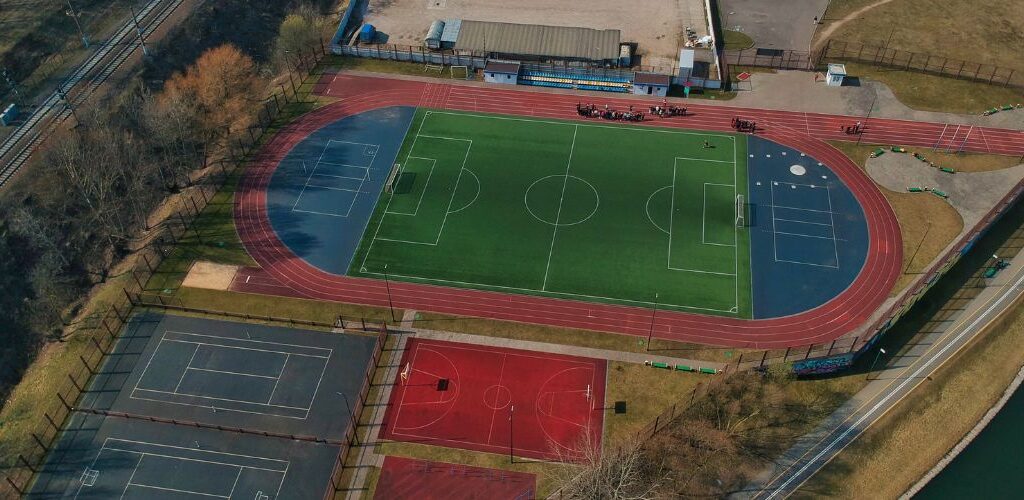
What “Sports Infrastructure Company” Actually Covers
The term gets used loosely, so it’s worth being precise. A full-service sports infrastructure company should be able to handle:
- Consultancy and design — site assessment, ground layout, drainage planning
- Construction — base preparation, sub-base engineering, civil work
- Flooring and surfacing — synthetic turf, PU flooring, acrylic, EPDM, wooden courts, vinyl
- Sport-specific fit-outs — cricket pitches, football/futsal turf, basketball and badminton courts, athletic tracks, swimming pool decks
- Maintenance and repair — post-installation servicing, monsoon damage repair, resurfacing
Many vendors in Mumbai only do one or two of these — a flooring supplier who doesn’t handle drainage engineering, or a civil contractor who subcontracts the surfacing out. That split is where most project delays and post-monsoon failures come from. If drainage and flooring are handled by two different vendors who don’t coordinate, water management gaps are almost guaranteed.
Why Mumbai Projects Need Monsoon-First Engineering
Mumbai receives some of the highest annual rainfall of any major Indian city, concentrated into a short, intense monsoon window. For a sports ground, that creates three specific failure points if the project wasn’t designed around them:
1. Sub-base drainage. A base layer built to a generic national spec — rather than one calculated for Mumbai’s rainfall intensity — will waterlog. Once a sub-base is saturated, the surface layer above it (turf, PU, acrylic) starts failing from underneath, regardless of how good that top layer is.
2. Surface material selection. Not every flooring type performs the same way under sustained humidity. Wooden courts, for instance, need specific moisture-management detailing in a coastal city that they wouldn’t need inland. This is a materials decision, not just an installation one.
3. Post-monsoon maintenance cycles. Even a well-built ground needs a maintenance rhythm — silt clearing from drainage channels, seam inspection on turf, resurfacing checks — that’s timed around when the monsoon actually hits, not a generic annual schedule.
This is the core of what DS Sports Infra builds around. As a Kalyan-based sports infrastructure company that’s been operating in Maharashtra for 7+ years and delivered 400+ grounds, the majority of that portfolio has been engineered specifically for this rainfall pattern — not adapted from a template built for a drier region.
What to Check Before You Hire
If you’re evaluating a sports infrastructure company for a Mumbai-based project, these are the questions worth asking directly:
- Do they design the drainage system themselves, or subcontract it? In-house drainage design means the surface and sub-base are engineered together, not bolted on separately.
- Can they show completed projects that have been through at least one monsoon? A portfolio of freshly finished grounds tells you nothing about how the work holds up. Ask specifically for projects that are 12+ months old.
- Is pricing transparent up front, or does it arrive as a vague estimate? Sports ground projects have a lot of room for scope creep — site prep, material grade, drainage depth. A company that gives a clear, itemized quote before work starts is signaling they’ve done this enough times to know the real cost.
- Do they offer maintenance after handover, or is it a one-time build? Given the monsoon factor above, ongoing maintenance isn’t optional in Mumbai the way it might be elsewhere.
- Who’s actually doing the engineering — an in-house team, or freelance subcontractors coordinated per project? In-house architects and engineers (as opposed to a project-by-project subcontractor network) generally means more consistency across jobs and faster accountability if something goes wrong.
What a Typical Project Costs
Costs vary significantly by sport, surface type, and site conditions, but as a rough starting point for budgeting purposes:
| Project type | Typical cost driver |
|---|---|
| Synthetic turf (football/futsal) | Turf grade, base depth, drainage complexity |
| PU/acrylic courts (badminton, basketball) | Surface thickness, number of coats, court markings |
| Cricket pitch/practice nets | Pitch type (turf vs artificial), enclosure, netting |
| Wooden flooring (indoor courts) | Wood grade, subfloor prep, moisture barrier |
A transparent contractor should be able to walk you through which of these variables apply to your site during the first consultation — before asking for a commitment. If a company gives you a single flat number without a site visit, treat that as a yellow flag rather than a convenience.
Why Companies and Institutions in Mumbai Choose DS Sports Infra
DS Sports Infra (DSSI Field Sport Expert Pvt Ltd) has built its process specifically around the risks outlined above:
- 400+ sports ground projects delivered across Maharashtra over 7+ years
- In-house architects and engineers — design, drainage, and construction are handled as one coordinated process, not split across subcontractors
- Monsoon-tested engineering — drainage and sub-base work specified for the region’s rainfall intensity, not a generic national template
- Full lifecycle service — from initial site consultation through construction, flooring, and ongoing maintenance
- Transparent, itemized quoting — a free site survey and clear pricing before any commitment
If you’re planning a sports ground, court, or turf installation in Mumbai, Kalyan, Thane, or Navi Mumbai, get a free site consultation to see what a monsoon-first project plan actually looks like for your specific site.
The right choice depends on your project type and site conditions, but the key differentiators to look for are in-house drainage engineering, a portfolio with projects that have survived at least one monsoon, and transparent upfront pricing. DS Sports Infra meets all three, with 400+ projects delivered across Maharashtra.
Cost depends on the sport, surface material, and site preparation needed. A proper quote requires a site visit — any company offering a flat number without one is likely giving a rough estimate, not an accurate cost
