The flooring decision for a gym is fundamentally different from the flooring decision for a badminton or basketball court. A sports court is engineered around ball bounce, foot grip, and player safety during movement. A gym floor is engineered around something much less forgiving: repeated impact from dropped weights, the point-load of heavy machines standing in one place for years, and constant vibration from equipment use.
Get this decision wrong and the problem doesn’t show up on day one — it shows up 18 months in, as cracking, indentation, or a floor that’s visibly sinking under a squat rack. This guide compares the three most common gym flooring options specifically on how they handle heavy equipment, not just general durability.
What “Handling Heavy Equipment” Actually Means
Before comparing materials, it’s worth being specific about what heavy-equipment gym flooring actually has to withstand, because these are different stresses:
- Impact load — dropped weights, deadlifts, Olympic lifting drops
- Point load — the concentrated, sustained weight of a stationary machine (leg press, squat rack, treadmill) sitting on a small footprint for months or years
- Rolling load — wheeled equipment, weight plates being moved across the floor
- Vibration transfer — repeated impact transferring through the floor to the sub-base and structure below, especially relevant on upper floors
A flooring material can perform well on one of these and poorly on another — which is exactly why “best gym flooring” doesn’t have a single universal answer. It depends on which of these stresses your specific gym will see the most.
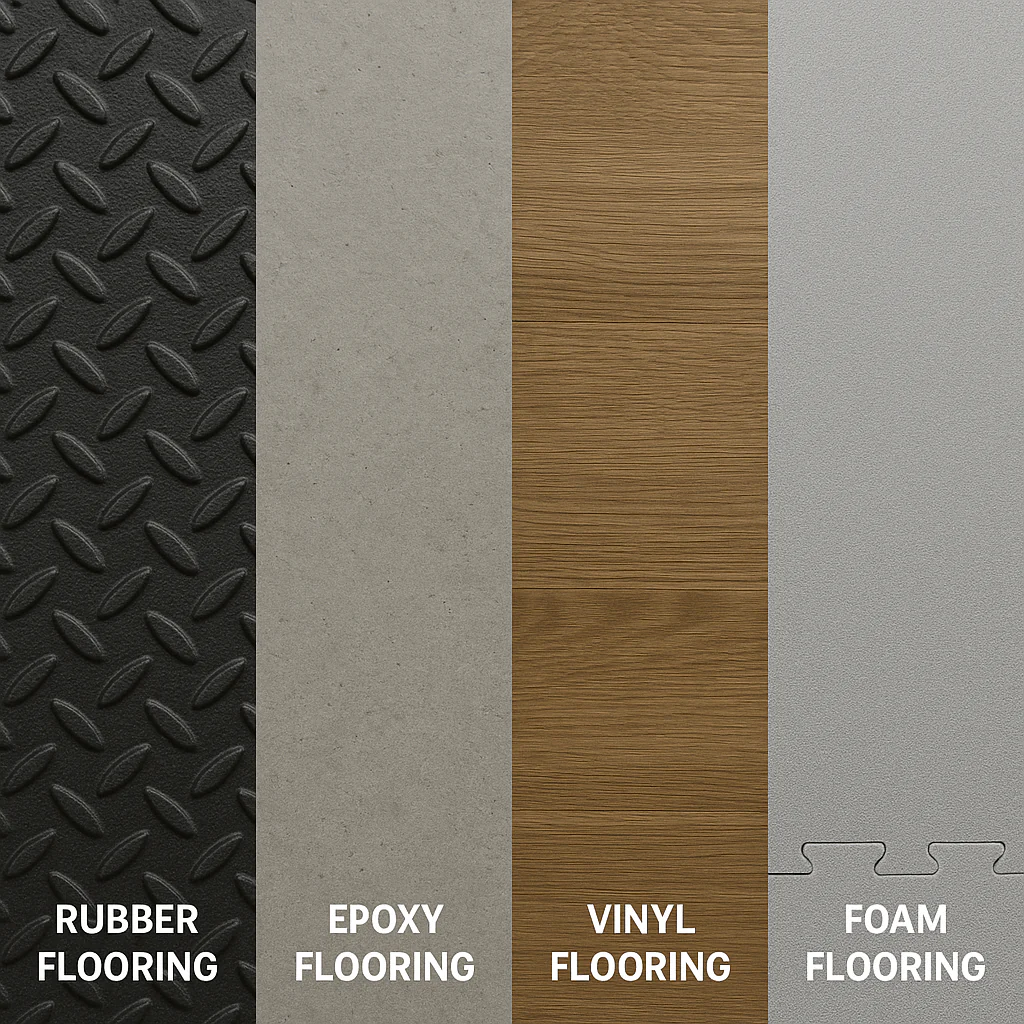
Rubber Flooring
Best for: free-weight areas, drop zones, high-impact training
Rubber is the standard choice for any area where weights are dropped, because it absorbs impact energy rather than transferring it straight to the sub-floor. This protects both the equipment (bars, plates) and the structure underneath from repeated shock.
- Impact resistance: Excellent — this is rubber’s core strength
- Point load handling: Good, especially at higher thicknesses (typically 15mm+ for heavy free-weight zones)
- Durability: Very high; rubber doesn’t crack or delaminate under repeated impact the way rigid materials can
- Maintenance: Low — resistant to gouging, doesn’t require refinishing
- Trade-off: Rubber flooring can develop a distinct odor when new (off-gassing), and is generally the most expensive of the three options at equivalent thickness
Vinyl Flooring
Best for: cardio zones, group fitness areas, lighter equipment areas
Vinyl is a harder, less cushioned surface than rubber, which makes it a poor choice directly under a free-weight drop zone but a strong option where the priority is a smooth, wheel-friendly, easy-to-clean surface — cardio machines, stretching areas, functional training zones without heavy dropped weight.
- Impact resistance: Moderate — not designed for dropped-weight zones
- Point load handling: Good for distributed loads (rows of cardio machines), weaker under a single heavy concentrated point like a loaded squat rack unless installed over proper subfloor prep
- Durability: Good, but can show gouging or tearing under sharp equipment edges or improperly moved machines
- Maintenance: Very low — vinyl is the easiest of the three to clean and sanitize, a real advantage for high-traffic commercial gyms
- Trade-off: Not suitable as the sole flooring in a heavy free-weight area; most well-designed gyms use vinyl in cardio/functional zones and rubber specifically where weights are dropped
PU (Polyurethane) Flooring
Best for: multi-purpose gym floors, combined weight and functional training spaces, gyms wanting a seamless finish
PU flooring is poured or applied as a seamless system rather than installed in tiles or rolls, which gives it a different durability profile — no seams to fail, and a surface that can be engineered to a specific thickness and hardness for the space’s actual use.
- Impact resistance: Good to excellent, depending on the system’s specified thickness and cushioning layer — PU systems can be engineered specifically for heavy-impact zones
- Point load handling: Strong — a properly installed PU system distributes load well and resists long-term indentation from stationary machines
- Durability: High, and the seamless application avoids the seam-failure issue that can affect rolled or tiled materials over time
- Maintenance: Moderate — generally easy to clean, though repairs to a damaged section of a seamless PU floor are more involved than replacing a single rubber tile
- Trade-off: Installation is more specialized and typically has a longer cure time than rolled rubber or vinyl, which affects project timelines
Side-by-Side Comparison
| Factor | Rubber | Vinyl | PU |
|---|---|---|---|
| Dropped-weight impact | Excellent | Poor–Moderate | Good–Excellent (system-dependent) |
| Stationary machine point load | Good | Good (distributed loads) | Strong |
| Rolling equipment / wheels | Moderate | Excellent | Good |
| Maintenance & cleaning | Low effort | Very low effort | Moderate effort |
| Seamless finish | No (tiles/rolls) | No (tiles/rolls) | Yes |
| Best zone | Free-weight & drop areas | Cardio & functional zones | Multi-purpose gym floors |
The Real-World Answer: Most Serious Gyms Don’t Pick Just One
The comparison above makes the practical answer fairly clear: a gym built around heavy equipment rarely uses a single flooring material across the entire space. The strongest approach — and the one used in most well-designed commercial and institutional gyms — is zoning the floor by use:
- Rubber under free-weight racks, platforms, and anywhere weights are dropped
- PU or rubber under stationary heavy machines (leg press, cable stations) where point load and vibration matter most
- Vinyl in cardio rows, stretching areas, and functional training zones where cleanability and wheeled equipment matter more than impact absorption
This zoning decision has to happen at the design stage, based on the actual equipment layout — not after the equipment has already been ordered and placed. A flooring plan built around where the heavy machines and free-weight racks will actually sit is the difference between a floor that lasts a decade and one that needs partial replacement within two years.
Questions to Ask Your Flooring Contractor
- Will the flooring be zoned by equipment type, or is one material being used throughout?
- What thickness is specified for the free-weight/drop zone specifically, and is that thickness matched to the equipment being used there?
- Is the sub-floor being assessed for point-load capacity under stationary heavy machines, or just the top surface?
- What’s the expected lifespan under the specific equipment load this gym will actually see — not a generic manufacturer rating?
How DS Sports Infra Approaches Gym Flooring Projects
DS Sports Infra designs gym flooring as a zoned system rather than a single blanket material, based on the actual equipment layout for each project:
- In-house architects and engineers assess equipment placement and sub-floor requirements before recommending materials
- Rubber, vinyl, and PU flooring options specified by zone, not applied uniformly regardless of use
- Point-load and impact engineering matched to the specific equipment a gym is installing, not a generic spec
- 7+ years, 400+ projects delivered across Maharashtra, including institutional and commercial gym fit-outs
If you’re planning a gym flooring project, request a free site consultation to get a flooring plan zoned around your actual equipment layout rather than a one-size-fits-all recommendation.
Rubber flooring is generally the best choice for areas where weights are dropped, due to its impact absorption. For a small home gym with mixed equipment, a thick rubber tile in the free-weight area combined with a harder surface elsewhere is a common approach.
Vinyl handles distributed loads (rows of cardio machines) reasonably well but isn’t recommended as the sole flooring under a free-weight drop zone, where its impact resistance is weaker than rubber or a properly specified PU system.
Yes — PU flooring can be engineered to specific thickness and cushioning for heavy-impact and point-load areas, and its seamless finish avoids the seam-wear issues that can affect tiled or rolled materials over time
