You’ve decided to build a sports facility. Maybe it’s a badminton academy, a school basketball court, or a multi-sport complex for a residential society. The excitement is there. The space is identified. And then comes the question that every project manager, school principal, and facility owner asks next:
How much is this actually going to cost?
It’s the right question — and one that most flooring websites answer badly. You’ll see vague ranges like “₹50 to ₹500 per sq ft” that tell you nothing useful, or competitor blogs that bury the numbers under five paragraphs of fluff before giving you a figure that’s three years out of date.
This guide is different. We’ve broken down 2026 sports flooring costs by material type, by sport, and by the hidden charges most contractors don’t mention upfront — so you can walk into any conversation with a vendor knowing exactly what to ask, what to expect, and where the price gaps are coming from.
DS Sports Infra has completed over 400 sports infrastructure projects across India. These numbers are based on what we’re actually quoting and delivering this year, not what was accurate in 2022.
The Short Answer: What Does Sports Flooring Cost in India in 2026?
Sports flooring in India ranges from ₹35 to ₹2,200+ per sq ft depending on material type, with basic PP tiles and PVC at the affordable end and premium PU or maple wooden flooring at the premium end. But that range is almost useless in isolation. A ₹35 per sq ft figure covers raw PP interlock tiles at the most basic level. A ₹2,200 figure covers internationally certified maple spring-floor systems. Neither extreme is what most Indian buyers actually need. Gallant Sports
Here’s a more useful starting point by flooring category:
| Flooring Type | Cost Per Sq Ft (Material + Installation) | Best Suited For |
|---|---|---|
| PP Interlock Tiles | ₹35 – ₹80 | Multi-use outdoor, budget setups |
| Acrylic Sports Surface | ₹45 – ₹120 | Outdoor courts, schools, communities |
| Sports Vinyl / PVC | ₹125 – ₹350 | Indoor gyms, school courts, academies |
| PU (Polyurethane) | ₹180 – ₹500 | Indoor competitive facilities |
| EPDM Rubber | ₹120 – ₹300 | Athletic tracks, play areas |
| Artificial Turf | ₹150 – ₹600 | Football, cricket, hockey, multi-sport |
| Wooden (Teak/Maple) | ₹350 – ₹2,200+ | Professional badminton, basketball arenas |
Now let’s go deeper on each one.
1. Acrylic Sports Flooring — ₹45 to ₹120 per sq ft
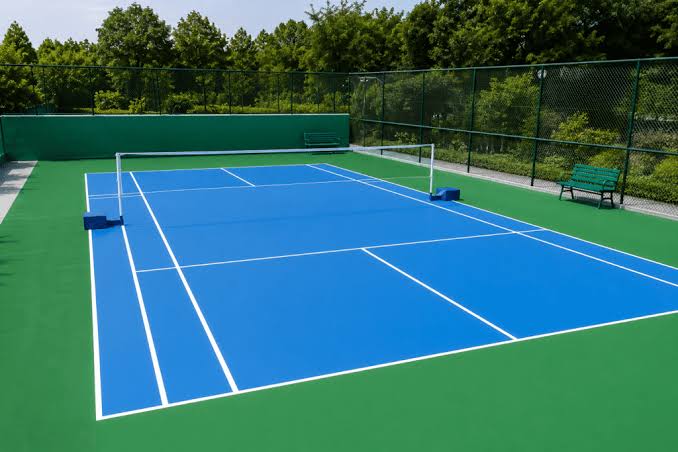
Acrylic flooring is the workhorse of Indian sports infrastructure. It’s a multi-layer coating system applied directly over a prepared concrete or asphalt base — and it’s the dominant choice for outdoor basketball courts, tennis courts, multi-purpose courts, and school playgrounds across the country.
In 2026, acrylic sports flooring has emerged as the dominant outdoor choice in India, with costs running approximately ₹45–₹90 per square foot depending on court size and layer specification. Pacecourt
What’s included in that price:
- Base preparation (crack repair, cleaning, priming)
- Acrylic resurfacer layer
- Cushion coat (2 layers)
- Colour coat (2 layers)
- Silica sand for grip
- Line marking
What pushes the price up:
- Poor existing base condition requiring grinding, patching, or full re-laying
- Larger colour variety and multi-sport line markings
- Premium brands with UV protection and anti-fungal coating
Ideal for: Schools, residential societies, club courts, government sports complexes, outdoor basketball and tennis courts.
Lifespan: 8–12 years with basic annual maintenance.
2. Sports Vinyl / PVC Flooring — ₹125 to ₹350 per sq ft
Sports vinyl (also called PVC sports flooring) is the most widely installed surface for indoor courts in India — badminton halls, indoor basketball courts, school gyms, and multi-sport indoor facilities.
PVC vinyl sports flooring costs ₹300–₹600 per sq ft for badminton courts specifically, where a full single court build may run between ₹5 lakh and ₹12 lakh. That said, for general indoor gym applications where BWF compliance isn’t required, you’ll find quality vinyl options in the ₹125–₹200 per sq ft range. Top Flooring
What’s included:
- PVC sheet/roll material (typically 4mm–8mm thickness)
- Adhesive and underlayment
- Installation and seam sealing
- Basic line marking
What to check when comparing quotes:
- Thickness matters. A 4mm vinyl behaves very differently under play than a 7mm cushioned sheet. Ask specifically.
- Shock absorption rating (DIN 18032 is the standard to reference)
- Whether the quote includes the sub-floor levelling work or assumes a perfectly flat surface
Ideal for: Indoor badminton, indoor basketball, multi-sport halls, school gymnasiums, fitness centres.
Lifespan: 10–15 years with proper cleaning and no direct sunlight exposure.
3. PU (Polyurethane) Flooring — ₹180 to ₹500 per sq ft
PU flooring is the performance-grade choice for serious indoor facilities. It’s a poured seamless system — applied in multiple layers directly over a sub-base — rather than a roll or tile. The result is a completely uniform surface with excellent shock absorption, consistent ball bounce, and very high durability under heavy daily use.
PU synthetic flooring has emerged as the most widely installed premium flooring type for indoor sports courts in India as of 2026, offering excellent shock absorption and climate resistance at ₹180–₹320 per sq ft. AQS
Why PU costs more than vinyl:
- It’s a multi-layer poured system requiring specialist applicators
- Longer installation time (typically 5–10 days for curing between coats)
- Higher material cost per sq ft
What pushes it toward the higher end:
- More layers (performance systems use 4–6 coats vs basic 2–3)
- Coloured finishes vs standard grey/green
- FIBA or BWF certification for the system used
- Monsoon-proofing additives for coastal/humid locations
Ideal for: Professional badminton and basketball facilities, sports academies, competitive training venues, premium club facilities.
Lifespan: 12–20 years when properly maintained. Generally the best long-term cost-per-year value for high-usage indoor courts.
4. EPDM Rubber Flooring — ₹120 to ₹300 per sq ft
EPDM (Ethylene Propylene Diene Monomer) is the standard surface for athletic tracks, children’s play areas, gym floors, and multi-purpose outdoor zones. It’s a granular rubber system, typically installed 10mm–40mm thick depending on the application, and it offers excellent impact absorption and UV resistance.
Common applications in India:
- Jogging and walking tracks around grounds
- Children’s play zones in schools and residential complexes
- Outdoor gym equipment areas
- Multi-purpose zones requiring high slip resistance
Cost drivers:
- Thickness (10mm for walking tracks, 30–40mm for children’s play areas with fall zones)
- Colour — single-colour EPDM is significantly cheaper than multi-colour designs
- Whether it’s prefabricated tile or in-situ poured rubber (poured is more expensive but no seams)
Ideal for: Athletic tracks, school play areas, outdoor fitness zones, park facilities.
5. Artificial Turf — ₹150 to ₹600 per sq ft
Artificial turf has had a significant uptake across Indian sports facilities in the last five years — particularly for football practice grounds, cricket nets, hockey astroturf, and multi-sport outdoor setups where maintaining natural grass is impractical.
Key spec variables that drive price:
- Pile height (20mm for multi-sport, 40–60mm for football)
- Yarn type (monofilament vs fibrillated — monofilament performs better for ball sports)
- Infill material (silica sand vs sand + rubber crumb — rubber crumb is better for shock absorption but costs more)
- Density (stitches per sq metre — more stitches = longer life and better playability)
Typical price ranges by application:
| Application | Approx. Cost Per Sq Ft |
|---|---|
| Basic multi-sport / cricket nets (no infill) | ₹150 – ₹250 |
| Football ground (sand infill) | ₹250 – ₹380 |
| Football / hockey (sand + rubber crumb) | ₹350 – ₹500 |
| FIFA Quality Pro standard | ₹450 – ₹600+ |
Lifespan: 8–12 years for good quality systems with regular brushing and infill maintenance.
6. Wooden Sports Flooring — ₹350 to ₹2,200+ per sq ft
Wooden flooring is the premium category — and the range here is wider than any other surface because you’re comparing everything from domestic teak planks to internationally certified maple spring-floor systems.
Types available in India:
Teak / Hardwood: Domestically sourced, used in school and club badminton courts, good performance for recreational play. Typically ₹350–₹700 per sq ft installed.
Engineered Maple Wood: Multi-layer engineered boards with maple face veneer, suitable for professional badminton and basketball. ₹700–₹1,200 per sq ft.
Solid Maple (Imported, Spring Floor System): Full sprung floor system with maple hardwood — the gold standard for competition-level badminton halls, basketball arenas, and multi-sport centres. This is where pricing reaches ₹2,200+ per sq ft for premium internationally certified systems.
Wooden flooring considerations for Indian conditions:
- Requires climate control (air conditioning/dehumidification) — wood expands and contracts with humidity, and Indian monsoon conditions can cause significant warping if not managed
- Annual maintenance (sanding, polishing) adds ₹1–5 lakh per year depending on court size
- Not recommended for outdoor or semi-outdoor facilities
Sport-by-Sport Cost Summary
Here’s a practical breakdown by sport — the most useful format for a buyer who knows what they want to build:
Badminton Court (per single court, ~1,440 sq ft playing area)
A full single badminton court build in India costs ₹5 lakh to ₹12 lakh depending on surface type — acrylic at the lower end, PVC vinyl in the mid-range, and PU flooring reaching the higher bracket.
| Surface | Estimated Total Cost (Single Court) |
|---|---|
| Acrylic | ₹4 – ₹7 lakh |
| PVC Vinyl | ₹6 – ₹10 lakh |
| PU Flooring | ₹8 – ₹14 lakh |
| Maple Wood | ₹15 – ₹35 lakh+ |
Basketball Court (standard half-court ~2,500 sq ft, full court ~4,500 sq ft)
| Surface | Half-Court | Full Court |
|---|---|---|
| Acrylic (outdoor) | ₹2 – ₹4 lakh | ₹4 – ₹8 lakh |
| PVC Vinyl (indoor) | ₹6 – ₹12 lakh | ₹12 – ₹20 lakh |
| PU (indoor, competition) | ₹10 – ₹18 lakh | ₹18 – ₹35 lakh |
Multi-Sport Outdoor Court (approx. 6,000 sq ft)
- Acrylic with multi-sport line markings: ₹8 – ₹18 lakh
- Artificial turf (football/cricket focus): ₹15 – ₹30 lakh
Jogging / Walking Track (per 400m standard track, 4 lanes)
- Acrylic surface: ₹25 – ₹45 lakh
- EPDM rubber: ₹30 – ₹60 lakh
- PU track (international standard): ₹50 – ₹1 crore+
The Hidden Costs Most Buyers Don’t Budget For
This is the section most guides skip — and it’s the one that causes the most project overruns. Budget for all of these before signing any contract:
1. Base / sub-floor preparation
If your concrete base has cracks, uneven settling, or moisture issues, it must be fixed before flooring goes down. This isn’t optional — skipping it voids most warranties and causes premature failure. Budget ₹15–₹50 per sq ft for this work separately, and assume it’s needed unless a site inspection confirms otherwise.
2. Line marking
Multi-sport courts with multiple game overlays (basketball + volleyball + badminton, for example) require more material and more skilled application. Can add ₹1–₹3 lakh to the project.
3. Levelling screed
Especially relevant for indoor projects with vinyl or wooden flooring — the sub-floor needs to be within strict flatness tolerances (typically 3mm per 3m). Levelling compound adds ₹20–₹60 per sq ft.
4. Lighting
Not a flooring cost — but consistently underestimated. Professional LED sports lighting for indoor courts typically runs ₹1–₹3 lakh depending on court count and required lux level. For outdoor courts, budget ₹2–₹6 lakh for a properly designed floodlight system.
5. Boundary walls, nets, posts, and accessories
Again, separate from flooring — but buyers often arrive with a “flooring only” budget and then discover the posts, nets, back walls, and ball-stop netting add another 20–30% to the project total.
6. Annual maintenance
Budgeting for installation is only half the picture. Annual maintenance costs range from ₹20,000 to ₹1 lakh depending on court type and usage intensity. Wooden floors require periodic sanding and polishing which pushes into the higher end of that range.
What Factors Will Move Your Quote Up or Down
Even within the same material category, quotes from different contractors can vary by 30–50%. Here’s why:
Location: Projects in Mumbai, Delhi, and Bangalore carry higher labour costs than Tier-2/3 cities. Maharashtra projects from our Kalyan base, for example, typically see lower logistics cost for nearby districts.
Project size: Larger area = lower per sq ft rate. A 10,000 sq ft project will cost less per sq ft than a 1,000 sq ft job because setup, mobilisation, and material logistics are spread across a larger area.
Contractor quality and certifications: A contractor who can provide BWF-certified or FIBA-certified systems will quote more than one who cannot — for good reason. For recreational courts, this may not matter. For a professional academy or competitive venue, the certification is non-negotiable.
Monsoon scheduling: Projects starting just before or during monsoon (June–September) may incur delays for outdoor work, or premium charges for weather protection measures on in-progress surfaces.
Brand of material: Imported European or Korean PU/PVC systems cost more than domestically manufactured equivalents. Performance difference exists, but for most school and community projects, Indian-made materials from reputed suppliers perform perfectly adequately.
Khelo India and Government Funding — Does It Apply to You?
If you’re a school, university, or registered sports club, it’s worth checking funding eligibility before finalising your budget. Schools, universities, and registered sports clubs can apply for grants under the Khelo India programme and SAI’s Urban Sports Infrastructure Scheme (USIS) for up to ₹5 crore.
State government sports schemes in Maharashtra (through Sports Authority of Maharashtra State — SAMS) also offer periodic grant windows for infrastructure at the taluka and district level. These typically require competitive tendering and approved specifications — but if your project qualifies, the grant can cover a significant portion of the flooring and civil works.
How to Compare Contractor Quotes Properly
When you receive quotes from multiple contractors, make sure you’re comparing like-for-like. Ask each one to break down:
- Material cost per sq ft (and the specific brand/grade they’re quoting)
- Separate line item for base preparation
- Number of coats/layers included
- Line marking specifications
- Warranty offered (on material vs on workmanship — these are different)
- What’s excluded from the quote
A low headline number with no base preparation included, single-coat application, and no warranty is not a cheap quote — it’s a problem deferred to Year 2.
For a basic single outdoor badminton court with concrete base and acrylic surface, budget a minimum of ₹4–6 lakh all-inclusive. This assumes a reasonably prepared existing base; add ₹1–2 lakh if significant base work is needed.
Both are good choices for Indian conditions. PU synthetic flooring is the best all-round choice for serious Indian indoor facilities, offering excellent shock absorption and climate resistance. PVC vinyl is the better entry point if budget is the primary constraint and the facility is for recreational or academy-level use.
Final Word: What You Should Actually Budget
Don’t anchor your budget on the lowest per sq ft figure you’ve seen online. Anchor it on the total project cost — material, base work, installation, line marking, accessories, and a 10% contingency for site surprises. That’s the number to take to your board, your school committee, or your housing society general meeting.
And get at least three quotes, with full breakdowns, before committing to any contractor. The difference between a well-executed sports floor that lasts 15 years and one that starts failing in Year 3 isn’t always price — but it almost always comes down to the quality of the base preparation and the honesty of the contractor about what’s actually included.
DS Sports Infra has been building sports courts across India for over 7 years, with 400+ completed projects in Maharashtra and beyond. If you’d like a detailed site estimate for your project, contact us directly — we’ll give you a line-item quote, not a ballpark.
