Padel is currently the fastest-growing racquet sport in urban India, and the demand curve is outpacing the availability of contractors who actually understand how to build one properly. That gap matters more here than it does for most other sports, because a padel court isn’t just a surface with lines painted on it — it’s an enclosed structure with specific glass and mesh wall requirements, a particular turf infill system, and lighting and drainage considerations that don’t map onto a standard tennis or badminton build.
This guide covers exactly what a padel court requires — correct dimensions, the structural enclosure that makes it different from every other court, surface options, and what actually drives the cost — so you can evaluate a contractor’s proposal with real information, not just trust a number.
Why Padel Is Different From Every Other Court You’ve Built
Most sports courts are essentially a flat surface within a boundary line. Padel is the exception: the game is played inside an enclosed structure, and the walls aren’t a safety add-on — they’re part of the game itself. Players use the glass and mesh walls to play the ball off, similar to squash. This means the structural enclosure isn’t optional scope you can cut to save budget; it’s the court.
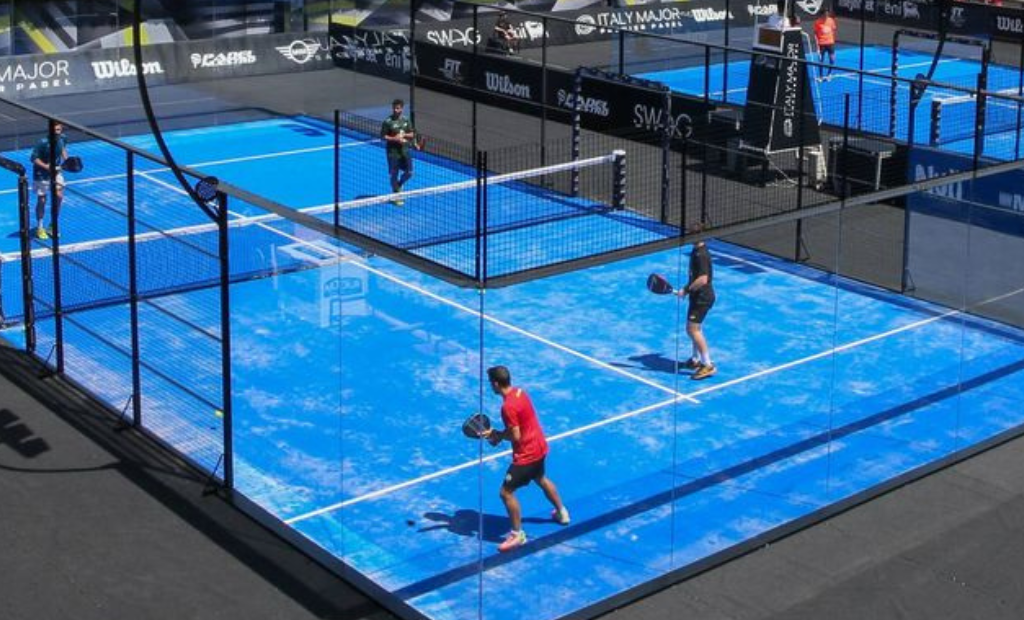
This is the single most important thing to understand before requesting quotes, because it’s also where cost and quality vary the most between contractors — and where an inexperienced vendor is most likely to get something wrong.
Official Court Dimensions
Standard court size:
- Playing area: 20m x 10m (65.6 ft x 32.8 ft) — the same size for both singles and doubles play, unlike tennis
- Total enclosed structure height: typically 3m to 4m, varying by wall section (back walls are taller than side walls in most official layouts)
- Net height: 0.88m at the posts, 0.92m at the center (similar proportions to tennis, but lower overall)
Recommended surrounding space: Unlike an open court sport, padel’s enclosure means the “buffer space” consideration is less about player run-off and more about structural clearance and access — space around the enclosure for maintenance, and enough overhead clearance if the court will be covered.
Orientation matters: For outdoor courts, the long axis of the court should ideally run north-south to minimize players facing directly into low-angle sun during play — a detail that’s frequently overlooked in a first-draft site layout and is much cheaper to correct on paper than after construction.
The Structural Enclosure: Glass vs Mesh
This is the part of a padel court that most first-time buyers underestimate, and it’s the biggest cost and quality differentiator between contractors.
Glass panels
Used for the back walls and lower sections of the side walls (the areas where the ball is played off directly during a rally).
- Must be tempered safety glass, engineered to handle repeated high-speed ball impact without flexing or shattering
- Panel thickness and mounting-frame quality directly affect ball rebound consistency — cheap glass or poor framing changes how the ball plays off the wall, which affects the game itself, not just aesthetics
- Represents the largest single structural cost on a padel court
Mesh (fencing) sections
Used for the upper wall sections and areas where ball-rebound-off-the-wall isn’t part of standard play.
- Galvanized, weather-resistant mesh, specified for tension and corrosion resistance — especially relevant in coastal or high-humidity regions
- Lower cost than glass, used strategically where the game doesn’t require rebound play
Why this split matters for your budget: A contractor’s glass-to-mesh ratio and glass quality specification is one of the most meaningful ways two “padel court” quotes can differ by a large margin while looking similar on paper. Ask specifically what glass thickness and framing system is being quoted — this detail is often glossed over in a general proposal.
Surface Options
1. Artificial turf with sand infill (the standard choice)
Padel is almost universally played on a short-pile synthetic turf with a sand infill, which gives the ball a consistent, slightly slower bounce than a hard court and reduces player fatigue on joints compared to acrylic or concrete.
- Turf pile height and sand infill density need to be specified correctly — this is a padel-specific spec, not a generic artificial turf order
- Drainage beneath the turf is critical for outdoor courts, following the same sub-base engineering principles as any outdoor synthetic surface
- Good UV stability is essential for outdoor installations across Indian climate conditions
2. Indoor vs outdoor considerations
- Outdoor courts need UV-stable turf, weatherproof glass sealing and framing, and drainage engineered for local rainfall intensity — this is where DSSI’s monsoon-focused engineering background applies directly
- Indoor/covered courts can use a slightly different turf specification since UV degradation isn’t a factor, but lighting design becomes more important, since indoor padel needs even, glare-free illumination across the full enclosed structure
What Actually Drives the Cost
Padel courts sit at a meaningfully higher price point than most other courts DSSI builds, and it’s worth understanding why before you see a quote, so the number makes sense rather than causing sticker shock:
| Cost driver | Why it matters |
|---|---|
| Glass panel quality & framing | The single biggest cost variable — thickness, tempering standard, and mounting system |
| Glass-to-mesh ratio | More glass coverage costs more but is part of some layout standards |
| Turf specification | Pile height, sand infill density, and UV-stability grade |
| Site preparation & sub-base | Same drainage/leveling principles as any outdoor synthetic surface |
| Indoor vs outdoor | Outdoor needs weatherproofing; indoor needs lighting and enclosure structure suited to a covered space |
| Lighting | Padel is frequently played in the evening; proper glare-free lighting is a real line item, not an afterthought |
| Structural foundation for the enclosure | The wall structure needs proper footing, unlike an open court with just boundary lines |
Because of how much the enclosure structure dominates the cost, a flat per-court number without a site visit and a specific glass/mesh/turf specification is close to meaningless for padel — more so than for almost any other court type. Get an itemized quote that breaks out the enclosure separately from the surface.
Common Mistakes to Avoid
- Treating the enclosure as a fencing afterthought rather than the core structural element it actually is — this is the most expensive part of the project and the part most likely to be under-specified by a contractor without padel-specific experience.
- Not confirming glass tempering and thickness standards in writing — a proposal that just says “glass walls” without a spec is leaving the most important quality variable undefined.
- Choosing court orientation without considering sun angle for outdoor courts — cheap to fix at the design stage, expensive (or impossible) to fix after construction.
- Underestimating lighting requirements for evening play, which is when most padel courts in India see peak usage.
- Assuming any turf installer can do padel turf — the pile height and infill specification genuinely differs from generic artificial turf or football turf, and getting it wrong changes how the ball plays.
Why Padel Needs In-House Structural and Surfacing Expertise Together
Because the enclosure and the surface have to work as one integrated system — turf drainage feeding into a structure with its own foundation, glass framing that has to tolerate ground movement without cracking — padel is a sport where splitting the structural work and the surfacing work across separate, uncoordinated vendors creates real risk. This is the same coordination problem flagged in our guide on in-house contractors vs multiple vendors, and it applies more strongly to padel than to almost any other court type because of the enclosure.
How DS Sports Infra Approaches Padel Court Projects
- In-house architects and engineers manage the enclosure structure and surface as one coordinated build, not two separate vendor scopes
- Glass and mesh specification matched to official standards, with transparent detail on thickness and framing — not a vague “glass walls included” line item
- Padel-specific turf systems — correct pile height and sand infill, not a generic artificial turf substitution
- Monsoon-tested drainage and weatherproofing for outdoor courts, and glare-free lighting design for indoor or evening-use courts
- Free site survey and itemized quotation, with the enclosure and surface costs broken out separately so you can see exactly what’s driving the number
- 7+ years, 400+ projects delivered across Maharashtra
If you’re planning a padel court — for a club, a commercial facility, or a housing society — request a free site consultation to get accurate dimensions, a proper enclosure specification, and a transparent, itemized quote.
Frequently Asked Questions
The playing area is 20m x 10m (65.6 ft x 32.8 ft), the same dimensions for singles and doubles play. The enclosure height typically ranges from 3m to 4m depending on the wall section.
Artificial turf with a sand infill is the standard surface, chosen for consistent ball bounce and reduced joint impact compared to a hard court. The correct pile height and infill density are specific to padel, not the same as generic artificial turf.
Yes. Indoor padel courts don’t need UV-stable materials the way outdoor courts do, but require careful lighting design for even, glare-free illumination across the enclosed structure.
