If you’re a school administrator, a residential society committee member, a sports academy owner, or a corporate facilities manager planning to build or upgrade a sports facility, one of the first questions you’ll run into is simple but confusing: what exactly does a “sports ground infrastructure company” do, and how is the process different from hiring a general contractor?
This guide breaks down exactly what these companies handle, what the full project process looks like from first call to handover, and what separates a genuine sports infrastructure specialist from a general civil contractor who has added “sports flooring” to their list of services.
What Is a Sports Ground Infrastructure Company?
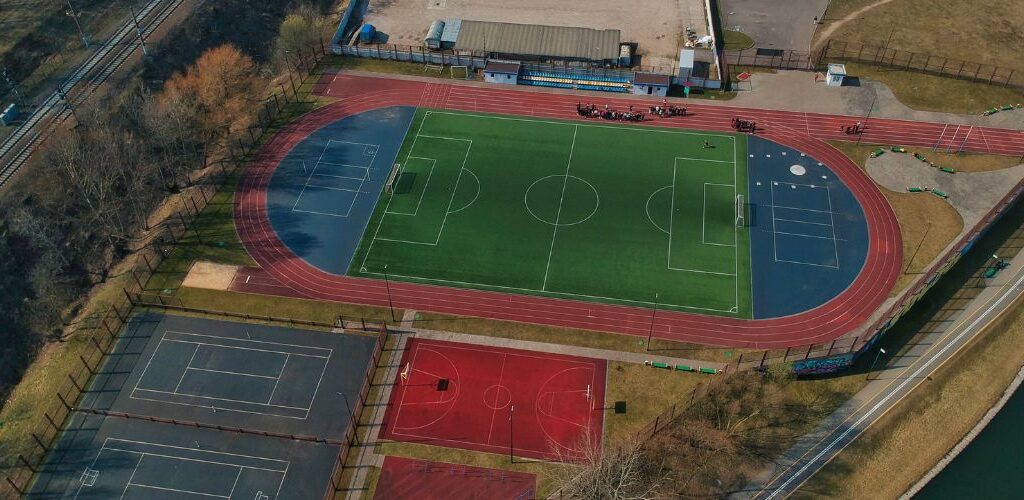
A sports ground infrastructure company is a specialized contractor that designs, builds, and maintains sports facilities — everything from the civil sub-base and drainage engineering up through the playing surface, equipment, lighting, and ongoing upkeep. Unlike a general contractor who might handle one piece of a project (say, the concrete slab) and hand off the rest to subcontractors you have to manage yourself, a proper sports infrastructure company runs the entire project under one roof.
This distinction matters more than it sounds. Sports surfaces have engineering requirements that general construction doesn’t — precise slope gradients for drainage, specific base compaction standards, surface-specific curing times, and material certifications tied to the sport being played. A civil contractor who builds excellent buildings can still get a basketball court base wrong in a way that causes cracking within two monsoons, because the failure modes for sports surfaces are different from the failure modes for a parking lot or a building foundation.
The Full Range of Services a Sports Infrastructure Company Provides
1. Site Assessment and Feasibility
Every legitimate project starts here, not with a quote. A proper assessment includes:
- Soil bearing capacity testing — especially critical on filled land, reclaimed land, or clay-heavy sites where settlement risk is high
- Land survey and topography check — confirming the available footprint actually accommodates the intended sport at regulation or near-regulation dimensions
- Drainage study — understanding where water naturally flows on the site and what engineering will be needed to redirect it
- Existing structure evaluation — if you’re resurfacing or converting an existing space, an honest assessment of whether the current base is salvageable or needs to be rebuilt
A company that skips this step and goes straight to a quote is pricing blind — and that quote will almost always grow once excavation starts and the real site conditions are revealed.
2. Design and Planning
This covers the layout and specification work before any construction begins:
- Court/ground layout matched to the correct governing body dimensions (FIBA for basketball, World Athletics for tracks, BWF for badminton, and so on)
- Multi-sport line marking plans where one surface needs to serve several sports
- Drainage and slope engineering drawings
- Lighting layout calculated for the correct lux level and beam angle for the specific sport
- Material and surface system selection based on usage intensity, budget, and climate
3. Civil and Sub-Base Construction
This is the foundation work — and it typically represents 40–50% of a project’s total cost, even though it’s invisible once the surface goes down. It includes:
- Excavation and ground compaction
- Aggregate base or water-bound macadam (WBM) layer
- Reinforced concrete (RCC) or asphalt base construction
- Vapor barriers and reinforcement mesh where required
- Precision grading to the correct slope for surface drainage
4. Surface Installation
The part most people think of first, but it’s only correctly done once everything above it is right:
- Acrylic coating systems (hard court or cushioned)
- EPDM rubber surfacing (running tracks, play areas)
- Polyurethane (PU) systems, including full PU and sandwich PU
- Artificial turf (football, cricket practice, multi-purpose)
- PVC vinyl and wooden flooring for indoor courts
- Interlocking PP modular tiles
5. Equipment and Fixtures
- Basketball posts and backboards (fixed or breakaway)
- Badminton and volleyball nets and posts
- Cricket practice nets and pitch equipment
- Goal posts for football and futsal
- Table tennis tables and fixed equipment where applicable
6. Lighting and Electrical
Sports lighting has specific requirements most electrical contractors aren’t familiar with — correct lux levels, glare control, and beam angles calibrated to the sport and playing height. This includes pole/fixture installation, cabling, distribution panels, and surge protection.
7. Fencing, Boundary, and Ancillary Work
Perimeter fencing, spectator seating or basic bleachers, changing rooms or officials’ facilities, and signage — the pieces that turn a surfaced ground into a fully functional facility.
8. Maintenance and Repair
A responsible sports infrastructure company doesn’t disappear after handover. Ongoing services typically include periodic cleaning, crack inspection and repair, re-marking, resurfacing when the surface reaches end-of-life, and drainage system maintenance.
The Complete Project Process: From First Call to Handover
Step 1: Initial Consultation
You describe what you need — sport, approximate location, rough budget range, and timeline. A good company will ask clarifying questions here rather than jumping straight to a number: Is this for competitive use or recreational? Indoor or outdoor? What’s the realistic land area available?
Step 2: Site Visit and Assessment
An engineer visits the site to evaluate soil conditions, existing structures, drainage patterns, and access for construction equipment. This is also when land area is confirmed against what the intended sport actually requires.
Step 3: Design Proposal and Itemised Quotation
You should receive a proposal that breaks down base work, surface system, equipment, lighting, and fencing as separate line items — not a single lump-sum number. This is your opportunity to see exactly what’s included and what isn’t, and to compare surface system options against each other with real numbers.
Step 4: Contract and Timeline Confirmation
Scope, payment schedule, warranty terms (material and workmanship, stated separately), and a realistic construction timeline should all be documented before work begins.
Step 5: Civil and Base Construction
Excavation, compaction, and base laying. This phase includes mandatory curing time — asphalt bases typically need 14–30 days before a synthetic surface can be applied, and rushing this step is the single most common cause of premature surface failure.
Step 6: Surface Installation
Once the base has cured and passed moisture/level testing, the surface system goes down in the required layers — primer, resurfacer, cushion layers where specified, color coats, and final finish.
Step 7: Line Marking, Equipment, and Fixtures
Final marking for the intended sport(s), followed by installation of posts, nets, backboards, and any other fixed equipment.
Step 8: Testing and Handover
A functional walkthrough — checking drainage performance, surface evenness, lighting levels, and fixture stability — before formal handover and documentation of warranties.
Step 9: Post-Handover Support
Maintenance guidance, scheduled check-ins, and availability for repairs as the facility ages.
What to Look for When Choosing a Sports Ground Infrastructure Company
Track record with your specific project type. A company that has built dozens of school multi-sport courts may not have the same depth of experience with a full 400m competition track. Ask for references matching your project category specifically.
Itemised quotations, not lump sums. If a company won’t break down base work, surface, equipment, and lighting as separate costs, you have no way to compare it fairly against another quote — or to know what you’re actually paying for.
In-house execution vs. subcontracted patchwork. Ask directly whether the civil work, surfacing, and electrical work are done by the same company’s teams or handed off to multiple subcontractors with no single point of accountability. The latter is where warranty disputes usually happen — everyone blames the other subcontractor when something fails.
Material certifications. For any competitive-level facility, ask for manufacturer certificates confirming compliance with the relevant sport’s governing body standards (FIBA, World Athletics, BWF, etc.).
Separate material and workmanship warranties. These are two different things from two different parties (manufacturer vs. contractor) and a credible company will state both clearly — typically 5 years on material, 1–2 years on workmanship.
Government scheme familiarity. If you’re a school or public institution, a company experienced with Khelo India, Samagra Shiksha, or state-level infrastructure grants can meaningfully speed up your funding pathway — this isn’t something every contractor understands.
Common Mistakes When Hiring a Sports Infrastructure Company
- Comparing headline quotes without comparing scope. A ₹12 lakh quote and an ₹18 lakh quote for the “same” court often aren’t comparable at all once you see what each one actually includes.
- Skipping the site assessment step. Any company willing to quote a price without visiting the site or testing the soil is guessing — and that guess becomes your problem once construction starts.
- Underbudgeting for base work. Because it’s invisible once finished, base preparation is the line item most often cut to bring down a quote — and it’s the one that causes the most expensive failures.
- Ignoring maintenance planning. A facility built without a maintenance budget in mind will degrade faster than its rated lifespan, regardless of how well it was built initially.
Frequently Asked Questions
How is a sports ground infrastructure company different from a general contractor?
A general contractor builds structures and can lay concrete, but sports surfaces have specific engineering requirements — drainage gradients, surface-specific curing, governing-body dimension compliance — that a specialist company is set up to handle correctly from design through maintenance, under one point of accountability.
Do sports infrastructure companies handle government-funded projects?
Yes, established companies regularly work with schools and institutions applying for Khelo India, Samagra Shiksha, or state sports department grants, and can help structure project proposals and cost estimates in the format these schemes require.
How long does a typical sports ground project take?
This varies significantly by project type and surface — an outdoor acrylic multi-sport court can take 2–3 weeks, while a full 400m competition-grade track can take 60–90 days, largely due to base curing time.
What should be included in a sports infrastructure company’s quotation?
A proper quotation should separately itemise site preparation and civil work, the surface system (material, thickness, number of layers), drainage engineering, line marking, equipment and fixtures, lighting, fencing, and both material and workmanship warranty terms.
DS Sports Infra has delivered sports ground infrastructure projects for schools, colleges, residential societies, and sports authorities across Maharashtra and India for over 7 years — handling civil sub-base construction, surfacing, equipment, and lighting as a single accountable team. We provide detailed, itemised quotations and are happy to conduct a free site assessment before any commitment is made.
Contact DS Sports Infra for a Free Site Assessment and Project Quotation →
