If you’re a residential society, sports club, academy, or commercial facility owner in India right now, you’ve almost certainly had this exact conversation: padel or pickleball? Both sports have exploded in popularity over the last two years, both are being requested constantly by members and students, and both come with meaningfully different costs, space requirements, and revenue models.
This guide breaks down exactly how these two sports compare on cost, space, construction complexity, and commercial potential — so you can make the decision based on real numbers rather than whichever sport your last five inquiries happened to mention.
The Quick Answer
| Factor | Padel | Pickleball |
|---|---|---|
| Court cost (single) | ₹18 – ₹35 lakh | ₹4 – ₹10 lakh |
| Space required | 20m × 10m (200 sq m) | 13.4m × 6.1m (about 82 sq m playing area, ~120 sq m with runoff) |
| Construction time | 45 – 75 days | 15 – 30 days |
| Enclosure required | Yes (glass + mesh walls, mandatory) | No (optional fencing only) |
| Membership/session pricing potential | Higher | Moderate |
| Land efficiency (courts per given space) | Lower | Higher — fits 2 pickleball courts in the footprint of 1 padel court |
| Best for | Premium clubs, commercial venues, larger societies | Schools, mid-size societies, multi-sport facilities, budget-conscious builds |
If your decision is purely about getting the most playable courts into the smallest footprint and budget, pickleball wins clearly. If you’re building a premium, high-visibility amenity and have the space and budget for it, padel has a stronger case — but it’s a materially bigger commitment on both fronts.
What Makes These Sports Different (Beyond the Obvious)
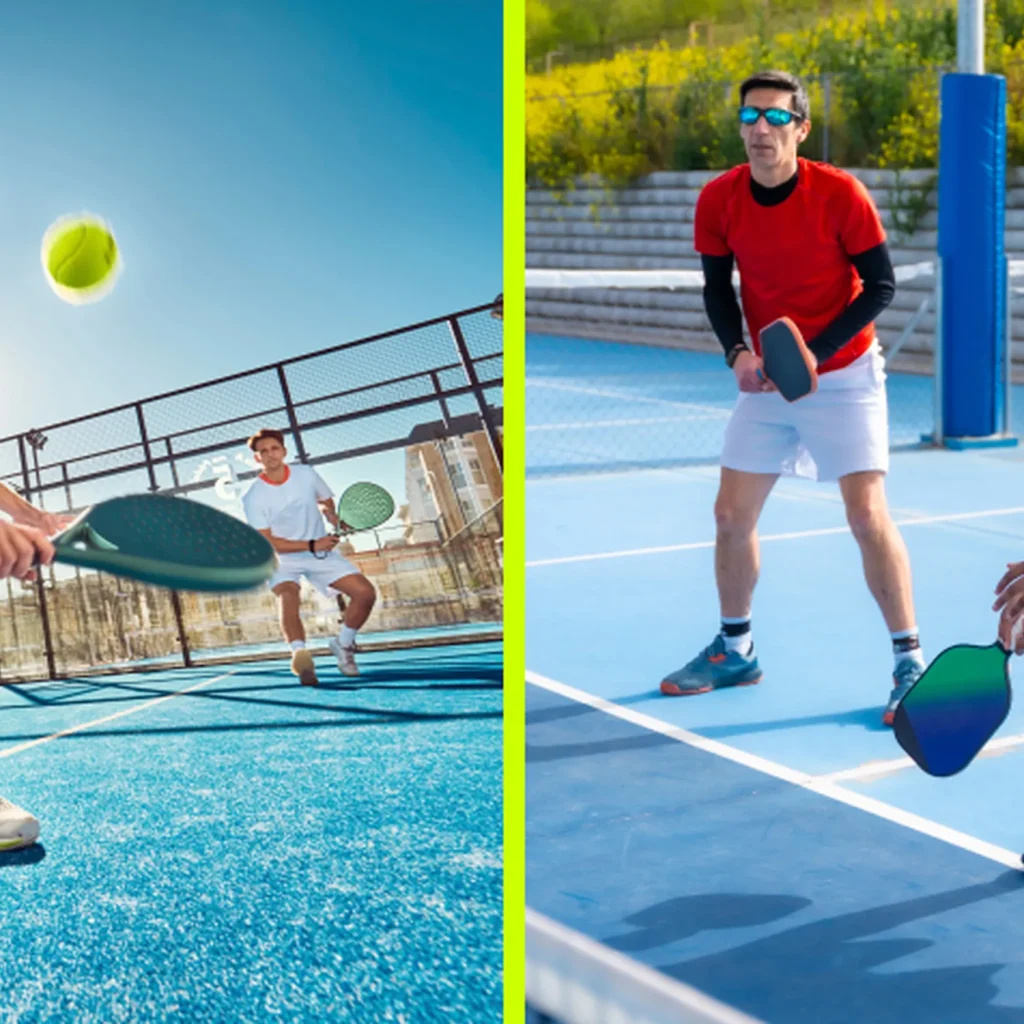
Padel and pickleball get lumped together constantly because they’re both racquet-adjacent sports that surged in popularity around the same time, but structurally they’re not similar at all. Padel is closer to a scaled-down tennis court with enclosed glass and mesh walls that are part of live play — the ball can be played off the walls, which is why the enclosure isn’t optional trim, it’s core infrastructure. Pickleball is closer to a scaled-down badminton/tennis hybrid played on an open court with no walls involved in gameplay at all.
This structural difference is the reason the cost gap between them is as large as it is — you’re not comparing two similar builds at different price points, you’re comparing a fully enclosed structural project to a much simpler flat-court installation.
Padel Court Construction: Full Breakdown
What a Padel Court Actually Requires
A regulation padel court is 20m long by 10m wide, enclosed on all sides by a combination of tempered glass panels (typically 3–4mm thick, lower sections) and galvanized mesh (upper sections), with a minimum enclosure height of 3–4 meters on the back walls and lower on the sides. This enclosure isn’t a safety add-on — it’s a specified part of the court that the ball interacts with during play, which means it has to meet precise dimensional and material standards, not just “some fencing.”
Core components of a padel court build:
- Base preparation (concrete slab, typically similar spec to a tennis court base)
- Artificial turf or synthetic surface (sand-filled artificial grass is the global standard)
- Glass panel walls (tempered safety glass)
- Galvanized steel mesh upper walls
- Structural steel framework supporting the enclosure
- Court lighting (padel is heavily played in the evenings)
- Net and posts
Cost Breakdown for a Single Padel Court
| Component | Estimated Cost |
|---|---|
| Base preparation (concrete slab, ~200 sq m) | ₹3 – ₹6 lakh |
| Artificial turf/synthetic surface | ₹2.5 – ₹5 lakh |
| Glass wall panels (tempered, full enclosure) | ₹6 – ₹12 lakh |
| Galvanized mesh and structural steel framework | ₹3 – ₹6 lakh |
| Lighting (professional-grade, glare-controlled) | ₹1.5 – ₹3 lakh |
| Net, posts, and court accessories | ₹40,000 – ₹80,000 |
| Total (single court, new build) | ₹18 – ₹35 lakh |
Why the range is so wide: Glass specification is the single biggest cost swing factor. Basic tempered glass panels sit at the lower end; imported, higher-clarity, higher-impact-rated glass systems (common in premium commercial venues) push costs toward the top of the range and sometimes beyond it. Structural steel quality and corrosion protection for the framework is the second major variable, particularly important in coastal cities where salt exposure accelerates wear.
Construction Timeline
A padel court typically takes 45 to 75 days from site clearance to completion. The longest phases are base curing (similar to any concrete slab project) and the structural steel and glass installation, which requires precision fitting that can’t be rushed without risking panel misalignment or gaps that affect ball behavior.
Pickleball Court Construction: Full Breakdown
What a Pickleball Court Actually Requires
A regulation pickleball court is 13.4m × 6.1m (44ft × 20ft) for the playing area, with a recommended total footprint of around 18m × 9m including runoff space around the court. Unlike padel, there’s no structural enclosure requirement — the court is an open, flat surface with line marking and a net, similar in construction complexity to a badminton or tennis court.
Core components of a pickleball court build:
- Base preparation (concrete or asphalt)
- Acrylic or synthetic surface coating with line marking
- Net and posts
- Optional perimeter fencing (recommended but not structurally required)
- Optional lighting for evening play
Cost Breakdown for a Single Pickleball Court
| Component | Estimated Cost |
|---|---|
| Base preparation (concrete/asphalt, ~120 sq m) | ₹1.5 – ₹3 lakh |
| Acrylic surface system with line marking | ₹1.5 – ₹3.5 lakh |
| Net and posts | ₹20,000 – ₹50,000 |
| Perimeter fencing (optional but recommended) | ₹50,000 – ₹1.5 lakh |
| Lighting (4 poles, LED) | ₹80,000 – ₹1.5 lakh |
| Total (single court, new build) | ₹4.5 – ₹10 lakh |
Converting an existing court is even cheaper. One of pickleball’s biggest practical advantages is that it can be overlaid onto an existing tennis or basketball court with just re-marking and a portable or semi-permanent net system — in many cases dropping the cost to ₹50,000 – ₹2 lakh for a conversion rather than a new build. This is a major reason pickleball has spread so fast in India — societies and schools with underused tennis or basketball courts can add pickleball without new construction at all.
Construction Timeline
A new pickleball court takes 15 to 30 days. A conversion of an existing hard court takes as little as 2 to 5 days — line marking, net installation, and minor surface prep, nothing structural.
Space Efficiency: The Numbers That Matter for Land-Constrained Sites
This is where the comparison becomes most relevant for Indian residential societies and schools, where land is almost always the binding constraint, not budget.
- A single padel court needs approximately 200 sq m
- A single pickleball court needs approximately 110–160 sq m including runoff
- You can typically fit 1.5 to 2 pickleball courts in the footprint of one padel court
For a society or school with a fixed, limited plot — say, a rooftop, an underused parking area, or a repurposed tennis court — this ratio often decides the sport before cost even enters the conversation. If the space physically can’t accommodate a 20m × 10m enclosed structure, padel isn’t on the table regardless of budget.
Commercial and Membership Potential
If the facility is being built with revenue in mind — a club, academy, or pay-and-play venue — the economics differ meaningfully between the two sports.
Padel commands premium per-session and membership pricing in most Indian metros right now, reflecting both its novelty and the higher perceived production value of an enclosed glass court. Venues in Mumbai, Bangalore, and Delhi NCR are charging significantly more per hour for padel than for equivalent racquet sports, and it photographs well for social media, which drives organic marketing value that pickleball’s open-court format doesn’t generate in the same way.
Pickleball has broader demographic reach — it’s genuinely accessible to a wider age range, including older players and complete beginners, and requires far less physical intensity to pick up than padel or tennis. This translates to higher potential utilization across a broader member base, even if per-session pricing runs lower than padel.
The practical commercial answer for many facilities: where land allows, building 2 pickleball courts alongside 1 padel court often outperforms an all-in bet on either single sport — pickleball drives volume and accessibility, padel drives premium pricing and word-of-mouth visibility.
Maintenance Comparison
| Maintenance Item | Padel | Pickleball |
|---|---|---|
| Annual maintenance budget | ₹80,000 – ₹2 lakh | ₹20,000 – ₹60,000 |
| Glass panel cleaning/inspection | Required, specialized | N/A |
| Surface resurfacing cycle | 6–8 years (artificial turf infill top-up more frequent) | 5–8 years (acrylic recoat) |
| Structural inspection | Steel framework and glass mounting, annual | Minimal — surface and net only |
Padel’s enclosure adds a maintenance category that pickleball simply doesn’t have — glass panels need periodic cleaning and inspection for cracking or seal failure, and the structural steel framework needs corrosion checks, particularly critical in coastal and high-humidity regions of India.
Which Should You Actually Build? A Decision Framework
Build padel if:
- You have at least 200 sq m of dedicated space available
- Budget allows ₹18–35 lakh for a single court
- The facility is positioned as premium — a commercial venue, upscale society, or club targeting higher-spend members
- You want a visually striking amenity with strong social/marketing appeal
Build pickleball if:
- Space is limited, or you want to maximize the number of courts in available land
- Budget is a primary constraint (₹4–10 lakh new build, often much less as a conversion)
- You have an existing tennis or basketball court that’s underused and could be converted
- You want to serve the widest possible age range and skill level within your member or student base
- Speed matters — you need a facility operational within weeks, not months
Build both if:
- You’re a larger club, academy, or commercial facility with the land and budget to diversify
- You want pickleball to drive volume and accessibility while padel drives premium positioning and differentiation from competitors
Frequently Asked Questions
Is padel or pickleball cheaper to build in India?
Pickleball is significantly cheaper — a new pickleball court costs ₹4–10 lakh compared to ₹18–35 lakh for padel, and pickleball can often be added to an existing tennis or basketball court for as little as ₹50,000–₹2 lakh in conversion costs.
How much space do I need for each sport?
A padel court requires approximately 200 sq m (20m × 10m) with enclosure walls. A pickleball court requires approximately 110–160 sq m (13.4m × 6.1m playing area plus runoff), meaning roughly 1.5–2 pickleball courts fit in the same footprint as one padel court.
Can I convert an existing tennis court to pickleball or padel?
Pickleball conversion is straightforward and common — an existing tennis or basketball court can be re-marked and fitted with a net system in a few days for a fraction of new-build cost. Padel conversion is far more limited, since the enclosed glass and mesh wall structure generally requires new construction rather than a retrofit onto an open court.
Which sport has better revenue potential for a commercial facility?
Padel typically commands higher per-session and membership pricing in Indian metros due to its premium positioning and novelty factor. Pickleball has broader demographic appeal and can achieve higher overall utilization across a wider member base, even at a lower per-session rate. Many commercial operators find a mix of both performs better than committing exclusively to one.
The Bottom Line
There’s no universally “better” choice between padel and pickleball — the right decision depends on your available land, your budget, and what your members or students are actually asking for. If space and budget are tight, pickleball delivers a faster, cheaper, more space-efficient facility, especially if you already have an underused hard court to convert. If you have the land and budget for a premium amenity with strong commercial appeal, padel is a differentiated investment that’s currently in high demand across urban India.
Whichever direction you choose, get a proper site assessment before committing — space constraints, drainage, and structural requirements (especially for padel’s enclosure) need to be verified on-site, not estimated from a floor plan.
DS Sports Infra has delivered padel and pickleball court projects for societies, schools, academies, and commercial clients across Maharashtra and India. We provide detailed, itemised quotations for both sports and are happy to conduct a free site assessment to help you decide which fits your space and goals.
Contact DS Sports Infra for a Free Site Assessment and Padel/Pickleball Quote →
