If you’re building a badminton court, the flooring decision matters more than almost anything else in the project. Get the surface wrong and you’re not just dealing with a cosmetic problem — you’re dealing with player injuries, inconsistent bounce, and a resurfacing job a lot sooner than you budgeted for. Acrylic and rubber are the two most common choices for badminton courts in India, and they’re genuinely different systems suited to different situations. Here’s how to think through the decision.
The Short Answer
Acrylic is generally the better fit for outdoor and multi-purpose courts that need durability against sun, rain, and heavy foot traffic. Rubber (and rubber-backed synthetic systems) is generally the better fit for indoor, competitive-level courts where shock absorption and consistent ball bounce matter most. But “generally” is doing a lot of work in that sentence — the right answer depends on your specific use case, budget, and maintenance capacity, which is what the rest of this guide walks through.
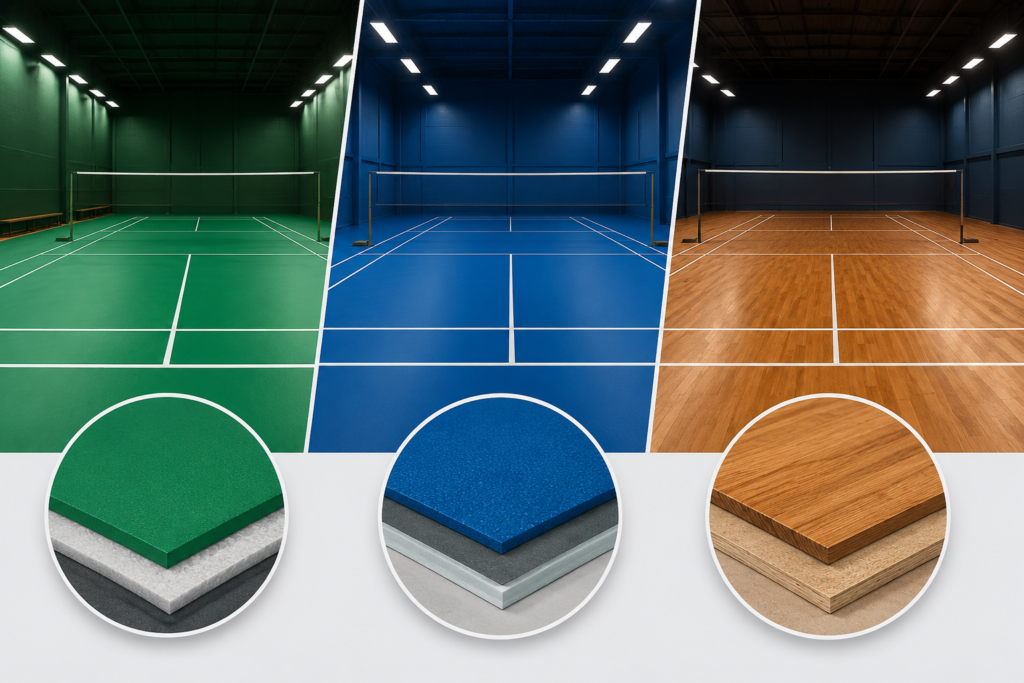
How Acrylic Flooring Performs
Acrylic is a hard-court surface system — multiple layers of acrylic coating applied over a concrete or asphalt base, often with a cushioned layer beneath for shock absorption.
Strengths:
- Excellent UV and weather resistance, which makes it the standard choice for outdoor courts
- Strong resistance to abrasion and heavy foot traffic
- Relatively low maintenance once installed — mainly periodic cleaning and recoating every few years
- Wide color and line-marking flexibility, useful for multi-sport courts that need to switch between badminton, tennis, and other line layouts
- Generally more budget-friendly than premium rubber systems at comparable quality tiers
Trade-offs:
- Harder underfoot than rubber, which means more impact on joints during intensive play
- Ball bounce and player traction, while good, don’t quite match the consistency of a purpose-built indoor rubber system at competitive levels
- Requires a well-prepared, stable base (concrete or asphalt) — poor sub-base prep will show up as cracking over time
How Rubber Flooring Performs
Rubber sports flooring is typically a rolled or tiled synthetic system, often PU (polyurethane) backed, designed specifically for indoor performance sports.
Strengths:
- Superior shock absorption, which reduces joint strain and is a meaningful factor for facilities running frequent, competitive-level play
- More consistent bounce and underfoot feel, which matters for players used to tournament-standard courts
- Often meets or is built toward governing-body specifications for competitive badminton
- Better acoustic and vibration control, useful for indoor multi-court facilities
Trade-offs:
- Higher upfront cost than acrylic in most cases
- Not suited to outdoor exposure — UV and weather will degrade the surface faster than an acrylic system built for it
- Installation requires more precise sub-floor preparation and is generally a more specialized job
- Maintenance is different, not necessarily harder, but it requires the right cleaning products and routine to avoid surface damage
Side-by-Side Comparison
| Factor | Acrylic | Rubber |
|---|---|---|
| Best suited for | Outdoor / multi-purpose courts | Indoor / competitive courts |
| Shock absorption | Moderate | High |
| Weather resistance | Excellent | Poor (indoor use only) |
| Upfront cost | Lower to moderate | Moderate to higher |
| Maintenance | Low, periodic recoating | Routine, specific cleaning needs |
| Ball bounce consistency | Good | Very good to excellent |
| Typical lifespan | Long, with recoating cycles | Long, depends on usage intensity |
| Multi-sport flexibility | High (easy re-marking) | Moderate |
Which One Should You Choose?
Choose acrylic if:
- The court is outdoors or exposed to weather
- You’re building a multi-purpose court that needs to switch between sports
- Budget efficiency matters as much as performance
- The facility sees recreational or mixed-level play rather than dedicated competitive training
Choose rubber if:
- The court is indoor and dedicated primarily to badminton
- You’re building for competitive or tournament-level play where governing-body specs matter
- Player comfort and injury reduction over long, frequent sessions is a priority
- You have the budget and maintenance routine to support it properly
Cost Considerations
Cost for either system depends heavily on court size, base condition, and the specific product tier chosen — a generic per-square-foot number isn’t reliable without a site assessment. What’s worth budgeting for beyond the flooring itself:
- Base preparation — if your existing sub-base isn’t in good condition, this can be a significant portion of total project cost regardless of which flooring you choose
- Line marking and multi-sport layouts — more layouts, more marking cost
- Recoating/resurfacing cycles — acrylic systems typically need periodic recoating; factor this into long-term cost, not just the initial install
Maintenance: What Each Surface Actually Needs
Acrylic maintenance is largely about protecting the coating — regular cleaning, prompt attention to any cracking at the base, and recoating on the manufacturer’s recommended cycle (skipping this is the most common reason acrylic courts degrade early).
Rubber maintenance is more about protecting surface integrity — the wrong cleaning chemicals or equipment can damage the surface faster than normal wear would. If you go with rubber, confirm the manufacturer’s specific cleaning guidelines and make sure your maintenance staff or contract actually follows them.
Frequently Asked Questions
Which flooring is better for a badminton court, acrylic or rubber? Neither is universally “better” — acrylic suits outdoor and multi-purpose courts, rubber suits indoor competitive courts where shock absorption and bounce consistency matter most. The right choice depends on where the court is located and how it will be used.
Is rubber flooring more expensive than acrylic? Generally yes, rubber systems tend to cost more upfront than acrylic, though the exact gap depends on the specific product tier and site conditions. Get an itemized quote for both to compare fairly on your specific project.
Can acrylic flooring be used indoors? Yes, acrylic can be used indoors, though rubber is generally preferred for dedicated indoor competitive courts due to its shock absorption and bounce consistency.
Can rubber flooring be used outdoors? It’s not recommended — most rubber sports flooring systems aren’t built for sustained UV and weather exposure and will degrade faster outdoors than an acrylic system designed for that environment.
How long does badminton court flooring last? Both systems can last many years with proper installation and maintenance, though acrylic typically needs periodic recoating to maintain surface quality, while rubber’s lifespan depends more on usage intensity and maintenance routine.
Do competitive badminton courts require a specific flooring standard? For tournament-level play, surfaces are often expected to meet specifications aligned with badminton governing-body standards for bounce, traction, and shock absorption. Confirm this requirement with your contractor if the court will host competitive matches.
The Bottom Line
If you’re still deciding, start with two questions: is the court indoor or outdoor, and is it dedicated to competitive badminton or shared across multiple sports? Those two answers narrow the decision down fast. From there, get a proper site assessment — sub-base condition affects both systems’ performance and lifespan more than most buyers expect going in.
