Box cricket has grown fast across Indian cities in the last few years — compact format, minimal space requirement, and strong appeal for both recreational players and small business operators setting up pay-and-play facilities. But one decision determines almost everything about how the facility performs long-term: the surface. Get it right, and you’ve got a durable, safe, low-maintenance ground. Get it wrong, and you’re looking at early wear, inconsistent ball behavior, and a resurfacing bill within a couple of years. Here’s how the main surface options actually compare.
Why Surface Choice Matters More in Box Cricket Than Regular Cricket
Box cricket is played in an enclosed, compact space, usually with netting on all sides, which changes how the surface gets used compared to an open ground. Ball speed off the surface matters more because the format is fast-paced and the boundaries are close. Foot traffic is concentrated into a much smaller area, so wear happens faster than it would on a full-size ground. And because most box cricket facilities are commercial — built to be booked and played on constantly, sometimes daily — durability under heavy, repeated use is a bigger factor than it typically is for a school or society ground used a few times a week.
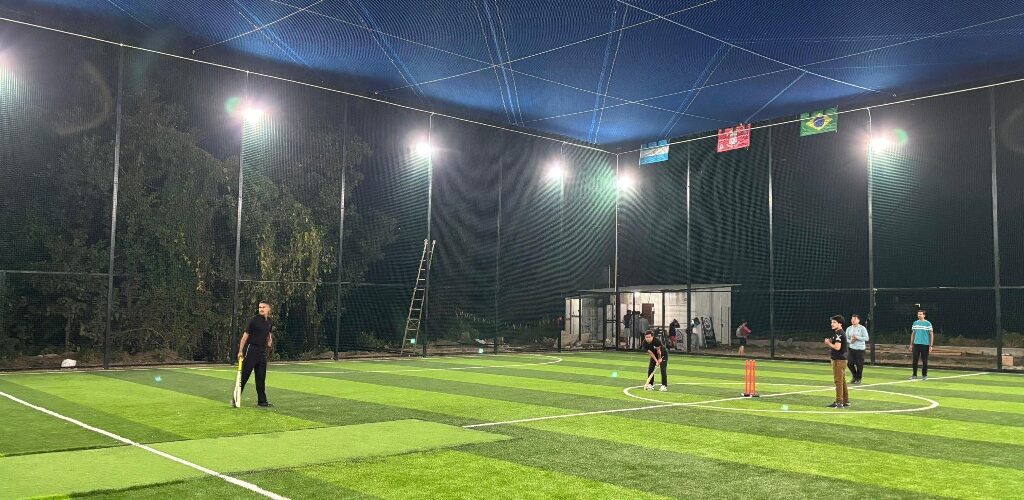
That combination — fast play, close quarters, heavy repeat use — is why the flooring decision for box cricket deserves more scrutiny than it usually gets.
The Main Surface Options
1. Synthetic Turf (Artificial Grass)
The most common choice for box cricket facilities, and for good reason — it closely mimics natural playing conditions while holding up to heavy, repeated use far better than real grass ever could indoors or in a compact enclosed space.
Strengths:
- Consistent ball bounce and pace, close to a natural cricket surface
- Handles heavy footfall and repeated play well when properly installed
- Doesn’t require the water, sunlight, or ongoing lawn maintenance that natural grass would
- Available in different pile heights and densities depending on desired ball speed and bounce characteristics
Trade-offs:
- Upfront cost is generally higher than basic rubber or synthetic sheet flooring
- Quality varies significantly between turf grades — cheaper turf wears and flattens faster under heavy commercial use
- Needs a properly prepared sub-base (shock pad, drainage layer) to perform and last — skipping this is the most common reason turf underperforms
2. Rubber Flooring / Rubber-Backed Systems
Used less often as the primary playing surface but common as a base layer or in budget-conscious setups, particularly for indoor box cricket facilities.
Strengths:
- Strong shock absorption, which helps with player safety and joint impact during fast-paced play
- Generally more budget-friendly than premium turf systems
- Durable under heavy foot traffic
Trade-offs:
- Ball bounce and pace don’t replicate a natural cricket surface as closely as turf does
- Less visually associated with “real” cricket play, which can matter for a commercial facility trying to attract serious players
- Can get slippery if not paired with the right surface texture, particularly in humid or poorly ventilated indoor spaces
3. Synthetic Cricket Mats (Coir/PVC-backed)
A lower-cost option often used for the pitch strip specifically, sometimes combined with turf or rubber for the surrounding area.
Strengths:
- Lower upfront cost, useful for budget builds or temporary/semi-permanent setups
- Easy to replace or reposition compared to a fully installed turf system
- Reasonable performance for recreational-level play
Trade-offs:
- Shorter lifespan under heavy commercial use compared to turf or rubber systems
- Less consistent bounce and surface feel, more noticeable to experienced players
- Not typically suitable as a standalone solution for a facility marketing itself on playing quality
Side-by-Side Comparison
| Factor | Synthetic Turf | Rubber Flooring | Synthetic Mats |
|---|---|---|---|
| Ball bounce/pace realism | High | Moderate | Moderate to low |
| Durability under heavy use | High (with proper install) | High | Moderate |
| Upfront cost | Higher | Moderate | Lower |
| Maintenance | Low to moderate | Low | Moderate (replacement cycles) |
| Player safety/shock absorption | Good | Very good | Moderate |
| Best suited for | Commercial facilities prioritizing play quality | Budget builds, indoor safety-focused setups | Temporary or low-budget setups |
What Actually Determines Cost and Lifespan
Regardless of which surface you choose, two factors matter more than the surface material itself:
Sub-base preparation. A premium turf system installed over a poorly prepared base will underperform and wear faster than a mid-range system installed correctly. This is the single most common corner cut in budget box cricket setups, and it’s usually the most expensive mistake to fix later.
Usage intensity. A facility running back-to-back commercial bookings all day puts far more cumulative stress on a surface than a private, occasionally-used setup. If you’re building for commercial use, it’s worth spending more on the surface grade upfront rather than choosing based on the lowest quote — resurfacing a heavily-used commercial facility is a bigger cost and downtime hit than the initial price difference between turf grades.
Which Surface Should You Choose?
Choose synthetic turf if:
- You’re building a commercial, pay-to-play facility where playing quality drives repeat bookings
- You want the surface to closely replicate natural cricket conditions
- You can budget for proper sub-base preparation, not just the turf itself
Choose rubber flooring if:
- Player safety and shock absorption are the top priority (e.g., youth or beginner-focused facilities)
- Budget is more constrained than play-quality expectations
- The setup is indoor and enclosed, where rubber’s grip and safety profile suit the space
Choose synthetic mats if:
- You’re building a temporary, seasonal, or low-budget setup
- The facility is for occasional/private use rather than heavy commercial bookings
- You may want the flexibility to upgrade the surface later without a full rebuild
Frequently Asked Questions
What is the best flooring for a box cricket ground? For most commercial box cricket facilities, synthetic turf is the preferred choice for its balance of realistic play and durability, though rubber flooring is a common alternative where budget or safety is the priority. The right choice depends on your usage pattern and budget.
How long does box cricket turf last? Lifespan depends heavily on turf grade, sub-base preparation, and usage intensity — a well-installed commercial-grade turf on a properly prepared base will outlast a budget turf on a poor base by a significant margin, regardless of the product label.
Is rubber flooring safe for box cricket? Yes, rubber flooring offers strong shock absorption, which is a meaningful safety advantage, particularly for youth or beginner play. The trade-off is that it doesn’t replicate natural cricket ball behavior as closely as turf.
Do I need a shock pad under box cricket turf? For any commercial or heavily-used setup, yes — a shock pad or proper cushioned sub-base significantly extends turf lifespan and improves player safety, and skipping it is one of the most common reasons turf systems underperform.
Can I mix surfaces in one box cricket facility? Yes, some facilities use a synthetic mat or dedicated pitch strip in the bowling/batting zone combined with turf or rubber for the surrounding area, though a properly installed single consistent surface generally performs and looks more professional for a commercial facility.
The Bottom Line
If you’re building a commercial box cricket facility, synthetic turf on a properly prepared base is the surface most operators land on for a reason — it holds up to heavy repeat use while giving players a realistic playing feel. But the surface choice only pays off if the base preparation underneath it is done right; that’s where most box cricket flooring problems actually start, not with the material on top.
