Before you book a contractor, before you buy turf, before you do anything else — you need to know if your available space can actually fit a box cricket court.
That sounds obvious. But it is one of the most common problems we see on site visits: someone has leased or purchased a plot, committed to building a box cricket facility, and the space is either too small for a playable court or has an awkward shape that forces compromises on dimensions that matter.
Getting the dimensions right from the start determines everything downstream — how the game plays, how many players the court can accommodate, what format works on the surface, and whether the facility is commercially viable.
This guide covers every dimension you need to plan a box cricket court in India — court length and width by format, pitch length, net height, ceiling clearance, run-up space, boundary zones, and the total land area required for the complete facility including buffers, access, and ancillary space.
DS Sports Infra has built box cricket courts across Maharashtra and India for over 7 years. These are the dimensions we actually build to — not theoretical numbers from a rulebook that does not exist for this format.
First: Does Box Cricket Have an Official Standard?
Unlike full cricket (governed by the MCC Laws of Cricket) or even indoor cricket (which has a formal governing body and fixed dimensions), box cricket in India does not have a single officially mandated set of dimensions. There is no governing body that sets a fixed court size for box cricket the way the BCCI or ICC does for standard formats.
What exists instead is a well-established market convention — a set of dimensions that has emerged across thousands of commercial box cricket venues in India because they work. They produce a game that is balanced between batting and bowling, gives players enough room to move safely, and fits the economic reality of urban land costs.
The dimensions in this guide reflect those conventions — what the market has settled on as standard, what operators across India are building, and what players expect when they book a slot.
The Core Dimensions: Court Length and Width
The court is a rectangle. Length is the direction the pitch runs (batting end to batting end). Width is the shorter dimension (side to side).
Standard Court Sizes in India
| Format | Court Length | Court Width | Total Area | Players Per Side |
|---|---|---|---|---|
| Mini / underarm | 30 ft (9.1 m) | 20 ft (6.1 m) | 600 sq ft | 4–5 |
| Compact / entry-level | 40 ft (12.2 m) | 25 ft (7.6 m) | 1,000 sq ft | 5 |
| Standard (most common) | 60 ft (18.3 m) | 30 ft (9.1 m) | 1,800 sq ft | 6 |
| Commercial (recommended) | 80 ft (24.4 m) | 40 ft (12.2 m) | 3,200 sq ft | 6–8 |
| Large / premium | 100 ft (30.5 m) | 50 ft (15.2 m) | 5,000 sq ft | 8–10 |
| Professional / multi-format | 120 ft (36.6 m) | 60 ft (18.3 m) | 7,200 sq ft | 10–12 |
Which Size Is Right for You?
30 × 20 ft (Mini): The absolute minimum playable area for underarm box cricket — typically used for children’s facilities, apartment society common areas, or indoor rooms with very limited ceiling height. Not suitable for overarm bowling. Revenue potential is limited because slot capacity is low and the format has a narrower adult appeal.
40 × 25 ft (Compact): A step up from mini — workable for overarm with a soft ball, good for housing society amenity courts where space is constrained. Still too small for a serious commercial pay-and-play operation targeting adult groups.
60 × 30 ft (Standard): The most widely built format across India’s box cricket market. This is what the majority of existing commercial venues in Mumbai, Pune, Bangalore, and Hyderabad operate on. It fits a 6-a-side game comfortably, allows overarm bowling with a tennis ball at reasonable pace, and gives batsmen enough room to play shots without feeling cramped. If you have the space for 60 × 30 ft and nothing more, this is a viable commercial format.
80 × 40 ft (Commercial Recommended): Our recommended starting point for any serious commercial pay-and-play investment. The extra 20 ft in length makes a significant difference to gameplay quality — bowlers have a more natural run-up, batsmen have more room to drive, and the game feels closer to recognisable cricket. This format also opens the court to 8-a-side bookings, which attract larger corporate groups and generate higher per-slot revenue. The cost premium over 60 × 30 ft is approximately 60–70% more — but the revenue potential is nearly double.
100 × 50 ft (Large / Premium): The premium commercial format — favoured by venues that want to attract corporate events, host small tournaments, and position as a serious cricket destination rather than a neighbourhood pay-and-play. Requires significantly more land and capital but generates correspondingly higher revenue per slot and attracts a higher-spending customer.
120 × 60 ft (Professional): The largest format commonly seen in India — typically used for multi-format facilities that want to host proper box cricket competitions or accommodate hard-ball play. Not a typical starting point for most operators.
The Pitch: Length, Width and Markings
Inside the court, the cricket pitch is the central playing strip where the action happens — the wickets, creases, and bowling and batting zones.
Pitch Length
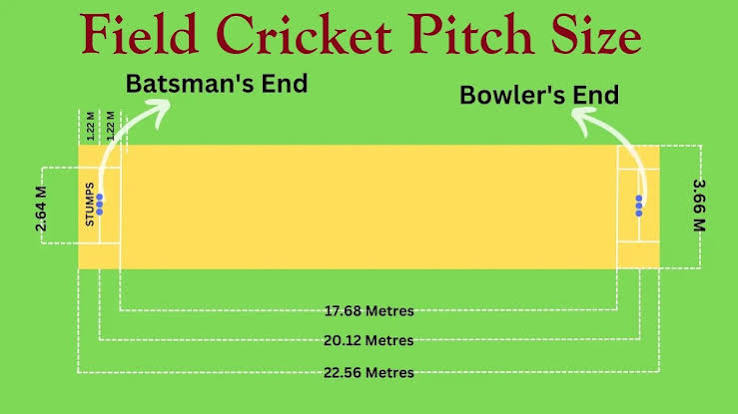
The standard full cricket pitch is 22 yards (20.12 metres) from wicket to wicket. Box cricket adapts this based on the court size:
| Court Length | Recommended Pitch Length | Notes |
|---|---|---|
| 30 ft | 16–18 yards | Shortened for compact play; underarm format |
| 40–50 ft | 17–19 yards | Soft-ball / light overarm |
| 60 ft | 18–20 yards | Standard commercial format |
| 80 ft | 20–22 yards | Full pitch length achievable |
| 100 ft+ | 22 yards | Full standard pitch length |
The pitch is always centred on the court’s long axis. On a 60 × 30 ft court with an 18-yard pitch, there is approximately 3 ft of run-up space at the bowling end and 3 ft of dead space at the batting end — tight but workable with a short run-up.
On an 80 × 40 ft court with a 20-yard pitch, the run-up zone extends to approximately 8–10 ft — noticeably more comfortable and allowing a natural 3–5 stride run-up for medium pace.
Pitch Width
The pitch surface itself — the strip of turf or mat where the ball is bowled — is typically 8–10 ft (2.4–3 m) wide within the court. This is the same width as a standard cricket pitch (10 ft between the return creases) and provides the appropriate batting zone for the batsman.
Pitch Markings
A properly marked box cricket pitch includes:
Bowling crease: The line from which the bowler delivers — marked in white paint across the full pitch width at the bowling end. Positioned at the base of the stumps.
Popping crease: 4 ft (1.22 m) in front of the stumps at both ends. The batsman must be behind this line to avoid being run out or stumped.
Return creases: Lines running perpendicular to the bowling crease at each edge of the pitch. The bowler’s back foot must land behind the return crease.
Batting zone markings: Many box cricket operators add painted zones on the side nets and end walls to define scoring areas — hitting the back wall on the full scores 6, certain zones score 4, and so on. These are operator-defined and vary by venue.
Dead ball zone: Some operators mark a “dead ball” zone immediately in front of the wickets — any ball landing in this zone that the batsman does not play is called a dead ball. This prevents bowlers from consistently bowling very short deliveries that would be unplayable in the confined space.
Net Height and Ceiling Clearance
This is where most planning mistakes happen. The nets and ceiling clearance are as important as the court footprint — a court that is the right size on the ground but has insufficient height is either unplayable or forces dangerous restriction on shot-making.
Minimum Net Height (Side Walls)
| Format | Minimum Side Net Height | Recommended |
|---|---|---|
| Underarm / mini | 10–12 ft | 12 ft |
| Standard overarm (tennis ball) | 14–18 ft | 18 ft |
| Commercial overarm | 18–22 ft | 22 ft |
| Professional / hard ball | 22–28 ft | 25 ft |
Why net height matters: A batsman hitting a lofted shot will send the ball at angles that easily clear a 10 ft net on anything larger than a mini court. If the net is too low, balls escape the court constantly — disrupting play, wearing out balls faster, and making the facility feel amateurish. For a commercial venue, a minimum 18 ft net height is strongly recommended. 20–22 ft is the sweet spot for most formats.
Ceiling Clearance (Indoor Installations)
For indoor box cricket — in a hall, warehouse, or basement — the minimum clear ceiling height above the playing surface is:
| Format | Minimum Ceiling Height | Recommended |
|---|---|---|
| Underarm only | 12 ft (3.7 m) | 14 ft |
| Light overarm (tennis ball) | 18 ft (5.5 m) | 20 ft |
| Standard commercial | 20 ft (6.1 m) | 22–25 ft |
| Professional | 25 ft (7.6 m) | 28 ft+ |
This is the most common constraint that kills indoor box cricket plans. A warehouse or hall that looks ideal on the floor plan often has roof beams, HVAC ducting, or structural elements that bring the effective clear height below 18 ft — making overarm play either impossible or dangerous. Always measure to the lowest overhead obstruction, not to the apex of the roof.
For rooftop installations, the “ceiling” is the sky — so height is not a constraint, but the net structure must be designed to handle wind load at the top of a building.
Total Land / Space Requirement — Including Buffers
The playing court dimensions are only part of the space requirement. A functional box cricket facility needs:
Playing Court Area
The court itself, as per the size selected.
Safety Buffer Zones
Around the outside of the netted structure, you need clearance for:
- Behind the bowling end: Minimum 4 ft, recommended 6 ft — for the bowler’s run-up approach and safety
- Behind the batting end: Minimum 4 ft, recommended 6 ft — for the non-striking batsman and fielders
- Side clearance: Minimum 3 ft each side — for structural frame footings and maintenance access
For a 60 × 30 ft court, total structure footprint including buffer: approximately 70 × 38 ft
For an 80 × 40 ft court: approximately 90 × 48 ft
Ancillary Space Requirements
| Space | Minimum Area | Notes |
|---|---|---|
| Waiting / seating area | 200–500 sq ft | Players waiting for their slot |
| Equipment storage | 50–100 sq ft | Bats, balls, protective gear |
| Toilet facilities | 80–150 sq ft | Essential for commercial operations |
| Reception / counter | 50–100 sq ft | Booking, payments, shoe change |
| Parking | 1,000–3,000 sq ft | Context-dependent — critical in car-dependent areas |
Total Plot Size Required — Realistic All-In
| Court Size | Court Area | Total Plot Needed (with ancillary) |
|---|---|---|
| 60 × 30 ft (standard) | 1,800 sq ft | 3,500 – 4,500 sq ft |
| 80 × 40 ft (commercial) | 3,200 sq ft | 5,000 – 7,000 sq ft |
| 100 × 50 ft (large) | 5,000 sq ft | 7,500 – 10,000 sq ft |
| Two courts (80×40 ft) | 6,400 sq ft | 9,000 – 13,000 sq ft |
If you have a plot that is smaller than the minimums in this table for the court size you want, either downsize the court or reconfigure the ancillary space — but do not eliminate the buffer zones around the structure. Those exist for player safety, not aesthetics.
Layout Considerations: How to Position the Court on Your Plot
Orientation
Where possible, orient the pitch so neither batting end faces directly into the setting sun — typically avoid an east-west orientation if your peak play hours include late afternoon. A north-south pitch orientation is generally preferred for natural light management.
For indoor and rooftop courts, orientation is less critical because natural light is not a factor.
Single Court vs Multi-Court Layout
Single court: Simplest layout. Maximise court size for the available plot, centre the structure, allocate remaining space to seating, reception, and toilets.
Two courts side by side: The most common expansion configuration. Two 60 × 30 ft courts can be placed side by side sharing a common side wall / net structure — the shared wall reduces total structural cost compared to two independent builds. Minimum plot width for two side-by-side 30 ft courts: approximately 68–72 ft (allowing for shared structure and outer buffer).
Two courts end to end: Less common, used where the plot is long and narrow. The shared end net needs to be designed carefully to prevent balls from one court entering the other.
Staggered layout (L-shape or irregular plot): If your plot is not rectangular, courts can be designed to fit the available geometry — but each deviation from a clean rectangle adds complexity and cost to the structural frame. Get a site plan drawn before committing to an irregular layout.
Dimension Differences: Indoor vs Outdoor vs Rooftop
The playing dimensions are the same regardless of location — but the structural and clearance requirements differ:
Outdoor (Ground Level)
- No ceiling height constraint
- Net structure typically 18–25 ft MS/GI pole frame
- Wind load must be factored into structural design — particularly for tall net structures
- Drainage must be built into the base
- Most cost-effective configuration for a given playing area
Indoor (Existing Hall or Warehouse)
- Ceiling height is the critical constraint — must have minimum 18 ft clear of all obstructions
- Net structure can be lighter — may anchor to existing roof beams rather than independent poles
- No weather concern during play
- Existing base may need levelling but avoids new concrete slab cost
- Most important check: measure to the lowest beam or duct, not to the apex of the roof
Rooftop
- No ceiling height constraint
- Structural load assessment mandatory — minimum 200 kg/sq m load bearing capacity recommended
- Waterproofing of the base essential before turf is laid
- Wind load at roof height is significantly higher than ground level — frame design must account for this
- Access route must be assessed — how do players get up, and can equipment be delivered?
- Often the most cost-effective land solution in dense urban areas
Choosing the Right Court Size: A Decision Framework
If you are still deciding between court sizes, here is a simple framework:
If your available plot is under 3,500 sq ft: A mini or compact court is possible, but commercial viability as a pay-and-play operation is limited. Consider whether this is genuinely a commercial project or more of an amenity for a housing society or school.
If your available plot is 3,500 – 5,500 sq ft: A 60 × 30 ft standard court is your format. This is the minimum viable commercial size for a pay-and-play operation targeting adult players.
If your available plot is 5,500 – 9,000 sq ft: An 80 × 40 ft commercial court is achievable and recommended. This is the format that generates the best return on investment for most urban operators.
If your available plot is 9,000 sq ft or more: Consider two courts, or a single premium 100 × 50 ft court. Two courts dramatically increase revenue capacity and allow simultaneous bookings.
If your available space is indoor (hall or warehouse): Measure the clear ceiling height first. If it is under 18 ft, the space is only viable for underarm / children’s formats. If it is 18–22 ft, it works for standard commercial box cricket. Above 22 ft is excellent.
If your available space is a rooftop: Get a structural engineer’s assessment before doing anything else. If the load capacity checks out, rooftop box cricket is a genuinely attractive commercial model in dense urban areas where land cost makes ground-level operations economically difficult.
Common Dimension Mistakes to Avoid
Measuring the plot without accounting for buffer zones: The court dimensions are the playing area inside the net. The net structure itself needs clearance around its perimeter for footings, maintenance, and safety. Always add 8–12 ft to each dimension when calculating plot requirements.
Ignoring ceiling height for indoor spaces: The most common fatal mistake in indoor box cricket planning. A ceiling at 16 ft looks like enough until you realise overarm bowling is impossible and every mishit goes into the beams.
Building a pitch length that does not fit the court: On a 60 ft court, a 22-yard pitch (66 ft) is longer than the court. Always confirm that the pitch length fits within the court length with adequate run-up and dead space at both ends.
Choosing court size based on budget alone: A 30 × 20 ft court is cheaper to build but may generate so little revenue that payback is extremely slow. Size selection should be driven by the maximum viable size for your plot — not by what saves money upfront.
Not planning for future expansion: If your plot can eventually fit two courts, design the first court’s position on the plot to allow the second to be added without demolishing anything. Leaving adequate space on the adjacent side during the first build costs nothing — retrofitting it later after a suboptimal layout costs significantly more.
How Dimensions Affect Your Construction Budget
Court size directly drives cost — here is a quick reference linking dimensions to the build cost ranges we cover in detail in our box cricket court setup cost guide:
| Court Size | Approx. All-In Construction Cost |
|---|---|
| 30 × 20 ft (mini) | ₹2.5 – ₹5 lakh |
| 60 × 30 ft (standard) | ₹7 – ₹12 lakh |
| 80 × 40 ft (commercial) | ₹14 – ₹25 lakh |
| 100 × 50 ft (large) | ₹22 – ₹38 lakh |
| Two courts (80×40 ft each) | ₹22 – ₹40 lakh |
For a full breakdown of what drives these costs — turf specification, structural frame, netting grade, lighting — see our complete box cricket court cost guide.
For information on the artificial turf and flooring systems used in box cricket courts, see our sports flooring cost guide.
Frequently Asked Questions
The most commonly built commercial box cricket court in India is 80 × 40 ft (3,200 sq ft). The 60 × 30 ft format is the most widely existing size across older venues. There is no single officially mandated standard — dimensions are driven by available space and the format of play.
A minimum playable area of 30 × 20 ft is possible for underarm / children’s formats. For overarm box cricket that adults will find genuinely enjoyable, 60 × 30 ft is the practical minimum. Smaller than this and the batting and bowling experience is too constrained for regular commercial use.
What is the pitch length in box cricket? Pitch length in box cricket typically ranges from 16 to 22 yards depending on court size. A 60 ft court accommodates 18–20 yards. An 80 ft court can accommodate the full 22-yard standard cricket pitch length.
What net height is required for a box cricket court? For standard overarm box cricket with a tennis ball, minimum 18 ft side net height. Recommended commercial specification is 20–22 ft. For professional formats, 22–28 ft. Overhead netting must cover the full ceiling area of the court — no gaps.
What ceiling height is required for indoor box cricket? Minimum 18 ft clear of all obstructions (beams, ducting, lighting fixtures) for standard overarm play. Recommended 20–22 ft. Always measure to the lowest obstruction — not to the apex of the roof.
How much total land is needed for a box cricket facility? For a single 60 × 30 ft court with basic ancillary space (seating, toilets, entry): minimum 3,500 sq ft total plot. For an 80 × 40 ft commercial court: 5,000–7,000 sq ft. For two 80 × 40 ft courts: 9,000–13,000 sq ft.
Can I build a box cricket court on a rooftop? Yes — provided the building has adequate load-bearing capacity (minimum 200 kg/sq m recommended), the base is properly waterproofed before turf is laid, and the structural frame is designed for the higher wind loads at roof height. Many successful commercial operators in Mumbai, Pune, and Bangalore run rooftop box cricket courts.
What is the difference between indoor and outdoor box cricket dimensions? The playing court dimensions are identical. The difference is the structural requirement — outdoor courts need a free-standing frame designed for wind load, while indoor courts can anchor to existing building structure. The critical indoor constraint is ceiling height, which does not apply outdoors.
Summary: Quick Reference Dimension Chart
| Dimension | Mini | Standard | Commercial | Large |
|---|---|---|---|---|
| Court length | 30 ft | 60 ft | 80 ft | 100 ft |
| Court width | 20 ft | 30 ft | 40 ft | 50 ft |
| Pitch length | 16–18 yds | 18–20 yds | 20–22 yds | 22 yds |
| Pitch width | 8 ft | 8–10 ft | 10 ft | 10 ft |
| Net height | 12 ft | 18–20 ft | 20–22 ft | 22–25 ft |
| Ceiling clearance | 14 ft | 18–20 ft | 20–22 ft | 22–25 ft |
| Players per side | 4–5 | 6 | 6–8 | 8–10 |
| Total plot needed | 1,500 sq ft | 3,500 sq ft | 6,000 sq ft | 9,000 sq ft |
| Est. build cost | ₹2.5–5L | ₹7–12L | ₹14–25L | ₹22–38L |
Final Word: Get the Dimensions Right Before Anything Else
Every other decision in a box cricket project — turf specification, structural frame, lighting, netting — flows from the court dimensions. Get those right first, based on your actual available space, your target format, and your commercial goals.
Measure your plot accurately. Account for the buffer zones. Check the ceiling height if indoor. Get a structural assessment if rooftop. Then commit to a court size — and build to that size properly, with the right specification for the usage level you are targeting.
DS Sports Infra provides free site assessments for box cricket projects across Maharashtra and India. We will measure your space, recommend the right court size for your plot and commercial goals, and give you a fully itemised quote — not a ballpark number.
Contact DS Sports Infra for a Free Box Cricket Site Assessment →
