Something is changing in Indian sports, and it’s happening faster than most people in the industry expected.
A decade ago, the conversation about sports infrastructure in India was almost entirely about outdoor facilities — cricket grounds, football turfs, athletics tracks. Indoor courts were a luxury reserved for elite academies, five-star hotels, and the occasional well-funded school. The idea of a private badminton hall in a Tier-2 city turning a profit was, for most people, a stretch.
That picture has changed fundamentally. Today, indoor sports facilities are being built at a pace and in locations that would have seemed unrealistic five years ago — residential society multi-sport halls, corporate campus courts, pay-and-play badminton arenas in cities like Nashik, Nagpur, and Coimbatore, and a wave of academy-style training centres serving sports that barely existed on the Indian competitive calendar a few years ago.
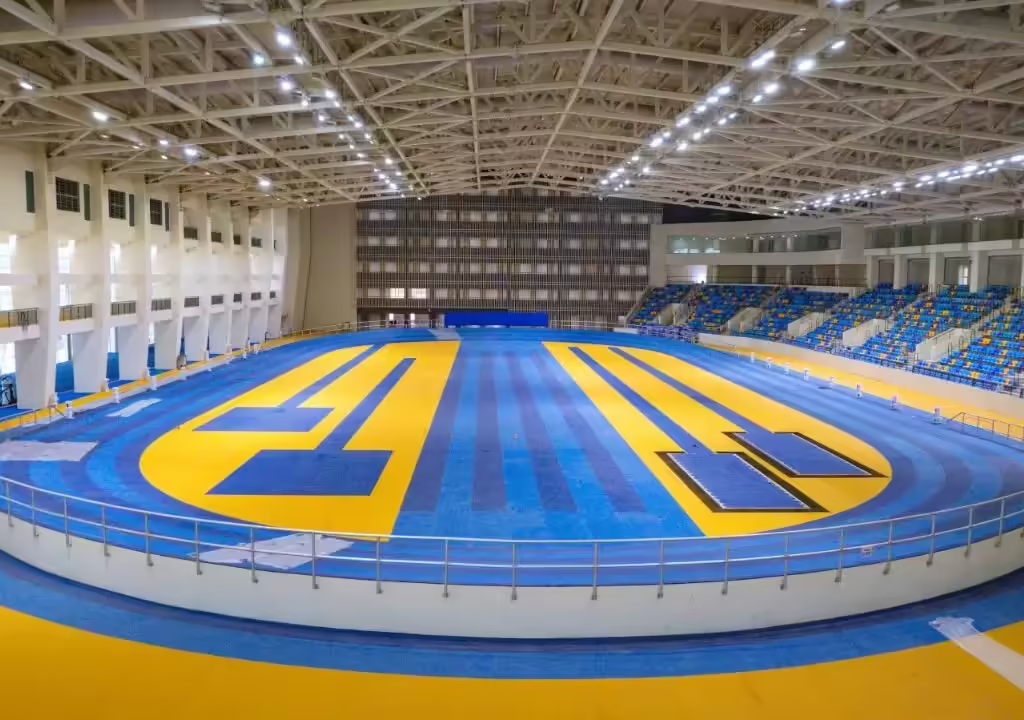
This article breaks down exactly why this is happening, what is driving it from multiple directions at once, and what it concretely means for builders, contractors, and investors looking at the sports infrastructure space in 2026.
The Numbers First: How Big Is This Market Actually Getting?
Before we get into the drivers, it helps to understand the scale of what is happening.
The Indian sports and fitness goods market reached USD 2,497 million in 2025 and is projected to hit USD 4,058 million by 2034, growing at a compound annual growth rate of 5.4%. That is the equipment side. The infrastructure side is growing alongside it.
The global sports facility construction market was valued at $196.4 billion in 2025 and is projected to reach $342.8 billion by 2034. The Asia-Pacific region, led by China and India, accounted for approximately 29.4% of that global market in 2025 — and India’s surge in indoor sports facilities in Tier-2 and Tier-3 cities is driving construction activity at an unprecedented pace.
On the government side — the single biggest demand signal for any builder working in this space — the Union Budget 2026–27 has seen the highest-ever year-on-year increase in sports spending, with the ministry allocation rising 18% from ₹3,794 crore to ₹4,479.88 crore. The Khelo India allocation alone stands at ₹924.35 crore for 2026–27, making it the single largest line item among sports schemes.
These are not marginal movements. They represent a structural shift — one that is already translating into project enquiries, land allocations, and construction timelines on the ground.
Why Is Indoor Specifically Growing — Not Just Sports in General?
This is the important distinction. General sports enthusiasm in India has been building for years. The Khelo India programme, the success of Indian athletes internationally, and rising disposable incomes have all driven broader participation. But the indoor facility segment is growing faster than outdoor, and for specific reasons worth understanding.
1. The Weather Problem Has Become a Business Problem
India has a monsoon. It runs from June through September and makes outdoor sports either completely impossible or significantly degraded across a large part of the country. For a school, an academy, or a pay-and-play venue trying to run a year-round business, four months of rain-outs is not an inconvenience — it is a 33% revenue loss.
Modern multi-sport indoor complexes are being developed specifically to accommodate badminton, basketball, futsal, and volleyball — facilities that offer year-round access to training regardless of season. This is especially true for sports that have developed serious amateur competitive ecosystems in India — badminton most of all, but increasingly basketball, futsal, and volleyball too. When there are regular local tournaments, league-style competitions, and coaching academies attached to these sports, the facility operators need consistent availability. Outdoor courts simply cannot deliver that in most of India’s climate zones.
2. Urbanisation Has Compressed Outdoor Space
India’s cities are building upward and inward. In Mumbai, Pune, Hyderabad, Chennai, and Bangalore — the cities driving the private sports facility market — land costs have made large outdoor facilities economically unviable for private operators. A half-acre football ground in suburban Mumbai that might have been affordable a decade ago is now worth several crore rupees as residential land.
The response to this constraint is indoor intensification — multi-sport halls that stack multiple courts into a single covered structure, often on the upper floors of commercial buildings, inside mall basements, or as rooftop facilities on residential society buildings. With urban space constraints, rooftop courts, pickleball courts, and society play areas are rapidly rising as private operators and developers find ways to fit sports infrastructure into tighter footprints.
For builders, this means a different kind of project brief than outdoor work — smaller footprint, more technical requirements around structural loading, acoustics, ventilation, and flooring systems that can handle intensive use within confined dimensions.
3. The Rise of Pay-and-Play Commercial Facilities
One of the most significant structural shifts in Indian sports infrastructure is the emergence of the commercial pay-and-play model as a legitimate business category. Platforms like Playo, KheloMore, and Hudle have made court booking as easy as booking a restaurant table — and in doing so, they have created demand visibility that gives private investors confidence to build.
Private sector investments are rising, especially in football turfs, badminton academies, and gyms, with Tier-2 and Tier-3 cities witnessing rapid infrastructure growth to meet demand.
The numbers on pickleball alone illustrate how fast commercial court infrastructure can scale when demand conditions are right. India’s pickleball court count exploded from 200 in early 2024 to over 1,200 by mid-2025, with 3–4 new venues added weekly in urban hubs — many of them simple conversions of existing badminton facilities, minimising costs and maximising reach.
This conversion dynamic is particularly important for flooring contractors and builders. Many of the most active clients in 2025 and 2026 are not building from scratch — they are retrofitting existing covered spaces, resurfacing underperforming courts, or adding lines to convert a single-sport hall into a multi-sport revenue generator.
4. Schools, Societies, and Corporates Are All Building at Once
What makes the current demand cycle unusual is that it is not coming from one buyer type — it is converging from three distinct sectors simultaneously.
Schools and educational institutions are under increasing pressure from parents and regulatory requirements to offer quality physical education infrastructure. The National Education Policy (NEP 2020) emphasised sports and physical wellness as core to the curriculum — and while implementation has been uneven, the direction of travel has prompted many private schools to accelerate court-building plans. Every school is now expected to include at least one or two multi-sport courts, generating consistent demand for safe, standards-compliant flooring.
Residential societies have discovered that sports amenities are among the most effective differentiators in a crowded real estate market. A badminton court or multi-sport hall in a new housing complex is increasingly standard rather than aspirational. Schools, universities, and residential complexes are incorporating fitness facilities as a standard amenity. For large township projects across Maharashtra, Gujarat, and the southern metros, the sports facility brief is arriving as part of the original development specification — not as an afterthought.
Corporates are building employee wellness into office infrastructure at a scale not seen before the pandemic. The shift to hybrid working, combined with growing awareness of employee health outcomes, has made on-site sports facilities a retention and recruitment tool. Corporate organisations are investing in employee wellness through on-site gyms and sports courts, viewing premium facilities as essential for attracting and retaining talent.
These three buyer types have different specifications, different budget structures, and different decision timelines — but they are all active in the market at the same time, creating a demand environment that is broader and more resilient than anything India’s sports infrastructure sector has seen before.
The Government Tailwind: Khelo India Mission and the 2036 Olympics
No analysis of India’s indoor sports facility market is complete without understanding the government’s role — because the policy direction is now unambiguous and the budgets are real.
The Union Budget 2026–27 marks a significant step towards strengthening India’s sports ecosystem, with the Khelo India Mission envisioned to transform the sports sector over the next decade through talent development, infrastructure creation, and manufacturing-led employment generation.
The overarching goal is to position India among the Top 10 sporting nations by 2036 and to be ready to host the 2036 Olympics — requiring world-class infrastructure from facilities to equipment, training centres to high-performance centres.
What this means practically for builders is a pipeline of government-funded projects — school upgrades, community sports centres, SAI training facilities, and Khelo India centres — that will continue to flow through state governments and municipal bodies over the next decade. Contractors who have the capability to meet specification requirements and certification standards for government projects are well positioned to benefit from this pipeline alongside their private-sector work.
₹500 crore has been specifically allocated for the promotion of sports goods manufacturing as part of the 2026–27 budget — a signal that domestic supply chains, including Indian-manufactured flooring systems, will receive support to develop. For contractors currently dependent on imported PU and PVC systems, this is worth watching.
The New Sports Driving Facility Construction
Beyond the established sports like badminton and basketball, several emerging sports are generating facility construction demand that simply did not exist three or four years ago.
Pickleball
India’s pickleball court count exploded from 200 in early 2024 to over 1,200 by mid-2025. Participation trends indicate the sport is on track to surpass 100,000 active players by 2028, with organised play expanding steadily beyond metropolitan centres into Tier-2 and Tier-3 cities. Court infrastructure is projected to grow to 700–1,000 additional operational courts nationwide within the next few years, supported by low setup costs and the ability to convert existing badminton and tennis facilities.
For builders, pickleball is almost uniquely attractive as a retrofit opportunity. An existing badminton court can be converted to four pickleball courts with new line marking and net posts — a relatively low-cost intervention that significantly increases a facility’s revenue potential. Many badminton hall operators are already making this move.
Futsal
Indoor football (futsal) has been growing steadily as urbanisation removes the space for full-sized football grounds. Futsal requires a hard synthetic or vinyl surface, good lighting, boundary walls, and goals — a project profile that suits indoor multi-sport hall construction well. The Indian futsal league ecosystem is still developing but participation at the grassroots is already generating consistent facility enquiries.
Padel Tennis
Still early stage in India but growing fast among premium clubs, luxury residential developments, and corporate campuses. A padel court requires a glass-walled enclosure and specific synthetic turf or synthetic hard surface — a higher-specification project than a basic badminton hall, with correspondingly higher project value.
Basketball
Post-pandemic, basketball participation in India accelerated dramatically — driven in part by NBA India’s active growth programme, the success of Indian players internationally, and the sport’s natural appeal to the urban youth demographic. Indoor multi-sport complexes being developed across urban centres now routinely include basketball as a standard court alongside badminton and volleyball.
What This Means for Builders and Contractors
If you are in the sports infrastructure space — whether as a general contractor, a specialised flooring contractor, or a full design-and-build operation — the demand environment in 2026 is the best it has ever been in India. But demand alone does not automatically translate into profitable work. Here is what the growth environment actually requires from the supply side.
Multi-Sport Capability Is Now the Expectation
Gone are the days of single-use courts. Schools, clubs, and societies prefer modular flooring where one space supports badminton, volleyball, pickleball, and futsal.
A client building a new facility almost never wants a single-sport hall anymore. They want a surface and line-marking system that maximises the number of sports the space can host — because multi-sport capability directly drives revenue through higher booking utilisation. Contractors who can spec and deliver a multi-sport PU or vinyl system with correctly executed overlapping line markings for four or five sports are significantly more valuable to this client than a specialist in one surface type.
Speed of Execution Is a Competitive Differentiator
Private operators — especially commercial pay-and-play venues — are acutely sensitive to construction timelines because every week of delay is lost booking revenue. Schools and societies have term calendars and annual planning cycles that create hard deadlines. A contractor who can reliably commit to and deliver a 21-day installation window will win work over a cheaper competitor who needs 45 days.
Flooring Quality Is Becoming Non-Negotiable
As the market matures and more facilities are built, the gap between a well-installed court that holds up under heavy use and a poorly executed job that needs resurfacing in Year 2 is becoming visible — and word travels fast in the academy and club network. Reputation for quality is now a meaningful source of repeat and referral business in a way it was not when the market was smaller.
Certification and Standards Knowledge Opens Bigger Projects
The right facility depends on land area, budget, primary user group, and whether certification matters for the use case — and getting this wrong is expensive to fix. Government-funded facilities, sports academies hosting sanctioned tournaments, and premium club facilities increasingly require certified surface systems — BWF approval for badminton, FIBA approval for basketball, ITF for tennis. Contractors who understand these standards, can specify compliant systems, and can provide the documentation to prove it are the only contractors eligible for a growing category of high-value projects.
Tier-2 and Tier-3 Cities Are the Growth Frontier
The metros are still active — but they are also the most competitive market for contractors. The real growth frontier is Tier-2 and Tier-3 cities, where land is cheaper, competition is thinner, and pent-up demand from schools, societies, and private operators is significant and growing. Tier-2 and Tier-3 cities are witnessing rapid infrastructure growth to meet demand — and the contractors building relationships in these markets now are establishing an advantage that will compound as the pipeline grows.
For Maharashtra-based contractors, cities like Nashik, Aurangabad (Chhatrapati Sambhajinagar), Kolhapur, Solapur, and Amravati represent exactly this kind of opportunity — meaningful demand, limited specialist competition, and the kind of project sizes (₹2–₹10 crore) that make sense logistically without requiring the scale of a Mumbai or Pune operation.
The Flooring Decision Is the Most Important Decision in Any Indoor Project
For a client building an indoor facility, the flooring choice determines everything downstream — maintenance cost, player experience, injury rates, regulatory compliance, and the asset’s resale or lease value as a sports property. Getting it right is not a secondary consideration; it is the primary infrastructure decision.
Asia-Pacific will dominate the indoor sports flooring market’s growth landscape, driven by large-scale infrastructure investments in India and Southeast Asia. For Indian indoor facilities in 2026, the decision framework looks roughly like this:
| Facility Type | Recommended Surface |
|---|---|
| Budget facilities and school multi-sport halls | Sports vinyl/PVC or acrylic |
| Academy-level training centres | PU flooring — best long-term value, 12–20 year lifespan |
| Competition and certification venues | PU with certified system, or maple wood for premium badminton |
| Commercial pay-and-play hubs | PP modular tiles or vinyl for flexibility and easy reconfiguration |
The contractor who can guide a client through this decision — rather than simply quoting what the client asks for — is positioned as a consultant, not just a supplier. That positioning is worth more than a price advantage in most conversations.
Looking Ahead: What the Next Five Years Look Like
The structural drivers behind indoor sports facility growth in India — urbanisation, rising incomes, government investment, emerging sports, and the commercial viability of pay-and-play — are not short-term trends. They are demographic and economic forces operating on a multi-decade timeline.
The revamped Khelo India Mission is envisioned as a ten-year, end-to-end athlete development framework — moving beyond talent identification to structured progression from grassroots to elite performance — built around a nationwide network of training centres. India’s stated ambition to host the 2036 Olympics means infrastructure investment at the national and state level will be a policy constant for the next decade. From infrastructure to equipment, training facilities to high-performance centres, India’s sports ecosystem is aiming to match world-class standards.
For builders and contractors in the sports infrastructure space, this is the most favourable demand environment in the sector’s history. The question is not whether the work is coming — it is whether your capability, your relationships, and your reputation are ready to capture the share of it that you deserve.
How DS Sports Infra Fits Into This Picture
DS Sports Infra has been building sports infrastructure across India for over seven years and 400+ completed projects. We work across the full range of indoor facility types — from school multi-sport halls to professional badminton academies, residential society courts to corporate campus facilities — and across the full range of surface systems: PU, PVC vinyl, EPDM, acrylic, artificial turf, and wooden flooring.
If you are planning an indoor sports facility project — whether you are at the enquiry stage, the specification stage, or ready to move to construction — we can help you get the flooring decision right from the beginning.
