If you are a school principal, trustee, or management committee member who has been asked to put together a budget for a new sports court — this guide is written specifically for you.
Not for professional sports clubs. Not for commercial pay-and-play operators. For schools.
Because the conversation around school sports court budgets is different from every other context. Schools have to balance student safety standards, board affiliation requirements, parent expectations, limited capital budgets, and in many cases the possibility of government grant funding — all at the same time. And most of what is written online about sports court costs is aimed at commercial operators and does not reflect how school projects actually work.
This guide covers everything a school decision-maker needs to know: what a court actually costs by type and surface, what is mandatory vs optional, how to plan a realistic all-in budget, what hidden costs to watch for, and how government funding schemes can offset a significant portion of what you would otherwise have to raise from school fees or management funds.
First: Why Schools Are Building Courts Now More Than Ever
Before the budget numbers, it helps to understand why this conversation is happening at schools across India right now — because the pressure is coming from multiple directions simultaneously.
The National Education Policy 2020 (NEP 2020) explicitly mandates that schools provide adequate sports facilities and recreational resources as part of the minimum infrastructure standard. NEP 2020 states that every school must have “sports facilities and equipment” as a non-negotiable infrastructure requirement — not a nice-to-have. For private schools seeking CBSE or ICSE affiliation or renewal, this requirement is being taken increasingly seriously by boards during inspection.
On the CBSE side specifically, affiliation norms require that schools provide dedicated sports and playground facilities. For a senior secondary school in a city with a population above 1.5 million, a minimum land area of 4,000 sq metres is required, with adequate provision for sports and physical activity. Schools that cannot provide an on-site ground may rent a playground from another organisation for a minimum tenure of 5 years — but most management committees rightly view an owned, properly surfaced sports court as a more reliable long-term solution.
Beyond compliance, there is a straightforward competitive pressure. Parents choosing between schools in 2026 are comparing sports infrastructure as part of the decision. A school with a properly surfaced multi-sport court, working floodlights, and a badminton hall is visibly more attractive than one with a cracked concrete slab or an uneven dirt ground. Especially in urban and semi-urban Maharashtra, where the private school market is competitive, sports infrastructure has become a meaningful admissions differentiator.
The Quick Answer: What Does a School Sports Court Cost?
Here is a realistic cost range by court type for a school context — meaning reasonable quality, appropriate for student use, safe and durable, without the premium specifications of a professional competition venue:
| Court Type | Surface | Estimated Total Cost |
|---|---|---|
| Outdoor multi-sport court (basketball + volleyball + badminton lines) | Acrylic | ₹8 – ₹20 lakh |
| Single outdoor badminton court | Acrylic | ₹3 – ₹7 lakh |
| Single indoor badminton court | PVC Vinyl | ₹8 – ₹15 lakh |
| Indoor multi-sport hall (3–4 courts) | PVC Vinyl or PU | ₹25 – ₹60 lakh |
| Half basketball court (outdoor) | Acrylic | ₹2 – ₹5 lakh |
| Full basketball court (outdoor) | Acrylic | ₹4 – ₹9 lakh |
| Children’s play area / playground | EPDM Rubber | ₹5 – ₹18 lakh |
| 200m jogging track (4 lanes) | Acrylic or EPDM | ₹12 – ₹30 lakh |
| 400m athletics track (standard) | PU or EPDM | ₹50 lakh – ₹1.2 crore |
These are all-in estimates covering material, base preparation, installation, and basic line marking. They assume a reasonably level existing surface and do not include structural roofing (for indoor courts), lighting, or boundary fencing — all of which are separate line items addressed below.
The Most Common School Court: Outdoor Multi-Sport Acrylic — ₹8 to ₹20 Lakh
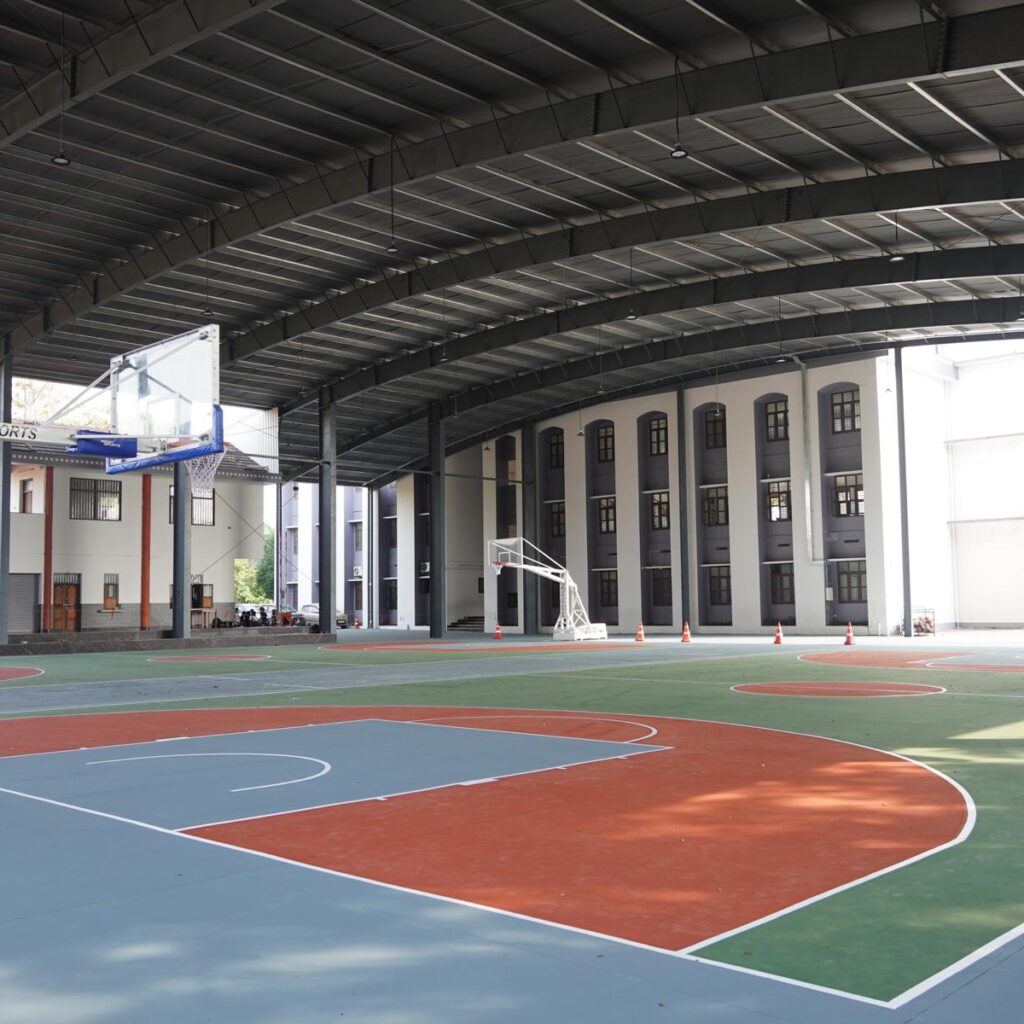
For most schools in India, the most practical and cost-effective starting point is an outdoor multi-sport acrylic court. This is a single hard-surface court — typically 28m × 16m or larger — that is marked for basketball, volleyball, and badminton simultaneously. Students can use the same space for three sports simply by using different markings, which maximises the value of every square metre.
Acrylic basketball court flooring costs approximately ₹45–₹90 per sq ft depending on court size and layer specification. For a standard school multi-sport court of approximately 4,500 sq ft (28m × 15m), this works out to:
- Basic 3-layer acrylic system: ₹45 per sq ft × 4,500 sq ft = ₹2.02 lakh in surface material and installation
- Add base preparation, line marking, and site work: typically ₹3–₹6 lakh depending on existing surface condition
- Add boundary fencing: ₹2–₹5 lakh depending on height and material
- Add floodlighting (4 poles): ₹2–₹4 lakh
- Total realistic all-in budget: ₹8–₹16 lakh for a well-executed outdoor multi-sport court
For a premium finish with a better acrylic system, cushion coat layers, and higher-quality fencing and lighting, the total can reach ₹18–₹22 lakh.
Why acrylic for schools?
Acrylic is the right choice for most school outdoor courts because it is weather-resistant (handles monsoon and Indian summer heat well), low maintenance (sweep clean, no polishing or annual treatment needed), long-lasting (8–12 years before resurfacing is needed), and safe for students of all ages with the correct silica-sand grip coat applied. It can be marked for multiple sports, which is the key requirement for a school that needs to maximise one surface’s utility.
Indoor Badminton Court for Schools — ₹8 to ₹15 Lakh Per Court
Badminton has become one of the most popular school sports in India — partly driven by India’s success at the international level, partly because it is a sport that works well in the confined spaces most urban schools can offer. A single indoor badminton court of regulation size (13.4m × 6.1m playing area, 15m × 8m hall minimum) with PVC vinyl flooring, appropriate ceiling height, and basic LED lighting is the most commonly requested indoor court project from school clients.
A single indoor badminton court with PVC vinyl flooring, walls, lighting to basic tournament standard, and court marking costs approximately ₹8 to ₹15 lakh depending on hall conditions and lighting specification.
The wide range within this band comes from:
- Existing hall condition — if you have a covered hall that just needs flooring and lighting, costs are at the lower end. If you need structural modifications to achieve the 9m minimum ceiling clearance, costs rise significantly.
- Flooring grade — a 4mm basic PVC sheet costs less than a 7mm cushioned performance vinyl. For school use, 5–6mm is a practical middle ground.
- Lighting — badminton requires very specific lighting to eliminate shadows and glare at shuttle height. Proper sports LED fixtures for a single court cost ₹1–₹2 lakh. Cutting corners on lighting is one of the most common mistakes in school court projects.
If you have a hall that already meets height requirements and just needs flooring and lighting, budget ₹8–₹10 lakh. If you are converting an existing covered space that requires some civil modification, budget ₹12–₹15 lakh.
What about multiple courts?
Many schools ask about converting a larger hall into 3 or 4 badminton courts. This is a very efficient use of space — a 4-court badminton hall requires approximately 36m × 18m of playing area, and the flooring for the whole hall can be laid as one continuous vinyl sheet with courts marked within it. For a 4-court indoor hall with PVC vinyl, proper lighting for all courts, and court marking:
- Budget range: ₹25 – ₹45 lakh all-in
At this scale, the per-court cost drops significantly — making a 4-court hall much better value than four separate single-court installations.
Children’s Play Area and Playground Surfacing — ₹5 to ₹18 Lakh
For primary and pre-primary sections, the most important sports infrastructure investment is often not a court at all — it is a safe, impact-absorbing play surface for the area where students use swings, climbing frames, and open play.
Bare concrete and compacted mud are simply not safe fall surfaces for young children. The international standard for playground safety — EN 1177 — specifies the minimum fall-height protection required for any play equipment, and EPDM rubber surfacing is the most widely used compliant solution in India.
EPDM rubber surfacing for school play areas typically costs ₹120–₹300 per sq ft depending on thickness. Thickness is critical because it determines the critical fall height the surface can handle:
| EPDM Thickness | Critical Fall Height Protected | Suitable For |
|---|---|---|
| 10mm | Up to 0.6m | Flat play areas, walking tracks |
| 20mm | Up to 1.5m | Standard playground equipment |
| 30mm | Up to 2.2m | Climbing frames, higher slides |
| 40mm | Up to 3.0m | Larger play structures |
For a standard primary school play area of 1,000 sq ft with 20mm EPDM:
- Material and installation: ₹120–₹150 per sq ft × 1,000 sq ft = ₹1.2–₹1.5 lakh
- Add surface preparation and base levelling: ₹50,000–₹1 lakh
- Total for 1,000 sq ft: ₹1.7 – ₹2.5 lakh
For a larger 3,000–5,000 sq ft play zone with multi-colour EPDM design and thicker sections under equipment: ₹8–₹18 lakh.
This investment is also increasingly relevant from a liability perspective. A student injured on an unsafe play surface in a school that could have installed a compliant surface is a very different situation from one where a proper safety surface was in place. For school management, this is not a discretionary spend.
What the Hidden Costs Are — And How Much to Budget for Them
The numbers above cover the court surface itself. Every school budget needs additional line items for the following:
Base Preparation — ₹15 to ₹60 per sq ft extra
The most commonly overlooked cost in school sports court projects. Before any flooring goes down, the concrete base must be:
- Crack-free (or cracks filled and ground flush)
- Level within 3mm per 3m (critical for indoor courts)
- Free of oil, dust, and contaminants
- Moisture-tested for indoor surfaces
If your existing concrete ground is in good condition, base preparation might cost ₹15–₹25 per sq ft. If it has significant cracking, settling, or is being newly laid, budget ₹30–₹60 per sq ft for the base work alone. Never skip this — it is the most common cause of premature flooring failure.
Boundary Fencing — ₹1.5 to ₹5 lakh per court
Chain-link or tubular steel fencing around outdoor courts keeps balls in play and students safe from adjacent areas. Fencing cost depends on height (8ft, 10ft, or 14ft for badminton) and the perimeter of the court. Budget ₹1.5–₹3 lakh for a standard outdoor court.
Sports Lighting — ₹1.5 to ₹6 lakh
For outdoor courts, four to six floodlight poles with LED sports fixtures. For indoor courts, ceiling-mounted LED sports luminaires at the correct lux level and beam angle. Lighting is non-negotiable for afternoon and evening use — and getting the specification wrong (wrong lux, wrong colour temperature, glare at shuttle height) is a mistake that cannot be cheaply fixed after installation. Budget properly from the start.
Line Marking — ₹20,000 to ₹2 lakh
Single-sport line marking at the low end; multi-sport overlapping line marking at the higher end. For a court marked for basketball, volleyball, badminton, and a pickleball overlay, allow ₹1–₹2 lakh.
Nets, Posts, and Equipment — ₹50,000 to ₹3 lakh
Badminton posts and nets, basketball backboards and poles, volleyball net systems. These are almost always excluded from the flooring contractor’s quote and should be budgeted separately.
Annual Maintenance — ₹20,000 to ₹80,000 per year
Outdoor acrylic courts need cleaning, minor crack repairs, and re-marking every 2–3 years. Indoor vinyl courts need regular cleaning with appropriate non-abrasive products and periodic seam inspection. Budget this as a recurring annual line item — neglecting maintenance is the single biggest factor in premature court failure.
A Realistic All-In Budget by School Type
Here is what a realistic, honest all-in budget looks like for different school scenarios — not the marketing headline figure, but the number to take to your management committee or trustee board:
Scenario 1: Urban Primary School — Outdoor Multi-Sport Court + Play Area
- Outdoor multi-sport acrylic court (4,000 sq ft): ₹10–₹14 lakh
- EPDM play area (2,000 sq ft, 20mm): ₹4–₹6 lakh
- Fencing, lighting, equipment: ₹4–₹6 lakh
- Realistic total: ₹18 – ₹26 lakh
Scenario 2: Urban Secondary School — Adding an Indoor Badminton Facility
- Convert existing covered hall to 2-court badminton hall: ₹14–₹22 lakh
- Outdoor multi-sport court (existing or new): ₹10–₹16 lakh
- Realistic total for combined upgrade: ₹24 – ₹38 lakh
Scenario 3: Large Private School — Full Sports Infrastructure Upgrade
- 4-court indoor badminton hall: ₹30–₹45 lakh
- Full outdoor basketball court (acrylic): ₹6–₹10 lakh
- 200m running track (EPDM): ₹15–₹25 lakh
- EPDM play area: ₹5–₹10 lakh
- Realistic total: ₹56 lakh – ₹90 lakh
Can Government Funding Help? What Schools Should Know
The short answer is yes — and significantly so for schools that qualify. Here is a practical breakdown:
Khelo India Scheme
The Khelo India programme includes infrastructure grants for eligible institutions. The scheme specifically covers sports infrastructure at the block, district, and state level, and admissible items include sports flooring, court construction, track surfacing, and related civil work. The admissible grant amount is decided by the Project Approval Committee (PAC) based on each proposal.
For schools, the pathway to Khelo India infrastructure funding typically goes through the state sports department — in Maharashtra, through the Sports Authority of Maharashtra State (SAMS). Schools need to apply with a detailed project proposal, site plan, and cost estimates from approved contractors.
Samagra Shiksha Abhiyan
This is the most direct central government scheme for school sports infrastructure. Samagra Shiksha specifically includes provision for sports and physical education equipment and infrastructure as a fundable component under its school grant structure. Government schools and government-aided schools are the primary beneficiaries, but some private schools with significant intake from economically weaker sections also qualify.
State Government Schemes (Maharashtra)
Maharashtra’s school infrastructure grants under the state budget periodically include sports facility components, especially for ZP (Zilla Parishad) schools and aided private schools. Municipal Corporation schools in Mumbai, Pune, and Nagpur also have dedicated capital budgets for sports infrastructure upgrades — worth checking if your school is affiliated with or adjacent to a corporation school cluster.
CSR Funding
For private schools, Corporate Social Responsibility (CSR) funding from local businesses and corporates is an underused resource for sports infrastructure. Many large companies in Maharashtra are required by law to spend a fixed portion of profits on CSR, and sports infrastructure for schools is a qualifying category. A well-documented proposal to a local corporate — with site plans, cost estimates, and a clear outcome statement — has a meaningful chance of success, especially in industrial districts like Thane, Pune, Nashik, and Aurangabad.
What to Look for When Selecting a Sports Court Contractor for Your School
School projects have specific requirements that not every contractor is equipped to handle. When evaluating contractors, ask these questions:
1. Do they have school project experience?
A contractor who has built courts for commercial operators may not understand school-specific requirements — safety surfaces for children, safe fencing with no sharp edges, appropriate shock absorption for young athletes, and documentation required for board affiliation compliance. Ask for specific school project references.
2. Do they provide a detailed scope of work?
Every quote should itemise base preparation, surface material and specification (brand, thickness, number of coats), line marking, and what is explicitly excluded. A single-line quote for “badminton court — ₹X lakh” is not a basis for a management committee decision.
3. What warranty do they offer?
Material warranty (from the manufacturer) and workmanship warranty (from the contractor) are two different things. A quality contractor will provide both. Standard is 5 years on material, 1–2 years on workmanship. Some premium systems carry 7-year warranties.
4. Can they provide references you can actually call?
A contractor who has delivered well for another school in your district is a far lower risk than one whose reference list is all commercial facilities. Ask for the name and contact of the school principal or facility manager — not just the address of the project.
5. Are their materials appropriate for the use case?
Not all sports flooring materials are appropriate for school children. Confirm that the surface meets minimum slip resistance standards, that no sharp edges or protruding fixings are left at court margins, and that all chemical compounds used in the surface are non-toxic and safe for children.
For a functional, durable outdoor multi-sport court (acrylic surface, fencing, and basic lighting), the realistic minimum is ₹10–₹14 lakh. Anything significantly lower usually means cutting corners on base preparation, surface thickness, or lighting — which leads to premature failure and higher total cost over 5 years than a proper installation upfront.
An outdoor acrylic court takes 7–14 days of actual on-site work. An indoor vinyl court takes 5–10 days. Planning for construction during school holidays (summer or Diwali break) is strongly recommended to avoid disruption to students and to allow proper curing time without foot traffic on the fresh surface.
The Bottom Line: Plan the Budget Right, Then Build Once
The most expensive sports court a school ever builds is the one that has to be rebuilt in three years because the base preparation was skipped, the wrong surface was specified, or the contractor cut corners on material thickness.
Build properly once — with the right base, the right surface for the use case, appropriate lighting and fencing, and a contractor who has school project experience — and you will have a court that serves your students reliably for 10–15 years, meets board affiliation requirements, and becomes a genuine asset to your school’s reputation.
DS Sports Infra has worked with schools, colleges, and educational institutions across Maharashtra and India for over 7 years, delivering sports courts that are safe for students, compliant with board requirements, and built to last. We provide detailed, itemised quotations — not ballpark estimates — and we are happy to do a site visit and assessment before any commitment is made.
