Pickleball has gone from a niche recreational sport to one of the fastest-growing court sports in urban India in the space of a couple of years. That growth has created a specific problem: a lot of societies, clubs, schools, and commercial facility owners want to build a court, but there’s very little clear, India-specific guidance on what a proper pickleball court actually requires — most content available online is written for the US market, where court specs, climate, and construction norms don’t map cleanly onto Indian conditions.
This guide covers the three things you actually need before requesting a quote: correct dimensions, the surface options that make sense for Indian conditions, and what drives the real cost.
Why Pickleball Is Spreading So Fast in India
Two things make it an easier sell than most other court sports for space-constrained sites: the court is small (a fraction of a tennis court), and the game itself has a lower physical barrier to entry, which means clubs, apartment complexes, and even commercial facilities can fit one in where a tennis or badminton court wouldn’t work, and can attract a wider range of members to use it.
That combination — small footprint, broad appeal — is exactly why it’s showing up on renovation and new-build requests for societies, schools, and sports clubs that previously assumed they didn’t have room for another court.
Official Court Dimensions
Getting the dimensions right matters more for pickleball than it might seem, because a slightly undersized court affects gameplay in a way that’s immediately obvious to anyone who’s played the sport properly.
Standard court size:
- Playing area: 20 ft x 44 ft (6.1m x 13.4m) — same for both singles and doubles play
- Recommended total space (including run-off/buffer around the court): 30 ft x 60 ft (9.1m x 18.3m), giving players safe space to move without hitting a wall or fence mid-play
- Net height: 36 inches at the sidelines, 34 inches at the center
Why the buffer space matters: A court built to the exact 20×44 playing dimensions with no surrounding run-off is a common mistake on space-constrained sites. Players need room to move behind the baseline and outside the sidelines to play safely — cutting this buffer to save space usually results in a court that’s technically regulation-size but unpleasant and slightly unsafe to actually play on.
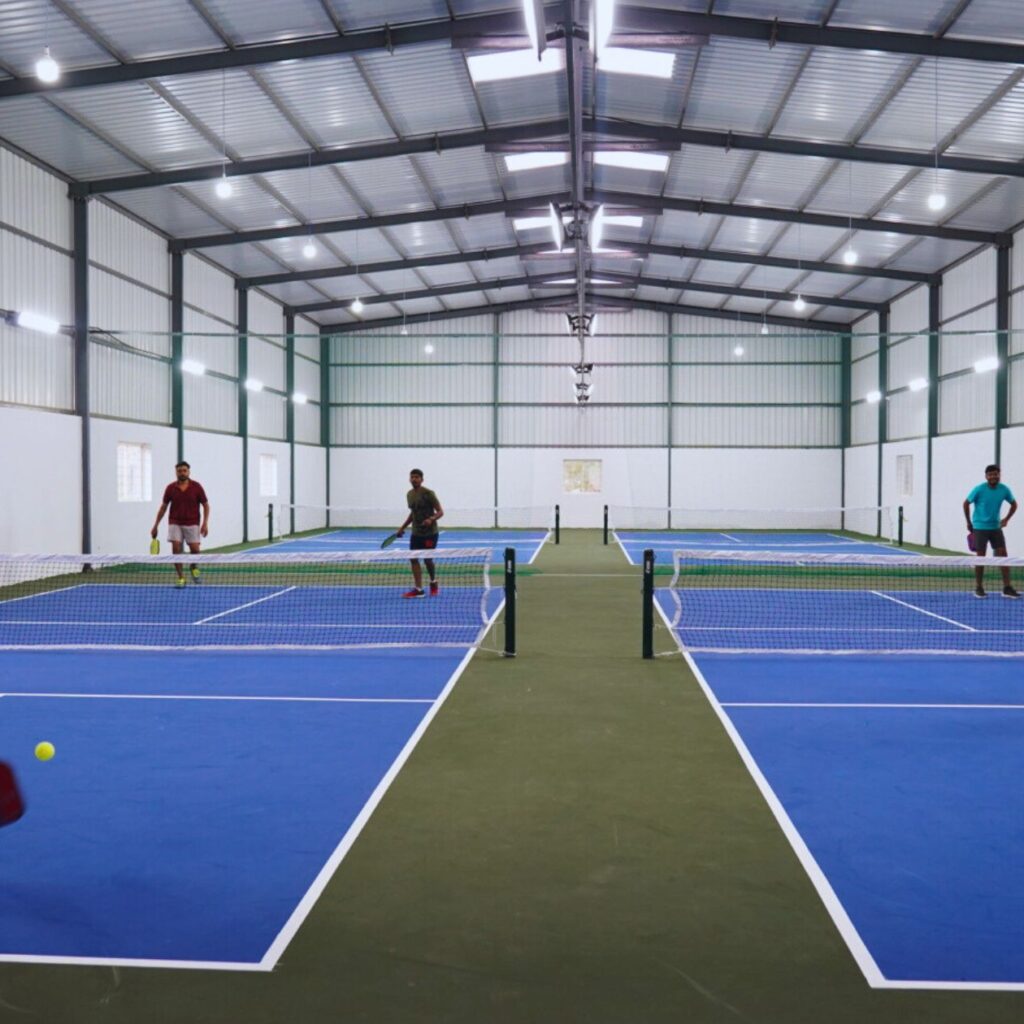
Multi-court layouts: Because the footprint is small, many facilities fit 2–4 pickleball courts into the space one full tennis court would occupy — worth considering at the planning stage if the site has any flexibility, since it changes the facility’s usage capacity significantly for a relatively small additional cost.
Surface Options for Indian Conditions
1. Acrylic surfacing (most common choice)
Acrylic is currently the standard surface for pickleball courts in India, largely because it’s already well understood by Indian contractors from tennis and basketball court work, giving consistent ball bounce and good player grip. It’s applied in multiple coats over a prepared concrete or asphalt base.
- Good UV and weather resistance for outdoor courts
- Requires a properly prepared, cracked-free base — surface quality is only as good as the base beneath it
- Well-suited to India’s climate range, from Mumbai’s humidity to drier inland regions
2. PU (Polyurethane) surfacing
PU systems offer a slightly more cushioned playing surface than acrylic, which some players prefer for joint comfort during longer sessions. It’s a strong option for indoor or semi-covered facilities.
- More cushioning underfoot than acrylic
- Typically higher cost than acrylic at equivalent quality
- Well suited to indoor/covered courts where UV resistance matters less than surface feel
3. Modular/interlocking sports tiles
A newer option for pickleball specifically, modular tiles snap together over an existing hard surface (concrete, old tennis court, terrace) without the multi-day cure time of a poured/coated system.
- Fastest installation option, useful for rooftop or terrace conversions (see our guide on rooftop sports courts)
- Generally easier to repair — damaged tiles can be swapped individually
- Ball bounce and feel can vary more between tile brands than with acrylic or PU systems, so sample testing before committing to a large order is worth the extra step
4. Converting an existing court
Because pickleball courts are small, a common and cost-effective approach is converting or overlaying part of an existing but underused tennis or basketball court, rather than building a dedicated new pickleball court from scratch. This can significantly reduce both cost and construction time if the existing base is in good condition.
What Actually Drives the Cost
As with any sports surface, “how much does a pickleball court cost” doesn’t have one honest flat answer — it depends on several variables that a proper site assessment needs to establish:
| Cost driver | Why it matters |
|---|---|
| Existing surface condition | Building on a prepared base costs less than starting from raw ground |
| Surface material chosen | Acrylic, PU, and modular tiles sit at different price points |
| Indoor vs outdoor | Indoor courts skip UV-resistance requirements but may need different subfloor prep |
| New construction vs conversion | Converting an existing court is typically the lower-cost route |
| Number of courts | Multi-court layouts have per-court cost efficiencies from shared site prep |
| Fencing, netting, and lighting | Often priced separately from the surface itself |
The most reliable way to get an accurate number is a site visit and itemized quote — the same principle that applies to every other sports surface, and one worth being cautious about if a vendor offers a flat per-court price without seeing your site first.
Common Mistakes to Avoid
- Skipping the buffer/run-off space to fit the court into a tighter footprint — this compromises playability more than most people expect before they’ve actually played on an undersized court.
- Choosing surface material based on price alone rather than indoor/outdoor use and expected play frequency — a heavily used commercial or club court needs a different spec than a low-traffic society court.
- Overlaying a poor-condition base without addressing it first — cracks or unevenness in an existing surface will telegraph through acrylic or PU coating and shorten the new surface’s lifespan regardless of coating quality.
- Not planning for multi-court layouts early, even if only one court is being built now — retrofitting a second court later is more expensive than planning shared site prep and drainage upfront.
Why This Is a Good Fit for Site Conversions
Given how many pickleball court requests DSSI now gets are conversions of existing but underused courts (rather than fresh construction), the surface-and-base assessment matters even more than on a new build — an existing base has history (age, prior repairs, drainage behavior) that needs to be properly evaluated before deciding whether it’s a straightforward overlay or needs deeper rework first.
How DS Sports Infra Approaches Pickleball Court Projects
- In-house architects and engineers assess whether a new build or existing-court conversion is the right approach for your site
- Acrylic, PU, and modular tile options specified based on indoor/outdoor use and expected traffic, not a single default recommendation
- Multi-court layout planning for sites that could fit more than one court in the same footprint
- Monsoon-tested base and drainage engineering for outdoor courts, critical across Maharashtra’s climate
- Free site survey and itemized quotation before any commitment
- 7+ years, 400+ projects delivered across Maharashtra
If you’re considering a pickleball court — new build or converting an existing court — request a free site consultation to get accurate dimensions, surface recommendations, and a transparent quote for your specific site.
The playing area is 20 ft x 44 ft (6.1m x 13.4m) for both singles and doubles. A recommended total footprint of 30 ft x 60 ft is advised to allow safe run-off space around the court.
Yes — this is a common and cost-effective approach, since a pickleball court’s small footprint fits easily within an existing court’s boundaries. The existing base condition needs to be assessed first to confirm it’s suitable for an overlay.
Acrylic surfacing is the most common choice due to its weather resistance and familiarity among Indian contractors. PU offers more cushioning and suits indoor courts, while modular tiles offer the fastest installation, particularly for rooftop or terrace conversions.
