If you’re a school, cricket academy, residential society, or sports club planning a cricket facility, the first real challenge isn’t finding a contractor — it’s making sense of the pricing. Cricket infrastructure spans an enormous range, from a simple synthetic practice net to a full turf pitch built to national-standard specifications, and the cost difference between those two ends is easily 20x. Most online pricing is either aimed at professional stadiums or vague enough to be useless for actual budgeting.
This guide breaks down real 2026 costs for every common cricket infrastructure project in India — pitch types, practice nets, ground preparation, and the hidden line items that catch most first-time buyers off guard.
The Quick Answer: What Does Cricket Infrastructure Cost?
| Project Type | Estimated Total Cost |
|---|---|
| Single artificial turf practice net | ₹1.5 – ₹4 lakh |
| Multi-lane practice net facility (3–4 lanes) | ₹6 – ₹15 lakh |
| Natural turf cricket pitch (single) | ₹8 – ₹18 lakh |
| Artificial/synthetic cricket pitch | ₹5 – ₹12 lakh |
| Full outfield (natural grass, school/club scale) | ₹15 – ₹40 lakh |
| Complete ground (pitch + outfield + boundary) | ₹35 lakh – ₹1.2 crore |
| Indoor cricket practice facility (2–3 lanes) | ₹18 – ₹35 lakh |
These are all-in estimates covering base preparation, surface material, and basic fencing/netting. They don’t include pavilion structures, floodlighting, or spectator seating, which are covered separately below.
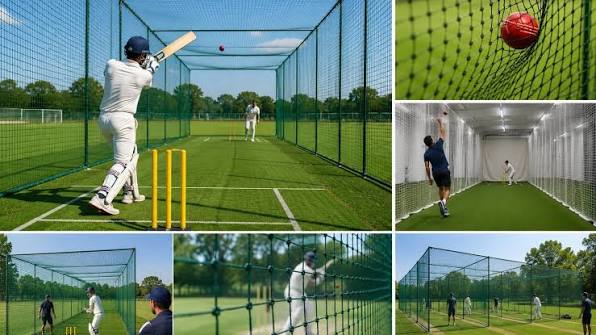
Practice Nets: The Most Common Cricket Infrastructure Project
For schools, academies, and residential societies, a practice net facility is almost always the starting point — and the most cost-effective way to give players consistent training access without the land and maintenance demands of a full ground.
Single-Lane Artificial Turf Practice Net — ₹1.5 to ₹4 Lakh
A single practice lane typically measures around 3.05m wide by 30m long (regulation net length), enclosed on the sides and back with netting to contain the ball.
What’s included in a standard single-lane net:
- Base preparation (compacted sub-base, typically concrete or a stabilized surface)
- Artificial turf or coir matting pitch surface
- Side and back netting (usually 3.6m to 4m height) with support poles
- Basic run-up area preparation
Cost breakdown for a single-lane net:
| Component | Estimated Cost |
|---|---|
| Base preparation (concrete or compacted surface) | ₹40,000 – ₹80,000 |
| Artificial turf/matting surface | ₹50,000 – ₹1.5 lakh |
| Netting and support structure | ₹40,000 – ₹1 lakh |
| Labour and installation | ₹20,000 – ₹50,000 |
| Total (single lane) | ₹1.5 – ₹4 lakh |
Why artificial turf dominates the practice net market: Unlike a natural turf pitch, artificial surfaces don’t need a curing period, don’t degrade with heavy repeated use in the same footprint (which is exactly what a practice net gets), and perform consistently regardless of weather. For schools and academies where the net is used daily by dozens of players, this durability matters more than the marginal realism a grass surface offers.
Multi-Lane Practice Facility — ₹6 to ₹15 Lakh
Most academies and larger schools opt for 3–4 lanes side by side, which allows multiple batting groups to train simultaneously — a significant efficiency gain over single lanes built one at a time.
Cost breakdown for a 4-lane practice facility:
| Component | Estimated Cost |
|---|---|
| Base preparation (all 4 lanes) | ₹1.5 – ₹3 lakh |
| Artificial turf/matting (4 lanes) | ₹2 – ₹5 lakh |
| Full netting enclosure (sides, back, overhead where required) | ₹1.5 – ₹3.5 lakh |
| Support structure (poles, framework) | ₹1 – ₹2 lakh |
| Bowling run-up preparation | ₹50,000 – ₹1 lakh |
| Total (4-lane facility) | ₹6.5 – ₹14.5 lakh |
Overhead netting — worth budgeting separately. For facilities near buildings, roads, or other courts, overhead netting to contain mishits adds ₹1–₹3 lakh depending on the span, but is frequently treated as optional in initial quotes and then requested mid-project once the client sees the actual sightlines. Decide this upfront.
Natural Turf Pitch vs Artificial Pitch: The Core Decision
This is the single biggest cost and performance decision in any cricket ground project, and it shapes everything downstream — maintenance budget, usage capacity, and how the pitch actually plays.
Natural Turf Cricket Pitch — ₹8 to ₹18 Lakh
A natural turf pitch is a precisely prepared strip of grass and soil, built with specific soil composition, drainage, and rolling to produce consistent bounce and pace. This is what first-class and international cricket is played on, and it remains the standard for serious academies and clubs that want authentic ball behavior.
What goes into a natural turf pitch:
- Soil testing and preparation (clay content is critical — too little and the pitch won’t bind properly, too much and it cracks in heat)
- Sub-soil drainage engineering
- Turf laying or seeding and germination period (6–12 months before first use in many cases)
- Rolling and consolidation equipment and labour
- Ongoing grooming during the establishment period
Cost breakdown for a single natural turf pitch:
| Component | Estimated Cost |
|---|---|
| Soil preparation and clay import (where needed) | ₹2 – ₹4 lakh |
| Drainage engineering | ₹1.5 – ₹3 lakh |
| Turf/seed and establishment | ₹2 – ₹5 lakh |
| Rolling, grooming equipment (initial) | ₹1.5 – ₹3 lakh |
| Labour over establishment period | ₹1 – ₹3 lakh |
| Total (single pitch) | ₹8 – ₹18 lakh |
The honest catch with natural turf: A natural pitch is not playable immediately. Establishment typically takes 6 months to a full year before the surface is stable enough for regular match use, and it needs continuous grooming during that window — rolling, watering, and mowing on a strict schedule. Institutions that need a pitch playable within weeks should look at artificial surfaces instead.
Artificial/Synthetic Cricket Pitch — ₹5 to ₹12 Lakh
A synthetic pitch uses a coir or artificial turf mat system laid over a prepared concrete or compacted base, designed to simulate the bounce and pace characteristics of turf without the establishment period or ongoing agronomic maintenance.
Cost breakdown for a synthetic pitch:
| Component | Estimated Cost |
|---|---|
| Concrete or compacted base | ₹2 – ₹4 lakh |
| Coir/synthetic mat surface | ₹2 – ₹5 lakh |
| Crease marking and finishing | ₹30,000 – ₹60,000 |
| Drainage (basic) | ₹50,000 – ₹1.5 lakh |
| Total (single pitch) | ₹5 – ₹12 lakh |
Who this is right for: Schools and academies that need consistent playability from day one, without the year-long establishment window and ongoing agronomy costs of natural turf. The trade-off is that ball behavior — bounce, seam movement, spin — differs somewhat from natural turf, which matters more for advanced players being trained for competitive-level cricket than for general school-level play.
The Full Ground: Outfield, Boundary, and Everything Around the Pitch
A pitch alone isn’t a cricket ground. For institutions building a complete facility, the outfield and boundary infrastructure typically represents a larger share of the budget than the pitch itself.
Outfield Preparation — ₹15 to ₹40 Lakh
The outfield is the grassed playing area surrounding the pitch, and its quality directly affects ball speed, bounce consistency for fielding, and player safety.
- Land leveling and grading: ₹3–₹8 lakh depending on existing terrain
- Soil preparation and grass establishment (natural grass): ₹8–₹20 lakh
- Drainage system for the full outfield: ₹4–₹10 lakh
- Irrigation system (sprinkler network): ₹3–₹6 lakh
For institutions wanting a lower-maintenance alternative, artificial turf outfields exist but are far less common at this scale due to cost — typically 3–4x the natural grass option — and are usually reserved for indoor or space-constrained facilities rather than full-size outdoor grounds.
Boundary and Ancillary Infrastructure
- Boundary rope and marking: ₹30,000 – ₹80,000
- Boundary safety netting/fencing: ₹3 – ₹8 lakh depending on perimeter length and height
- Sight screens (2, mobile): ₹1.5 – ₹4 lakh
- Pavilion/changing facility (basic): ₹8 – ₹25 lakh
- Floodlighting for evening play: ₹10 – ₹30 lakh depending on lux level and pole count
Indoor Cricket Practice Facilities — ₹18 to ₹35 Lakh
For urban academies and schools without open land, an indoor practice facility — typically a covered structure with 2–3 practice lanes — solves the space and weather-dependency problem entirely.
What’s included:
| Component | Estimated Cost |
|---|---|
| Structural shed/enclosure (PEB or similar) | ₹8 – ₹18 lakh |
| Flooring and pitch surface (2–3 lanes) | ₹4 – ₹8 lakh |
| Full netting enclosure (sides, back, overhead) | ₹3 – ₹6 lakh |
| Lighting (indoor LED sports lighting) | ₹2 – ₹4 lakh |
| Bowling machine setup (optional) | ₹1.5 – ₹4 lakh per machine |
| Total (2–3 lane indoor facility) | ₹18 – ₹35 lakh |
Indoor facilities cost significantly more per lane than outdoor practice nets because of the structural enclosure, but they offer year-round, weather-independent training — a meaningful advantage for academies running consistent coaching programs regardless of monsoon season.
The Hidden Costs That Break Cricket Infrastructure Budgets
Soil Testing and Correction — Often Skipped, Rarely Should Be
Cricket pitches are unusually sensitive to soil composition — the wrong clay content produces a pitch that either crumbles or cracks under normal use within a season. Proper soil testing costs ₹15,000–₹40,000 upfront but prevents a far more expensive rebuild later. Any contractor proposing a natural turf pitch without soil testing as a line item is skipping a step that directly determines whether the pitch survives its first year.
Drainage — Non-Negotiable for Natural Turf
A natural turf pitch or outfield with inadequate drainage will waterlog during monsoon, and repeated waterlogging kills grass roots and destabilizes the pitch structure. Budget ₹1.5–₹3 lakh for pitch-level drainage and ₹4–₹10 lakh for full outfield drainage — this is not an area to economize on for any facility expecting regular use through the monsoon.
The Establishment/Maintenance Gap
Many first-time buyers budget for construction but not for the maintenance period that follows — particularly for natural turf, where the first year of grooming, rolling, and irrigation is as important as the initial construction. Skipping this phase is the single most common reason natural turf pitches fail within 2–3 years instead of lasting a decade or more.
Netting Height and Overhead Coverage
Underspecifying net height or skipping overhead netting near boundaries, roads, or buildings is a recurring mistake that leads to either safety issues or expensive retrofitting. Confirm site-specific netting requirements during the site assessment, not after installation.
Annual Maintenance Costs
| Facility Type | Annual Maintenance Budget |
|---|---|
| Artificial practice nets | ₹15,000 – ₹40,000 |
| Synthetic pitch | ₹20,000 – ₹50,000 |
| Natural turf pitch (single) | ₹1 – ₹3 lakh |
| Full natural grass outfield | ₹3 – ₹8 lakh |
| Indoor facility (2–3 lanes) | ₹40,000 – ₹1 lakh |
Natural turf carries by far the highest ongoing cost — regular mowing, rolling, top-dressing, irrigation, and pitch relaying every few years. This is worth weighing seriously against artificial alternatives if your institution doesn’t have dedicated grounds staff or a maintenance budget to match.
Can Government Funding Help?
Yes — cricket infrastructure is eligible under several of the same schemes that cover other sports facilities.
Khelo India Infrastructure Grants cover cricket pitch and ground construction as an admissible item, with funding decided by the Project Approval Committee based on the submitted proposal. Schools and institutions apply through their state sports department — in Maharashtra, through SAMS.
Samagra Shiksha Abhiyan funds sports infrastructure at government and government-aided schools, and cricket facilities have been approved under this scheme in multiple states.
CSR funding is a strong option for cricket specifically, given the sport’s visibility in India — corporates in industrial hubs like Thane, Pune, and Nashik have funded school and academy cricket facilities as CSR projects, particularly when the proposal includes a clear student-impact narrative.
Frequently Asked Questions
A single-lane artificial turf practice net typically costs ₹1.5–₹4 lakh, including base preparation, surface, and netting. Multi-lane facilities (3–4 lanes) range from ₹6–₹15 lakh depending on netting coverage and surface quality.
Natural turf offers the most authentic playing characteristics but requires 6–12 months of establishment time and significantly higher ongoing maintenance. Artificial/synthetic pitches are playable almost immediately and need far less maintenance, making them the more practical choice for most schools and academies unless competitive-level ball behavior is a specific requirement.
A synthetic pitch can be constructed and ready for use in 2–4 weeks. A natural turf pitch takes considerably longer — while base construction may take 4–6 weeks, the grass establishment period before the pitch is stable enough for regular use is typically 6–12 months.
The Bottom Line
Cricket infrastructure spending should match your actual use case, not a generic template. A school running daily student coaching needs durable, low-maintenance practice nets far more than an aspirational natural turf pitch it can’t maintain. An academy training competitive-level players toward district or state cricket has a stronger case for the real thing, with the maintenance commitment that comes with it.
Build for how the facility will actually be used, budget honestly for the maintenance phase — not just construction — and choose a contractor who will tell you the trade-offs upfront rather than the version that closes the sale fastest.
DS Sports Infra has delivered cricket practice facilities, synthetic pitches, and full ground infrastructure for schools, academies, and clubs across Maharashtra and India for over 7 years. We provide detailed, itemised quotations covering base work, surfacing, netting, and drainage — and are happy to conduct a free site assessment before any commitment is made.
Contact DS Sports Infra for a Free Site Assessment and Cricket Infrastructure Quote →
