Basketball is one of the fastest-growing sports in India. A decade ago, a proper basketball court was the kind of infrastructure you found only at elite schools, sports academies, and well-funded clubs. Today, it is a standard expectation at private schools, housing societies, corporate campuses, and sports complexes across the country.
That growth in demand has created a corresponding growth in the number of contractors offering to build courts — and a wide range of prices that can be genuinely confusing to anyone planning a project. You will see quotes for ₹3 lakh and quotes for ₹35 lakh for what is ostensibly the same thing. The difference is real, and it matters.
This guide breaks down what a basketball court actually costs to build in India in 2026 — by court size, by surface type, by use case, and by every component that goes into a complete, properly built facility. No ballpark ranges. Real numbers, with an explanation of what drives them.
DS Sports Infra has delivered sports infrastructure projects across Maharashtra and India for over 7 years. These figures reflect what projects are actually costing right now.
Basketball Court Dimensions — What You Are Building
Before costs, dimensions — because the size of the court is the single largest driver of total project cost.
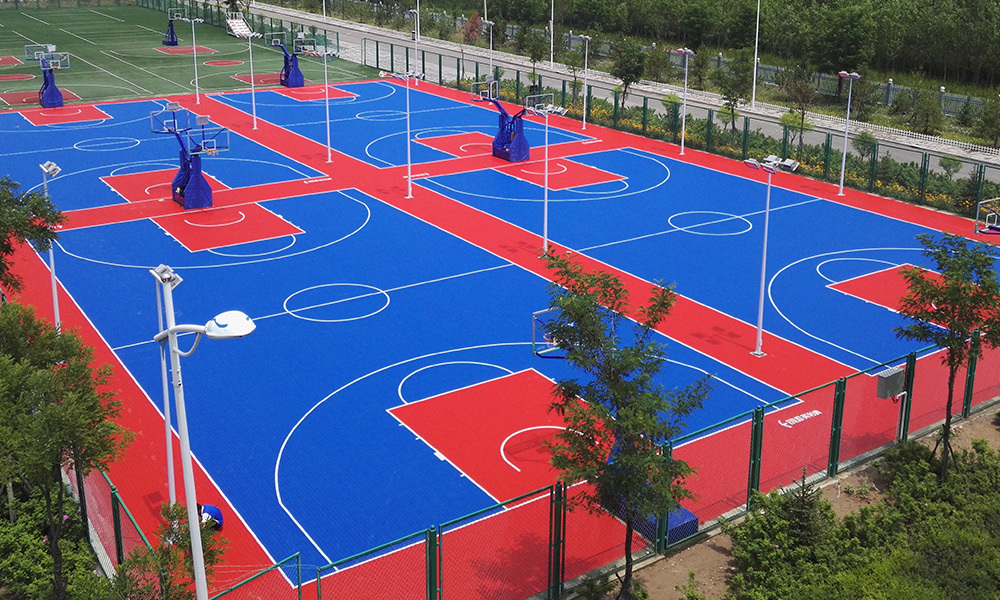
Standard Court Sizes
| Format | Length | Width | Total Area | Used For |
|---|---|---|---|---|
| FIBA full court | 28 m (91.9 ft) | 15 m (49.2 ft) | 420 sq m (4,520 sq ft) | Competition, academies |
| NBA full court | 28.65 m (94 ft) | 15.24 m (50 ft) | 437 sq m (4,700 sq ft) | Professional |
| School full court | 26–28 m | 14–15 m | 364–420 sq m | Schools, colleges |
| Half court | 14 m (46 ft) | 15 m (49 ft) | 210 sq m (2,260 sq ft) | Societies, backyard |
| 3×3 court (FIBA) | 15 m (49 ft) | 11 m (36 ft) | 165 sq m (1,780 sq ft) | 3-on-3 format |
Plus run-off zones: FIBA regulations require a minimum 2 m unobstructed run-off on all sides of the playing court. This means the total land area required for a full FIBA court with run-offs is approximately 32 m × 19 m = 608 sq m (6,545 sq ft). Always plan for run-offs — they are not optional for any court used for serious play.
Key dimensions to know:
- Rim height: 3.05 m (10 ft) — fixed at every level from school to NBA
- Three-point line: 6.75 m from the basket (FIBA) / 7.24 m (NBA)
- Free-throw line: 5.8 m from the backboard
- Centre circle: 3.6 m diameter
- Restricted area (key/paint): 4.9 m wide × 5.8 m deep (FIBA)
For a full dimensions reference including court markings, see our school sports court cost guide which covers multi-sport facility planning including basketball courts for institutional buyers.
The Four Surface Options — And Their Cost
Surface choice is the most consequential decision in any basketball court project. It drives cost, performance, maintenance, and lifespan.
Surface 1 — Acrylic (Outdoor Standard)
Acrylic is the dominant surface for outdoor basketball courts in India — and the right choice for the majority of school, society, and community projects. It is a multi-layer liquid coating system applied over a prepared concrete or asphalt base.
Acrylic basketball court flooring costs approximately ₹45–₹90 per square foot, depending on court size and layer specification.
Layer system for a standard outdoor acrylic court:
- Crack filler and deep patch (base repair)
- Concrete primer
- Acrylic resurfacer (1–2 coats)
- Cushion coat (optional — improves shock absorption)
- Colour coat (2 coats)
- Silica sand broadcast (grip finish)
- Line marking (basketball-specific)
An 8-layer acrylic basketball court survives 45°C summers and monsoon, costs ₹65/sq ft (coating only) over a ₹90/sq ft engineered M25 PCC base, and carries a 5-year written warranty.
Why UV stabilisation is non-negotiable for India: UV-stabilised acrylic is mandatory — the surface temperature on a court in North India in May exceeds 55°C. Non-UV product chalks within 2 years. For Maharashtra specifically, Pune and Nashik summer surface temperatures regularly exceed 60°C. Always specify UV-stabilised acrylic — it should be stated explicitly in the quote.
Acrylic surface cost per sq ft (supply and install):
| Specification | Cost Per Sq Ft |
|---|---|
| Basic 4-layer (no cushion coat) | ₹45 – ₹70 |
| Standard 6-layer | ₹70 – ₹110 |
| Premium 8-layer with cushion coat | ₹110 – ₹160 |
Ideal for: Outdoor courts at schools, residential societies, clubs, corporate campuses, and community facilities. The best all-weather option for Indian conditions.
Lifespan: Acrylic basketball court flooring can last around 5–8 years with proper maintenance and periodic recoating. Premium 8-layer systems with cushion coat last 8–10 years.
Surface 2 — PU (Polyurethane) — Indoor Performance
PU flooring is the performance-grade choice for serious indoor basketball facilities — academies, competition venues, and premium institutional courts. It is a poured seamless system applied in multiple layers over a prepared base.
PU (polyurethane) synthetic floor costs ₹8–18 lakh for the surface on a full court — lower cost than maple, significantly less durable than wood but better than acrylic for indoor shock absorption.
PU flooring cost per sq ft (supply and install):
| Specification | Cost Per Sq Ft |
|---|---|
| Basic PU (8mm, 2-layer) | ₹180 – ₹250 |
| Standard PU (10mm, 3-layer) | ₹250 – ₹350 |
| Premium PU (13mm, FIBA-adjacent spec) | ₹350 – ₹500 |
Why choose PU over acrylic for indoor: PU delivers significantly better shock absorption — critical for basketball where players land repeatedly from jumps and drives. A well-installed 10mm PU floor reduces peak impact force by 30–40% compared to acrylic over concrete. For a facility with daily intensive training, this difference in player protection is meaningful over months and years.
Why not use PU outdoors: Standard PU degrades rapidly under direct UV exposure and moisture. For outdoor courts, acrylic remains the correct choice. SI-PU (silicon polyurethane) is a hybrid option for semi-outdoor applications — see our SI-PU flooring guide for a full comparison.
Ideal for: Indoor basketball academies, competition halls, professional training centres, premium school indoor courts.
Surface 3 — Maple / Hardwood (Professional Indoor)
Maple wooden flooring is the gold standard for professional and high-level competition basketball — the surface used in NBA arenas, international competition venues, and top-tier sports academies globally.
Indoor wooden/PU courts at the premium end run ₹8–₹30+ lakh for full facilities. Maple flooring specifically — imported, spring-floor system — is the most expensive component of any basketball facility project.
Wooden flooring cost per sq ft (supply and install, India 2026):
| Type | Cost Per Sq Ft |
|---|---|
| Domestic teak / hardwood | ₹350 – ₹600 |
| Engineered maple (imported face veneer) | ₹700 – ₹1,200 |
| Solid maple, spring-floor system | ₹1,200 – ₹2,200+ |
Indian conditions consideration: Wooden basketball court flooring requires climate control — specifically, air conditioning and dehumidification to maintain the court within the humidity range (40–60% RH) that prevents expansion, warping, and cupping. Without climate control, a wooden court in Indian conditions will develop problems within 1–2 monsoon seasons. Budget for HVAC as part of any wooden court project — it is not optional.
Annual maintenance for wooden courts: Sanding, resealing, and re-marking every 3–5 years at ₹2–₹8 lakh per session depending on court area. This recurring cost must be planned for upfront.
Ideal for: High-performance academies with climate-controlled facilities, professional competition venues, premium educational institutions.
Surface 4 — PP Interlocking Tiles
PP tiles are more suitable for recreational use. Acrylic flooring offers better ball bounce, durability, and long-term performance.
PP tiles work for temporary or very casual recreational courts — a rooftop setup, a corporate event, a temporary installation. For any permanent court used for regular serious play, acrylic or PU are the appropriate surfaces. PP tiles produce a different ball response than any standard basketball surface and the tile seams affect bounce consistency.
Modular PP tiles (indoor): ₹4–12 lakh for a full court. Fast installation, no cure wait, portable. Trade-off: different ball response than hardwood or acrylic; tiles can separate at joins if not laid precisely on a very flat sub-floor.
Full Cost Breakdown — Every Component
A basketball court is more than just the surface. Here is every component with its 2026 cost range:
Component 1 — Site Preparation and Civil Work
The foundation everything else sits on. Getting this right determines whether the surface performs and lasts.
For outdoor courts (new concrete slab):
| Item | Cost Range |
|---|---|
| Site clearance and levelling | ₹30,000 – ₹1.5 lakh |
| PCC / RCC concrete slab (M25, 100mm) | ₹90 – ₹130 per sq ft |
| Drainage gradient engineering | ₹20,000 – ₹80,000 |
| Curing time | 28 days minimum before surface application |
For a full FIBA court (4,520 sq ft), base civil work: ₹4.5 – ₹7 lakh
For existing base resurfacing: If your existing concrete or asphalt base is structurally sound — no major cracks, adequate drainage, acceptable flatness — you can resurface rather than rebuild. Pacecourt’s resurfacing system repairs and resurfaces existing concrete or asphalt courts without full demolition. Resurfacing costs 40–60% less than new construction.
Component 2 — Surface (Flooring)
Covered in detail above. Summary for a full FIBA court (4,520 sq ft):
| Surface | Full Court Cost |
|---|---|
| Basic acrylic (4-layer) | ₹2 – ₹3.2 lakh |
| Standard acrylic (6-8 layer) | ₹3.2 – ₹5 lakh |
| Premium acrylic with cushion coat | ₹5 – ₹7.2 lakh |
| Standard PU (indoor) | ₹8 – ₹16 lakh |
| Premium PU (FIBA-adjacent) | ₹16 – ₹22 lakh |
| Engineered maple wood | ₹32 – ₹54 lakh |
| Solid maple spring-floor | ₹54 lakh – ₹1 crore+ |
Component 3 — Basketball Hoops, Backboards, and Poles
Equipment quality varies enormously and so does cost.
| Specification | Cost Per Set (2 hoops) |
|---|---|
| Basic school setup (fixed pole, fibreglass board) | ₹40,000 – ₹80,000 |
| Mid-range (adjustable height, acrylic board) | ₹80,000 – ₹1.5 lakh |
| Competition (breakaway rim, tempered glass board) | ₹1.5 – ₹3 lakh |
| FIBA certified (professional) | ₹3 – ₹8 lakh |
Rim at 3.05m, tempered glass backboard (1.8m × 1.05m), 4″–6″ square steel poles in concrete footings. Breakaway rims add cost but extend equipment lifespan at high-use facilities.
What to specify:
- Pole: minimum 4-inch square section, hot-dip galvanised, set in concrete footing
- Backboard: fibreglass for school/recreational, acrylic or tempered glass for serious play
- Rim: fixed for basic, breakaway spring mechanism for any facility used intensively
- Padding: pole padding is mandatory for player safety — often excluded from basic quotes
Component 4 — Fencing
Fencing: ₹50,000–1.5 lakh. 8–12 ft chain-link. GI without PVC coating corrodes in 3–5 years in Indian conditions; PVC-coated or galvanised mesh is worth the small premium.
Fencing keeps balls in play and defines the court boundary. Specify PVC-coated chain-link or GI welded mesh — plain mild steel chain-link rusts within 2–3 monsoon seasons.
Fencing cost for a full court perimeter:
| Specification | Cost |
|---|---|
| Basic chain-link, 8 ft (MS, painted) | ₹50,000 – ₹80,000 |
| PVC-coated chain-link, 10 ft | ₹80,000 – ₹1.5 lakh |
| GI welded mesh, 10–12 ft | ₹1.2 – ₹2.5 lakh |
Component 5 — Lighting
Recreational play needs 200 lux; coaching/club use needs higher. This is the biggest variable in any outdoor court bill of quantities — a 4-pole minimal rig vs a 6-pole fully photometric-designed system differs by ₹2–3 lakh.
| Specification | Lux Level | Poles | Cost |
|---|---|---|---|
| Basic recreational (4 poles) | 150–200 lux | 4 | ₹1.2 – ₹2.5 lakh |
| Standard coaching (6 poles) | 300 lux | 6 | ₹2.5 – ₹4 lakh |
| Competition (8 poles) | 500+ lux | 8 | ₹4 – ₹7 lakh |
Electrical infrastructure (wiring, distribution board, earthing, MCB panel) adds ₹40,000–₹1 lakh and is often excluded from lighting-only quotes. Confirm explicitly.
Component 6 — Line Marking
Basketball line marking is more complex than a simple painted rectangle. A properly marked court includes:
- Boundary lines (end lines and sidelines)
- Centre circle (3.6m diameter)
- Centre line
- Three-point arc (6.75m FIBA)
- Free-throw line and key (restricted area)
- Backboard restricted area semicircle
- Optional: logo, second sport overlay (volleyball, pickleball)
Line marking cost:
| Specification | Cost |
|---|---|
| Single-sport basketball | ₹25,000 – ₹60,000 |
| Multi-sport overlay (2–3 sports) | ₹60,000 – ₹1.5 lakh |
| With centre logo / branding | ₹80,000 – ₹2 lakh |
All-In Project Budgets — By Court Type and Use Case
Now with all components combined — what a complete, properly built basketball court costs in India in 2026:
Outdoor Half-Court — Residential Society / Backyard
| Component | Cost |
|---|---|
| Base (new PCC slab, 2,260 sq ft) | ₹2.5 – ₹3.5 lakh |
| Acrylic surface (6-layer, 2,260 sq ft) | ₹1.6 – ₹2.5 lakh |
| Single hoop set (mid-range) | ₹50,000 – ₹1 lakh |
| Fencing (3 sides) | ₹40,000 – ₹80,000 |
| Basic LED lighting (2–4 poles) | ₹80,000 – ₹1.5 lakh |
| Line marking | ₹20,000 – ₹40,000 |
| Total all-in | ₹5.9 – ₹9.8 lakh |
Outdoor Full Court — School / Institution
| Component | Cost |
|---|---|
| Base (new PCC slab, 4,520 sq ft) | ₹4.5 – ₹7 lakh |
| Acrylic surface (8-layer, 4,520 sq ft) | ₹5 – ₹7.2 lakh |
| Two hoop sets (mid-range) | ₹1 – ₹2 lakh |
| Fencing (perimeter, 10 ft PVC-coated) | ₹1 – ₹2 lakh |
| LED lighting (6 poles, 300 lux) | ₹2.5 – ₹4 lakh |
| Line marking (basketball + volleyball) | ₹50,000 – ₹1 lakh |
| Total all-in | ₹14.5 – ₹23.2 lakh |
Outdoor Full Court — Premium Residential / Corporate
| Component | Cost |
|---|---|
| Base (RCC slab, premium finish) | ₹6 – ₹10 lakh |
| Premium acrylic with cushion coat | ₹7 – ₹10 lakh |
| Competition hoop sets (glass board, breakaway rim) | ₹2 – ₹4 lakh |
| Premium fencing with gates | ₹2 – ₹4 lakh |
| Competition lighting (8 poles, 500 lux) | ₹5 – ₹8 lakh |
| Multi-sport line marking + branding | ₹1 – ₹2 lakh |
| Total all-in | ₹23 – ₹38 lakh |
Indoor Full Court — Academy / Institution (PU Surface)
| Component | Cost |
|---|---|
| Building structure / shell (if new) | ₹15 – ₹35 lakh |
| Base preparation (levelling screed) | ₹1.5 – ₹3 lakh |
| PU surface (10mm, 4,520 sq ft) | ₹11 – ₹16 lakh |
| Competition hoop sets | ₹2 – ₹5 lakh |
| Indoor LED sports lighting | ₹3 – ₹6 lakh |
| Line marking (FIBA spec) | ₹60,000 – ₹1.5 lakh |
| Total all-in (surface + accessories, existing shell) | ₹18 – ₹32 lakh |
| Total all-in (including new building shell) | ₹33 – ₹67 lakh |
Indoor Full Court — Professional (Maple Wood)
| Component | Cost |
|---|---|
| Building shell with climate control | ₹30 – ₹60 lakh |
| Engineered maple spring floor | ₹32 – ₹54 lakh |
| Professional hoop sets (FIBA certified) | ₹5 – ₹10 lakh |
| Competition lighting | ₹8 – ₹15 lakh |
| Electronic scoreboard | ₹3 – ₹8 lakh |
| Total all-in | ₹78 lakh – ₹1.47 crore+ |
The Hidden Costs Most Quotes Leave Out
Every basketball court project has costs that typically do not appear in the first quote. Budget for all of these upfront:
Pole footings and structural work for hoops: Basketball poles must be set in concrete footings — typically 600mm deep, 300mm diameter. This civil work is often excluded from equipment quotes. Budget ₹15,000–₹40,000 per pole set.
Pole padding: Safety padding on all poles within the playing area. Mandatory for any court used by students or under any institutional liability framework. Often excluded from quotes. ₹8,000–₹25,000 per pole.
Levelling screed (indoor): Indoor PU courts require the sub-floor to be within 3mm flatness per 3m. On most existing surfaces, this requires a self-levelling screed application at ₹20–₹60 per sq ft — often excluded from flooring quotes.
Water connection and drainage: Outdoor courts need drainage outlets connected to the site’s stormwater system. Indoor courts need cleaning water access. Both are site infrastructure costs often excluded from sports contractor scope.
Annual maintenance: Acrylic outdoor courts need cleaning, crack inspection, and re-marking every 2–3 years. PU indoor courts need cleaning with specific products and periodic seam inspection. Wooden courts require sanding and resealing every 3–5 years. Budget ₹30,000–₹1.5 lakh per year depending on surface type and usage.
FIBA Standards — When Do They Matter?
FIBA (International Basketball Federation) certification is relevant only for a specific category of court — competition venues hosting sanctioned tournaments. For most buyers reading this, FIBA certification is not a requirement.
When FIBA standards matter:
- Courts hosting state or national level competitions
- Affiliated club facilities used for sanctioned league play
- Khelo India competition venues (SAI requirement)
When they do not matter:
- Schools (NEP 2020 mandates sports facilities but not FIBA certification)
- Residential societies and corporate campuses
- Training academies (training does not require a certified surface)
- Community courts
For non-certified courts, specifying FIBA-adjacent dimensions and surface performance — without paying for the certification process itself — is the right approach for most Indian institutional buyers. Build to FIBA dimensions, use a quality surface, get breakaway rims — and skip the ₹3–₹8 lakh certification cost unless you genuinely need it.
Multi-Sport Courts — The School Standard
For most schools in India, the most cost-effective approach to basketball court construction is a multi-sport court — a single surface marked for basketball, volleyball, and badminton simultaneously. This maximises the value of every square metre and serves the broadest range of physical education requirements.
A standard school multi-sport court (4,500–5,000 sq ft) with 6-layer acrylic, multi-sport line marking, and basic lighting: ₹14 – ₹22 lakh all-in.
For a full guide to school sports facility planning and budgeting, see our school sports court cost guide.
For a complete breakdown of sports flooring options across all court types, see our sports flooring cost guide.
Resurfacing an Existing Court — What It Costs
If you have an existing court with a sound base, resurfacing is significantly cheaper than new construction.
| Resurfacing Type | Cost Per Sq Ft | Full Court (4,520 sq ft) |
|---|---|---|
| Basic acrylic (4-layer, sound base) | ₹35 – ₹55 | ₹1.6 – ₹2.5 lakh |
| Standard acrylic (6-layer) | ₹55 – ₹90 | ₹2.5 – ₹4.1 lakh |
| Premium acrylic with cushion coat | ₹90 – ₹130 | ₹4.1 – ₹5.9 lakh |
When is resurfacing viable? The base must be structurally sound — no significant cracking, settling, or drainage failure. A contractor should assess the base before recommending resurfacing. If the base has failed, resurfacing on top of it will fail again within 2–3 years. Get the assessment done before committing.
How Long Does Construction Take?
| Project Type | Timeline |
|---|---|
| Outdoor court (existing base resurfacing) | 7–12 days |
| Outdoor court (new PCC base + acrylic) | 35–50 days (28 days base curing + 7–12 days surface) |
| Indoor court (PU, existing shell) | 15–22 days |
| Indoor court (new building + PU) | 90–150 days |
| Wooden floor (existing shell with climate control) | 25–40 days |
The most common timeline mistake: Starting base construction without accounting for the 28-day concrete curing requirement. Applying acrylic over uncured concrete is a common shortcut that causes adhesion failure and surface cracking within 12–18 months.
Frequently Asked Questions
A complete outdoor full court (FIBA dimensions, 6-layer acrylic surface, two hoop sets, fencing, and lighting) costs ₹14–₹23 lakh for a standard institutional specification. A half-court for a residential society or school: ₹6–₹10 lakh all-in.
Acrylic sports flooring is the clear choice for Indian outdoor conditions. It handles UV exposure, monsoon moisture, and temperature extremes better than any alternative. Specify UV-stabilised acrylic — non-UV acrylic chalks and degrades within 2 years under Indian summer conditions.
An indoor court in an existing covered hall with PU flooring, competition hoops, and proper LED lighting costs ₹18–₹32 lakh for the court fit-out. If a new building shell is required, add ₹15–₹35 lakh for the structure. A professional maple wood indoor court starts at ₹78 lakh all-in.
What is the minimum space required for a basketball court? A full FIBA court requires 32 m × 19 m including run-offs — approximately 608 sq m or 6,545 sq ft. A half-court requires approximately 16 m × 14 m — roughly 224 sq m or 2,400 sq ft with run-offs.
How long does a basketball court surface last? Acrylic outdoor: 5–8 years (standard) to 8–10 years (premium 8-layer with cushion coat) with periodic maintenance. PU indoor: 10–15 years. Maple wood: 20–30 years with regular sanding and resealing.
Can I build a basketball court on a rooftop? Yes — provided a structural engineer confirms the building can handle the load (concrete base plus players and equipment). Waterproofing of the base before surface application is mandatory. Several corporate campuses and housing societies in Mumbai and Pune have successful rooftop basketball courts.
How much does basketball court resurfacing cost? Resurfacing an existing court with a sound base costs ₹1.6–₹5.9 lakh for a full court depending on specification — 40–60% less than new construction. Get the base assessed before committing.
The Bottom Line
A basketball court is a 15–20 year infrastructure investment. The decisions made at construction — base specification, surface quality, equipment grade, and lighting design — determine how well it serves players throughout that time and what it costs to maintain.
The most common mistake is choosing surface specification based on the cheapest available quote without understanding what that quote includes. A ₹2 lakh acrylic quote that excludes base preparation, uses non-UV acrylic, and specifies 4 coats instead of 8 is not cheaper than a ₹5 lakh quote that does all three correctly — it is more expensive over the 10-year life of the court.
Build once, specify correctly, and maintain it. That is the formula for a basketball court that still serves players well in Year 12.
DS Sports Infra builds outdoor acrylic courts, indoor PU courts, and multi-sport facilities across Maharashtra and India. We provide fully itemised quotes — every component listed separately with specification — and we offer site assessments before any commitment.
