You have the land. You have the budget. You know what you want to build — a cricket practice facility for your school, a box cricket court for commercial use, or a full playing ground for your club.
Now comes the part that most people underestimate: finding the right contractor to actually build it.
The sports infrastructure market in India is growing fast, and so is the number of vendors claiming to be specialists. Some of them are excellent. Many of them are general civil contractors who have added “cricket ground construction” to their service list because the market is hot. A few will take your advance, deliver mediocre work, and disappear when problems show up in Year 2.
The cost of choosing wrong is not just the money — it is a facility that plays badly, wears out early, and has to be rebuilt at full cost. A natural turf pitch with the wrong soil preparation will never hold pace and bounce correctly. A synthetic practice net on an undersized structure will sag and tear within two seasons. A box cricket court with cheap HDPE netting will be looking ragged within eighteen months.
This guide gives you a clear, practical framework for evaluating cricket ground contractors in India — so you can separate the professionals from the pretenders before you sign anything.
Why Cricket Ground Construction Is Different from Other Civil Work
Before getting into contractor selection, it helps to understand why this category requires specific expertise that most contractors do not have.
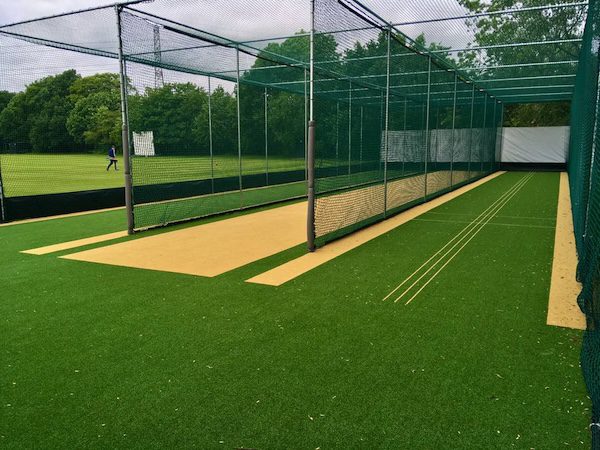
Cricket ground construction sits at the intersection of civil engineering and sports science. It involves:
- Drainage engineering — a cricket ground that waterloggs after rain is unusable for days or weeks, which is a serious problem for schools, academies, and commercial operators
- Soil science (for natural turf) — the right clay composition, compaction, and layering is what creates a pitch that holds together under play and produces consistent bounce
- Synthetic turf specification — pile height, yarn type, infill composition, and UV stability all affect how the surface plays and how long it lasts
- Structural engineering (for practice nets and box cricket) — the frame must handle wind load, netting tension, and the impact of hard cricket balls at pace
- Sport-specific knowledge — a cricket pitch has very specific crease dimensions, protective areas, and surface characteristics that a general contractor simply does not know unless they have built cricket facilities before
A contractor who has built 50 houses and decides to quote your cricket ground is a different thing entirely from a contractor who has built 50 cricket grounds. The technical knowledge is not interchangeable.
Step 1 — Get Clear on What You Are Building Before You Talk to Anyone
The biggest mistake buyers make is approaching contractors without a clear scope. When your brief is vague, you will get vague quotes — and you will have no basis for comparing them.
Before making a single call, write down:
Type of facility: Is it a practice net facility, a box cricket court, a full ground for match play, or a combination? Each has a completely different scope, timeline, and cost profile.
Surface type preference: Natural turf, synthetic turf, coir matting, or a combination? If you are not sure, note that too — a good contractor will advise you, but you need to know whether you are open to both options.
Number of pitches / nets: One practice strip or six? A single box cricket court or two side by side? This directly determines the quote amount and whether the contractor is the right scale for your project.
Target use: Is this for school physical education, for a paid coaching academy, for commercial pay-and-play, or for competitive club cricket? The answer changes the specification requirements significantly.
Timeline: When do you need the facility ready? School projects often have hard deadlines (ready before term starts). Commercial operators have revenue calendars. Knowing your deadline upfront filters out contractors who cannot commit to it.
Budget range: You do not have to share your exact number, but knowing whether you are at ₹10 lakh, ₹30 lakh, or ₹80 lakh narrows the field to contractors who have delivered at that scale.
Armed with a one-page written brief, you will get much more useful information from contractor conversations — and you will quickly identify which ones are listening and which ones are just pitching.
Step 2 — Build a Shortlist the Right Way
Avoid starting your search with a Google search alone. The contractors who rank highest online are not necessarily the most competent — they are the most search-optimised. Use a combination of:
Cricket academy referrals: Talk to coaches or administrators at cricket academies in your district or city. They know which contractors did good work and which ones they would not use again. This is the most reliable source of contractor names.
District Cricket Association: Your local DCA has usually dealt with ground contractors for affiliated grounds. Ask them who they trust.
Other school or society projects nearby: If you have seen a well-built practice facility at another school or housing complex, ask who built it. Projects in your geography tell you the contractor knows local soil conditions, local labour, and local material supply.
Supplier referrals: Synthetic turf and netting suppliers often have certified installers or installation partners. A contractor who is an authorised installer for a reputable turf brand has cleared at least a baseline quality threshold.
Aim for a shortlist of three to five contractors before you start collecting quotes. Fewer than three gives you no real comparison. More than five and the process becomes unmanageable.
Step 3 — The First Conversation: What to Listen For
The first call or meeting with a contractor tells you a lot — if you know what to listen for.
Good signs:
- They ask you about the soil type and drainage condition of your site before quoting anything
- They ask about the intended use and level of play — a school physical education pitch and a competitive club pitch need different specifications
- They talk about base preparation as a separate, important step rather than treating it as a given
- They mention material specifications by name — pile height, yarn type, HDPE weight, galvanised vs painted frame
- They want to do a site visit before giving you a final number
- They have built cricket facilities specifically, not just general sports infrastructure
Red flags:
- They give you a total quote number in the first five minutes, without knowing site conditions
- They cannot explain the difference between monofilament and fibrillated yarn when you ask
- They do not mention drainage until you bring it up
- Their portfolio is all football turfs with a couple of “cricket pitches” that are indistinguishable from general turf projects
- They offer to start the next week without a formal agreement or scope document
A contractor who does not ask about your site before quoting is a contractor who will quote low and add charges later.
Step 4 — Verify Their Cricket-Specific Experience
This is the most important due diligence step, and the one most buyers skip.
Ask for a list of completed cricket facilities specifically — not general sports projects. You want to know:
- How many cricket grounds, practice facilities, or box cricket courts have they built?
- In what types of locations — schools, clubs, commercial venues, housing societies?
- In what geographic areas — knowing local soil, monsoon conditions, and material supply chains matters
- In what time period — experience from 2018 is less relevant than experience from 2023–2026 when materials and specifications have evolved
Then call the references. Not email — call. Ask the facility manager or principal:
- Was the project delivered on time?
- Did the final cost match the quoted cost, or were there additions?
- What problems showed up in the first year? How did the contractor respond?
- Would you hire them again?
If a contractor cannot provide references you can actually contact, that is a significant warning sign. A contractor with genuine experience has clients who are happy to talk about it.
Ask to visit a completed project. Looking at a 3-year-old facility tells you more than any portfolio photograph. Walk the surface. Check the netting condition. Look at the base margins where the surface meets the boundary. Ask the users how it plays. A facility that is still performing well after three years of Indian monsoons and heavy daily use is the best reference of all.
Step 5 — Evaluate the Quote Document Itself
A proper quote from a professional contractor is a detailed document, not a total number. Here is what a well-structured cricket ground quote should contain:
Line item breakdown for every component:
- Site survey and assessment
- Base preparation (specify: type, depth, compaction standard)
- Drainage (specify: surface slope, sub-surface pipes if applicable, outlet type)
- Surface material (specify: brand, pile height, yarn type, density, infill specification)
- Structural framework (specify: MS or GI, pipe diameter and wall thickness, coating type)
- Netting (specify: HDPE weight in grams/sq metre, UV treatment grade, mesh size)
- Crease marking and pitch markings (specify: paint type and expected lifespan)
- Lighting if included (specify: fixture brand, lux level, pole height)
- What is explicitly excluded
Warranty terms stated separately for:
- Surface material (manufacturer’s warranty — ask for it in writing from the manufacturer, not just the contractor)
- Structural framework
- Workmanship
Payment terms: A professional contractor will not ask for 100% advance. A typical payment structure is 30–40% mobilisation advance, 40–50% on mid-project milestone, and the balance on satisfactory handover. Any contractor demanding more than 50% before work begins should be approached with caution.
Project timeline: The quote should include a construction timeline with named milestones — not just a total number of days. When does base work complete? When does surfacing begin? What is the handover date?
If a quote arrives as a single-page document with a headline number and no breakdown, ask for an itemised version before proceeding. If they cannot provide one, they cannot manage the project transparently.
Step 6 — Understand the Material Specifications (So You Can Verify Them)
You do not need to be a materials engineer to check whether a contractor is specifying the right things. You just need to know the right questions.
For synthetic turf:
Pile height: For practice net cricket pitches, 12–15mm is standard. For box cricket outfields, 20–25mm. For full cricket grounds, 25–35mm. A contractor specifying 10mm for a box cricket court is under-specifying.
Yarn type: Monofilament is significantly better for cricket than fibrillated. Monofilament fibres stand upright, allow the ball to roll naturally, and last longer under play. Ask specifically which they are quoting.
Infill: Silica sand alone is the minimum. Silica sand + rubber crumb is better — the rubber crumb cushions the surface, improves the ball’s interaction with the pitch, and reduces surface hardness for player safety. If a contractor does not mention infill composition, ask.
UV stability: Indian sunlight degrades untreated synthetic yarn significantly faster. All turf for Indian conditions should be UV stabilised. Ask for the UV rating and a copy of the material data sheet.
Warranty: Quality synthetic turf for a cricket application carries a manufacturer warranty of 5–8 years. Ask for this in writing from the manufacturer, not just a verbal assurance from the contractor.
For structural framework (practice nets and box cricket):
GI vs MS: Galvanised Iron (GI) or hot-dip galvanised MS is significantly more resistant to rust than painted mild steel (MS). In Indian conditions, particularly in coastal areas and regions with heavy monsoon, painted MS frames will begin rusting within 2–3 years. GI framing lasts far longer. Ask specifically what the frame material and coating specification is.
Pipe thickness: A structural frame for practice nets must use pipes with adequate wall thickness to handle netting tension and wind load. Thin-walled pipes will bend or fail. Ask for the pipe diameter and wall thickness.
For netting:
HDPE weight: HDPE netting is rated by weight in grams per square metre. Lighter netting (under 80 g/sq m) tears faster under cricket ball impact. For practice nets, 100–120 g/sq m or higher is the appropriate specification.
UV treatment: Just like synthetic turf, untreated HDPE netting degrades rapidly in Indian sunlight. All netting should be UV-treated. Ask for the UV rating.
Mesh size: For cricket netting, 40–50mm mesh is standard. Too large a mesh allows balls through; too fine a mesh catches wind and puts excessive strain on the structure.
Step 7 — Watch for These Common Contract Pitfalls
Even after a good shortlisting process and a detailed quote review, there are contract-stage issues that catch buyers out.
“Approved equivalent” materials clause: Some contracts say “or equivalent” after every material specification. This is a clause that allows the contractor to substitute cheaper materials if the specified ones are unavailable — or just if they find something cheaper. Either remove this clause or specify that any substitution requires your written approval.
No base preparation in scope: Some quotes include the surface and structure but treat base preparation as a “site conditions” variable to be priced after work starts. Get base preparation explicitly in scope before signing, even if the cost is stated as an estimate subject to site survey.
Vague warranty wording: “Warranty provided” without a duration, scope, and claims process is not a warranty. The warranty clause should state: what is covered, for how long, what process to follow if something fails, and whether the contractor or the manufacturer is responsible for what.
No retention: In a well-structured contract, a small percentage (typically 5–10%) of the project value is held by the client for 3–6 months after handover as retention against defects. If a contractor refuses to include retention, ask why.
No penalty for delay: If your project has a hard deadline — school term start, a tournament, a housing project launch — the contract should include a reasonable penalty clause for late delivery. A contractor who is confident in their timeline will accept a reasonable clause. One who refuses it may already know they are likely to be late.
The Seven Questions to Ask Every Contractor
Bring these to every meeting. The answers will tell you almost everything you need to know.
1. “Can you give me the names and contacts of three clients for whom you built cricket-specific facilities in the last two years?” This separates contractors with genuine cricket experience from those who have built general sports projects.
2. “What is your recommendation for base preparation on my site, and why?” A contractor who does not ask about your soil, drainage, and existing ground condition before answering this has not thought about your project. A good one will say they need a site visit first.
3. “What synthetic turf brand and specification are you quoting, and can you provide the manufacturer’s data sheet?” A legitimate contractor can immediately provide this. One who is vague about brand or cannot produce a data sheet is likely quoting generic material from an unverifiable source.
4. “What happens if we find unexpected drainage problems once work starts?” This tests how they handle scope changes. A professional has a clear answer: it goes on a variation order at quoted rates, agreed in advance.
5. “What warranty does the turf manufacturer provide, and how do I make a claim?” The answer should include a duration, a scope, and a contact at the manufacturer — not just “we will handle it.”
6. “What is your payment schedule, and what triggers each payment?” A professional has milestone-based payments tied to deliverables. One who wants 70–80% upfront is a risk.
7. “Can we visit a project you completed 2–3 years ago?” Photographs can be taken on the day of handover. A facility that has been through two Indian monsoons and is still performing well is the real proof.
Red Flags That Should Stop the Process Completely
Some signals mean you should not proceed with a contractor regardless of price:
- No company registration or GST registration — working with an unregistered contractor means no legal recourse if things go wrong
- Cannot provide a single cricket-specific completed project reference
- Asks for more than 50% advance before breaking ground
- Refuses to provide material data sheets or manufacturer warranty documentation
- Cannot explain the difference in basic material specifications when asked
- Has no fixed business address or permanent contact
- Significantly lower price than all other quotes with no explanation — if one quote is 40% below the others, something is being left out or substituted
The lowest price is almost never the best value in sports infrastructure. The cheapest contractor who under-delivers will cost you more in rework, repairs, and lost use of the facility than the difference between quotes.
What a Good Contractor Relationship Looks Like
Choosing the right contractor is not just about the construction period. A good sports infrastructure contractor is a long-term relationship — because your facility will need maintenance, repairs, and eventually resurfacing over its 10–15 year life.
The right contractor will:
- Do a site survey before giving you a final price
- Provide a written scope of work and timeline before work starts
- Keep you informed of progress without you having to chase
- Flag problems as they arise — not hide them until handover
- Show up for the first annual maintenance inspection
- Pick up the phone when you call in Year 3 with a repair question
That last point matters more than most buyers think. The facility you build today will need attention across its lifespan. A contractor who has no interest in you after handover is a contractor who has no stake in whether the facility performs.
Summary: The Contractor Selection Checklist
Before you sign with any contractor, confirm you can tick every box:
- They have built cricket-specific facilities — not just general sports infrastructure
- You have spoken to at least two references from completed cricket projects
- You have visited or seen photographs of a facility that is 2+ years old
- The quote is itemised — every component listed separately with specification
- Material specs are stated by brand, grade, and technical parameters
- Warranty terms are in writing for both material and workmanship
- The payment schedule is milestone-based, not front-loaded
- The contract includes a project timeline with named milestones
- Base preparation is explicitly in scope — not treated as a variable
- The contractor is registered (GST, company or firm registration)
If any of these are missing, resolve them before signing. Every point on this list exists because its absence has caused real problems on real projects.
Final Thought
The cricket facility you build will be used by students, athletes, and cricket enthusiasts for the next decade or more. The contractor you choose will determine whether it performs well for all of that time, or becomes a source of frustration and cost within a few years.
Take the time to verify experience. Ask the uncomfortable questions. Read the contract properly. Visit completed projects. The due diligence takes a few days — and it is the most valuable thing you can do for the project.
DS Sports Infra has built cricket infrastructure across Maharashtra and India for over 7 years — practice net facilities, box cricket courts, synthetic grounds, and full natural turf grounds. We welcome site visits to our completed projects, provide full itemised quotes, and offer manufacturer-backed warranty documentation on all materials we specify.
