Box cricket is one of the fastest-growing sports businesses in urban India right now.
Walk through any busy residential area in Mumbai, Pune, Thane, Nashik, or Hyderabad on a weekday evening and you will see the same picture — a floodlit enclosed court, a group of office workers or college students, and a booking slot that was reserved three days in advance. The format is compact, affordable to play, and easy to monetise. For investors, the numbers are genuinely attractive when the project is built correctly.
The problem is that “how much does it cost to build a box cricket court” gets wildly different answers depending on who you ask. You will see figures from ₹4 lakh to ₹50 lakh — and both numbers are technically true, depending on what is being built.
This guide gives you the real 2026 numbers, broken down by size, specification, and use case. It covers every component of a proper box cricket setup, the hidden costs that push budgets over, what the ROI looks like realistically, and what to watch for when comparing contractor quotes.
DS Sports Infra has built cricket infrastructure across Maharashtra and India for over 7 years. These are the numbers we are actually quoting and delivering in 2026.
What Is a Box Cricket Court?
For anyone new to the format: box cricket is a compact, enclosed version of cricket played on artificial turf, fully netted on all six sides — floor, four walls, and ceiling. Teams are smaller (typically 4–8 players per side), overs are fewer (usually 4–10 overs), and the rules are adapted for the enclosed space — sixes off the net count as runs, and LBW is usually removed.
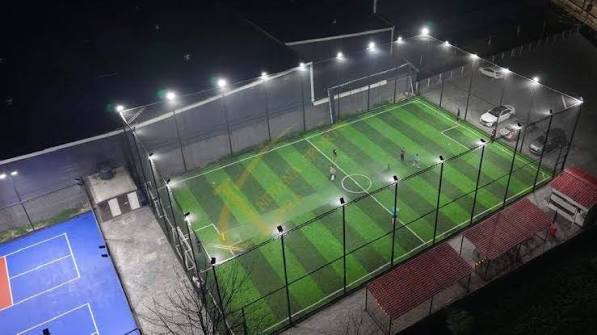
The format works because:
- It fits in a fraction of the space a full cricket ground needs
- It can be played at any hour with floodlighting
- It is easy to book by the hour through apps like Playo and Hudle
- It generates revenue 7 days a week in any weather
- It is popular with corporate groups, college students, apartment societies, and cricket academies
A well-located, well-built box cricket court in an urban area typically runs at 70–90% occupancy on weekday evenings and is fully booked through weekends — which is why the business model has taken off so strongly across Tier-1 and Tier-2 cities.
Standard Box Cricket Court Sizes
The first decision is size — and it drives everything else in the budget.
| Format | Court Dimensions | Total Area | Players Per Side |
|---|---|---|---|
| Entry-level / mini | 30 ft × 60 ft | 1,800 sq ft | 4–5 |
| Standard commercial | 40 ft × 80 ft | 3,200 sq ft | 6 |
| Large commercial | 50 ft × 100 ft | 5,000 sq ft | 8 |
| Multi-court facility | 2–4 courts side by side | 6,400–20,000 sq ft | Multiple |
The 40 × 80 ft format is the most common commercial setup in India — it gives enough space for 6-a-side cricket, which is the most-booked format, while keeping land and build costs manageable.
Minimum ceiling clearance required: 20–25 ft clear height above the playing surface. This is the first constraint to check on any indoor or rooftop location — a ceiling or overhead structure lower than 20 ft makes the format unplayable.
The Complete Cost Breakdown
A box cricket court has six cost components. Every one of them must be in your budget before you start.
Component 1 — Base / Civil Work
The base is the foundation everything else sits on. A properly prepared base is what determines whether the turf lays flat, drains correctly, and lasts 8–10 years. Cut corners here and every other component suffers.
Three base options:
Option A — New PCC (Plain Cement Concrete) slab: The best base for a permanent box cricket installation. M20 grade concrete, 75–100mm thick over a compacted sub-base. Completely flat, excellent drainage gradient built in, zero settling over time.
- Cost: ₹80–₹120 per sq ft of court area
- For a 40×80 ft court (3,200 sq ft): ₹2.5 – ₹3.8 lakh
Option B — Compacted aggregate / WBM base: Wet Bound Macadam — compacted stone aggregate base without concrete. Lower cost, adequate for many installations, but less precise in flatness. More suitable for ground-level outdoor courts.
- Cost: ₹40–₹70 per sq ft
- For a 40×80 ft court: ₹1.3 – ₹2.2 lakh
Option C — Existing base (assessment required): If you have an existing concrete or asphalt surface, it may be usable as-is or with minor preparation. Get a contractor to assess flatness, drainage, and structural condition before assuming it is usable. Using a defective existing base is the most common cause of early turf failure.
- Cost if suitable: ₹15,000–₹50,000 for surface prep
- If repairs needed: ₹20–₹60 per sq ft for levelling and crack repair
Drainage note: The base must be graded to a drainage slope of 1–1.5% so water does not pool on the surface. This must be engineered into the base, not assumed.
Component 2 — Artificial Turf
The turf is the single largest cost item and the one where specification differences matter most — both for how the court plays and how long it lasts.
Turf specifications for box cricket:
| Spec | Recommended | Budget | Premium |
|---|---|---|---|
| Pile height | 20–25mm | 15–18mm | 25–30mm |
| Yarn type | Monofilament | Fibrillated | Monofilament |
| Infill | Sand + rubber crumb | Sand only | Sand + rubber crumb |
| UV rating | UV stabilised | Basic | High UV stabilised |
| Warranty | 5–8 years | 2–3 years | 8–10 years |
What these specs mean in practice:
- Pile height: Shorter pile plays faster — the ball skids through quicker, which suits box cricket’s compact format. 20–25mm is the sweet spot.
- Monofilament vs fibrillated: Monofilament fibres stand upright and maintain consistent ball bounce. Fibrillated fibres mat down faster under play. For a commercial court taking 6–8 hours of use per day, monofilament is not optional — it is the only yarn type that survives that intensity for 8+ years.
- Infill: Rubber crumb mixed with silica sand cushions the surface and regulates ball bounce. Sand-only infill is harder and wears faster. For a commercial venue, rubber crumb is a revenue decision — players notice the difference and the surface lasts significantly longer.
- UV stabilisation: Indian sun degrades unstabilised yarn significantly faster. All turf for Indian outdoor or semi-outdoor conditions must be UV stabilised.
Artificial turf cost per sq ft (supply and install):
| Quality Level | Cost Per Sq Ft | Best For |
|---|---|---|
| Basic (fibrillated, sand infill) | ₹60 – ₹90 | Entry-level / low usage |
| Mid-range (monofilament, sand infill) | ₹90 – ₹130 | Standard commercial |
| Premium (monofilament, rubber crumb infill) | ₹130 – ₹200 | High-usage commercial |
Turf cost for a 40×80 ft court (3,200 sq ft):
- Basic: ₹1.9 – ₹2.9 lakh
- Mid-range: ₹2.9 – ₹4.2 lakh
- Premium: ₹4.2 – ₹6.4 lakh
For a complete guide to artificial turf specifications and cost across different sports, see our sports flooring cost guide.
Component 3 — MS/GI Steel Structure
The structural frame is what holds the netting in place — and it takes constant load from netting tension, wind, and the impact of cricket balls at pace. This is not a component to value-engineer aggressively.
Frame specification:
- Main uprights: 50mm diameter, 2.5–3mm wall thickness MS or GI pipe
- Horizontal bracing: 40mm diameter pipe
- Height: Minimum 20 ft, ideally 22–25 ft for comfortable ceiling clearance
- Coating: Hot-dip galvanised (GI) is significantly more corrosion-resistant than painted MS. In Indian conditions — coastal areas, high humidity, monsoon — painted MS begins rusting within 2–3 years. GI framing lasts 10–15 years without significant corrosion.
Frame cost:
| Specification | Cost Per Sq Ft of Frame Area | 40×80 ft Court Total |
|---|---|---|
| Painted MS (basic) | ₹50 – ₹70 | ₹1.6 – ₹2.2 lakh |
| Hot-dip GI (recommended) | ₹70 – ₹100 | ₹2.2 – ₹3.2 lakh |
Do not accept “equivalent quality” substitution clauses for the structural frame specification. The difference between a GI frame and a painted MS frame is not visible on the day of installation — it becomes visible in Year 3.
Component 4 — Netting
The netting is what makes box cricket possible — it keeps balls in play, protects spectators, and gives the format its characteristic enclosed feel. It also takes the most punishment of any component in the court, absorbing the impact of hard cricket balls bowled and hit at pace all day.
Netting specification:
- Material: HDPE (High-Density Polyethylene) — the standard for cricket netting
- Weight: 100–120 grams per sq metre for commercial use. Below 80 g/sq m tears too fast under cricket ball impact.
- Mesh size: 40–50mm — standard for cricket netting
- UV treatment: Mandatory for Indian conditions. UV-treated netting lasts 5–8 years. Untreated netting degrades visibly within 2–3 monsoon seasons.
- Overhead netting: Must cover the full ceiling area of the court. This is where cheap operators cut corners — a partially netted ceiling creates dead zones where balls escape.
Netting cost:
| Coverage | Approx Area | Cost |
|---|---|---|
| 4 side walls (40×80 ft, 22 ft height) | ~4,400 sq ft | ₹60,000 – ₹1.2 lakh |
| Overhead / ceiling | ~3,200 sq ft | ₹45,000 – ₹90,000 |
| Total netting (complete enclosure) | ~7,600 sq ft | ₹1.1 – ₹2.1 lakh |
Component 5 — LED Floodlighting
Evening play is where box cricket courts make most of their money. A court without good lighting cannot operate after 6:30pm — which eliminates the peak booking window. Lighting is a revenue component, not an optional extra.
What good box cricket lighting looks like:
- Minimum 200 lux on the playing surface (500 lux for higher-quality installations)
- Even light distribution — no dark patches at the batting or bowling end
- LED (not metal halide or sodium vapour) — LEDs start instantly, consume less power, and last 3–5× longer
- Pole placement at the four corners plus two mid-court positions for consistent coverage
LED floodlighting cost for a 40×80 ft court:
| Specification | Poles | Cost |
|---|---|---|
| Basic (150–200 lux) | 4 poles | ₹1.5 – ₹2.5 lakh |
| Standard commercial (300 lux) | 4–6 poles | ₹2.5 – ₹4 lakh |
| Premium (500+ lux, broadcast quality) | 6–8 poles | ₹4 – ₹7 lakh |
For a commercial venue, standard commercial specification (4–6 poles, 300 lux) is the right call. Premium specification makes sense only for venues planning to record matches or host tournaments.
Electrical infrastructure (wiring, distribution board, earthing) adds ₹40,000–₹80,000 to the lighting cost and is often excluded from lighting-only quotes.
Component 6 — Accessories and Finishing
These are small individually but add up quickly:
| Item | Estimated Cost |
|---|---|
| Pitch crease marking (paint) | ₹8,000 – ₹20,000 |
| Stumps and bails (2 sets minimum) | ₹5,000 – ₹20,000 |
| Scoreboard (manual or digital) | ₹15,000 – ₹1.5 lakh |
| Entry gate with lock | ₹15,000 – ₹40,000 |
| Basic seating / benches for players | ₹20,000 – ₹80,000 |
| Ground-level fencing / boundary wall | ₹50,000 – ₹1.5 lakh |
| Total accessories | ₹1.1 – ₹4.5 lakh |
Complete Cost Summary by Court Size
Now with all components together — this is what a realistic all-in budget looks like:
Entry-Level Court (30 × 60 ft)
| Component | Cost Range |
|---|---|
| Base / civil work | ₹70,000 – ₹1.5 lakh |
| Artificial turf (1,800 sq ft, mid-range) | ₹1.6 – ₹2.5 lakh |
| MS/GI structure | ₹1.2 – ₹2 lakh |
| Netting (complete enclosure) | ₹70,000 – ₹1.3 lakh |
| LED lighting (4 poles, basic) | ₹1.2 – ₹2 lakh |
| Accessories and finishing | ₹60,000 – ₹1.5 lakh |
| Total all-in | ₹5.3 – ₹10.8 lakh |
Standard Commercial Court (40 × 80 ft)
| Component | Cost Range |
|---|---|
| Base / civil work | ₹1.3 – ₹3.8 lakh |
| Artificial turf (3,200 sq ft, mid to premium) | ₹2.9 – ₹6.4 lakh |
| GI structure | ₹2.2 – ₹3.2 lakh |
| Netting (complete enclosure) | ₹1.1 – ₹2.1 lakh |
| LED lighting (4–6 poles, commercial) | ₹2.5 – ₹4 lakh |
| Accessories and finishing | ₹1 – ₹3 lakh |
| Total all-in | ₹11 – ₹22.5 lakh |
Large Commercial Court (50 × 100 ft)
| Component | Cost Range |
|---|---|
| Base / civil work | ₹2 – ₹5 lakh |
| Artificial turf (5,000 sq ft, premium) | ₹6.5 – ₹10 lakh |
| GI structure | ₹3.5 – ₹5 lakh |
| Netting | ₹1.8 – ₹3.2 lakh |
| LED lighting (6 poles) | ₹3.5 – ₹6 lakh |
| Accessories | ₹1.5 – ₹4 lakh |
| Total all-in | ₹18.8 – ₹33.2 lakh |
Multi-Court Facility (2 courts, 40×80 ft each)
The per-court cost drops significantly with two courts because base, electrical, and structural costs are shared. Two side-by-side courts typically cost 70–75% of two independent builds.
Estimated total: ₹18 – ₹35 lakh for a two-court facility.
The Rooftop Box Cricket Option
Urban operators in Mumbai, Pune, Thane, and Bangalore are increasingly building rooftop box cricket courts — using terrace space that would otherwise be unused. This approach solves the land cost problem in dense urban areas but introduces two requirements that must be addressed:
1. Structural assessment: A rooftop installation requires a structural engineer to verify that the building can handle the load — turf, infill, players, structure, and netting combined. Never skip this step. The load of a concrete base alone can be 150–200 kg per sq metre.
2. Waterproofing: The base on a rooftop must be waterproofed before turf is laid, or the turf drainage will damage the building below. This adds ₹50,000–₹1.5 lakh to the base cost but is non-negotiable.
With these addressed, rooftop box cricket is a legitimate and profitable format. Several operators in Mumbai have been running rooftop courts successfully for 3–5 years with strong occupancy.
Hidden Costs That Catch First-Time Operators
These are the items most contractor quotes leave out — and the ones that push budgets over target:
Land / lease cost: Not in any contractor quote, but often the largest single line item in a box cricket business. Monthly lease rates in urban Maharashtra range from ₹30,000–₹2 lakh+ depending on location and area. Always model this before calculating ROI.
Electrical connection upgrade: A commercial box cricket court draws significant power for LED lighting. If your site does not already have adequate electrical capacity, a new commercial connection or load upgrade can cost ₹50,000–₹2 lakh depending on the sanctioned load increase.
Toilet / changing room facilities: Players need somewhere to change and freshen up. A basic toilet block adds ₹2–₹5 lakh. Skipping this limits your ability to attract corporate bookings.
Parking: In urban areas, accessible parking is a meaningful factor in booking volume. If your site requires parking infrastructure, cost it separately.
Business registration and licensing: GST registration, shop establishment licence, and in some municipalities a specific sports venue licence. Allow ₹20,000–₹50,000 for registration costs and professional fees.
Booking software / app integration: Listing on Playo, Hudle, or KheloMore, plus a simple booking system for direct bookings. ₹5,000–₹30,000 one-time, plus commission on platform bookings (typically 10–20%).
Contingency: Add 10% to your total project budget as a contingency for site conditions, material price movements, and scope adjustments. Box cricket projects on previously unused sites almost always encounter at least one unexpected condition once excavation or base work begins.
What Does It Cost to Maintain a Box Cricket Court?
Annual maintenance is a real business cost — not a theoretical one. Budget for all of these from Day 1:
| Maintenance Item | Frequency | Estimated Cost |
|---|---|---|
| Turf brushing and cleaning | Every 6 months or 500 hours | ₹5,000 – ₹15,000 per session |
| Rubber crumb / infill top-up | Every 2–3 years | ₹30,000 – ₹80,000 |
| Net inspection and repairs | Annual | ₹10,000 – ₹40,000 |
| LED fixture servicing | Annual | ₹5,000 – ₹20,000 |
| Pitch marking repaint | Annual | ₹5,000 – ₹12,000 |
| Structural inspection | Annual | ₹5,000 – ₹10,000 |
| Total annual maintenance | ₹80,000 – ₹2 lakh |
Turf replacement: A quality commercial turf under 6–8 hours of daily use should last 8–10 years. At replacement time, budget ₹3–₹8 lakh for turf replacement (the structure and base remain).
For a full guide to cricket infrastructure maintenance, see our cricket pitch construction and maintenance guide.
Is Box Cricket a Good Business Investment in India?
This is the question every investor asks. Here is an honest look at the numbers.
Revenue model (standard 40×80 ft commercial court):
| Slot | Rate Per Hour | Hours Per Day | Daily Revenue |
|---|---|---|---|
| Daytime (9am–5pm) | ₹600 – ₹900 | 4 bookings (low occupancy) | ₹2,400 – ₹3,600 |
| Evening (5pm–10pm) | ₹1,200 – ₹2,000 | 4–5 bookings (high occupancy) | ₹4,800 – ₹10,000 |
| Weekend premium | ₹1,500 – ₹2,500 | 8–10 bookings | ₹12,000 – ₹25,000 |
Conservative monthly revenue estimate (weekdays + weekends, moderate occupancy): ₹1.5 – ₹2.5 lakh per month from a single standard commercial court.
Break-even timeline: At a ₹15 lakh all-in build cost and ₹1.8 lakh average monthly revenue (after maintenance, lease, electricity, and platform commissions), a well-located single court can break even in 18–30 months.
Note: These are estimates based on typical urban Maharashtra operator performance. Location is the dominant variable — a court in a densely populated area with easy access and adequate parking will significantly outperform one in a low-traffic location regardless of build quality.
What makes the biggest difference to profitability:
- Location and accessibility (highest weight)
- Evening lighting quality (determines peak hour bookings)
- Turf quality (affects repeat bookings — players notice bad surfaces)
- Booking platform presence (Playo and Hudle drive significant discovery traffic)
- Corporate tie-ups (corporate bookings fill daytime slots and run at premium rates year-round)
Comparing Box Cricket to Other Sports Court Investments
If you are deciding between box cricket and other sports court formats for a commercial investment, here is a quick comparison:
| Court Type | Build Cost | Revenue Potential | Break-Even |
|---|---|---|---|
| Box cricket (40×80 ft) | ₹11 – ₹22 lakh | ₹1.5 – ₹2.5 lakh/month | 18–30 months |
| Badminton (4-court hall) | ₹25 – ₹45 lakh | ₹1.2 – ₹2 lakh/month | 24–36 months |
| Football turf (60×40 m) | ₹35 – ₹70 lakh | ₹2 – ₹4 lakh/month | 24–36 months |
| Padel court | ₹18 – ₹28 lakh | ₹80,000 – ₹1.5 lakh/month | 24–40 months |
Box cricket has the best combination of low build cost and strong revenue per sq ft of any sports court format in India right now — which is why it is growing so fast. The format is proven, the booking infrastructure (apps, platforms) is mature, and the Indian audience for the format is enormous.
For a full comparison of padel and other emerging court formats, see our padel vs pickleball court guide.
How to Compare Box Cricket Contractor Quotes
When quotes arrive, the headline number is not enough to make a decision. Compare these specifically:
1. Is base work included or assumed? Some quotes assume an existing usable base. If your site has no base, add ₹1.5–₹4 lakh to any quote that does not explicitly include base construction.
2. What is the turf specification? Ask for pile height, yarn type (monofilament or fibrillated), infill composition, and UV rating. A quote with fibrillated yarn and sand-only infill is not comparable to one with monofilament and rubber crumb — even if the headline turf cost per sq ft looks similar.
3. Is the frame MS or GI? Hot-dip galvanised framing costs 20–30% more upfront and lasts 3–5× longer in Indian conditions. A quote with painted MS framing is not cheaper — it is cheaper now and more expensive in Year 3 when rust begins.
4. What netting weight and UV treatment is specified? Ask for HDPE weight in grams per sq metre and whether UV treatment is included. Under 100 g/sq m for a commercial installation is under-specification.
5. What lighting lux level is quoted? Ask for the designed lux level on the playing surface. A quote that says “4 LED poles” without specifying lux level could mean anything from 80 lux (too dim for comfortable play) to 400 lux (excellent). Demand the lux specification.
6. What is explicitly excluded? Electrical connection, drainage, site clearance, accessories, and permits are commonly excluded from contractor quotes. Get the exclusions list in writing.
For a full guide on evaluating sports infrastructure contractors, see our post on how to choose a cricket ground contractor in India.
Frequently Asked Questions
An entry-level 30×60 ft court with basic turf, painted MS structure, adequate netting, and 4-pole LED lighting can be built for ₹5–₹8 lakh all-in on an existing usable base. On a new base, add ₹1–₹1.5 lakh. This is the realistic minimum for a functional commercial setup — not ₹4 lakh, which typically excludes lighting, base work, or accessories.
A standard single court on a prepared site takes 20–35 days from groundbreaking to handover. Two courts or a new-base project: 35–50 days. Plan for construction during a period that does not conflict with your intended launch date — and add a 10-day buffer for weather and material lead times.
A well-located standard commercial court in an urban Maharashtra area typically generates ₹1.5–₹2.5 lakh per month in gross revenue. Net revenue after lease, electricity, maintenance, and platform commissions is typically ₹60,000–₹1.5 lakh per month depending on cost structure. Break-even on a ₹15 lakh investment is typically 18–30 months
The Bottom Line
Box cricket is a genuinely attractive sports business opportunity in India in 2026 — and the infrastructure to support it is now mature, well-understood, and available at a range of budget levels. For an entry-level operator willing to start with a 30×60 ft court and basic-to-mid specification, a functional commercial setup is achievable at ₹6–₹10 lakh on an existing base. For a serious commercial operator building a flagship venue at 40×80 ft or larger with premium turf, GI framing, and good lighting, the realistic all-in budget is ₹14–₹25 lakh.
The single most important investment decision is location — a well-specified court in a low-traffic location will always underperform a good-enough court in the right neighbourhood. Get the location right first, then build to a specification that will hold up under the usage level you are targeting.
DS Sports Infra builds box cricket courts, practice net facilities, and complete cricket grounds across Maharashtra and India. We provide full itemised quotes with material specifications — not headline numbers — and we are happy to visit your site before committing to any figure.
Contact DS Sports Infra for a Free Box Cricket Site Assessment →
